On the day after Lyn’s big operation, she’s moved from the ICU to a step-down neuro recovery unit. She had brain surgery on June 30 to address two aneurysms.
Jan’s mom continues to recover physically from her surgery – but there’s been a complication. She’s showing signs of what is called “hospital-induced delirium”, a condition that shows up in older patients that are under anesthesia for a long time. She’s confused about where she is; she thinks she’s back where she used to live in Michigan.
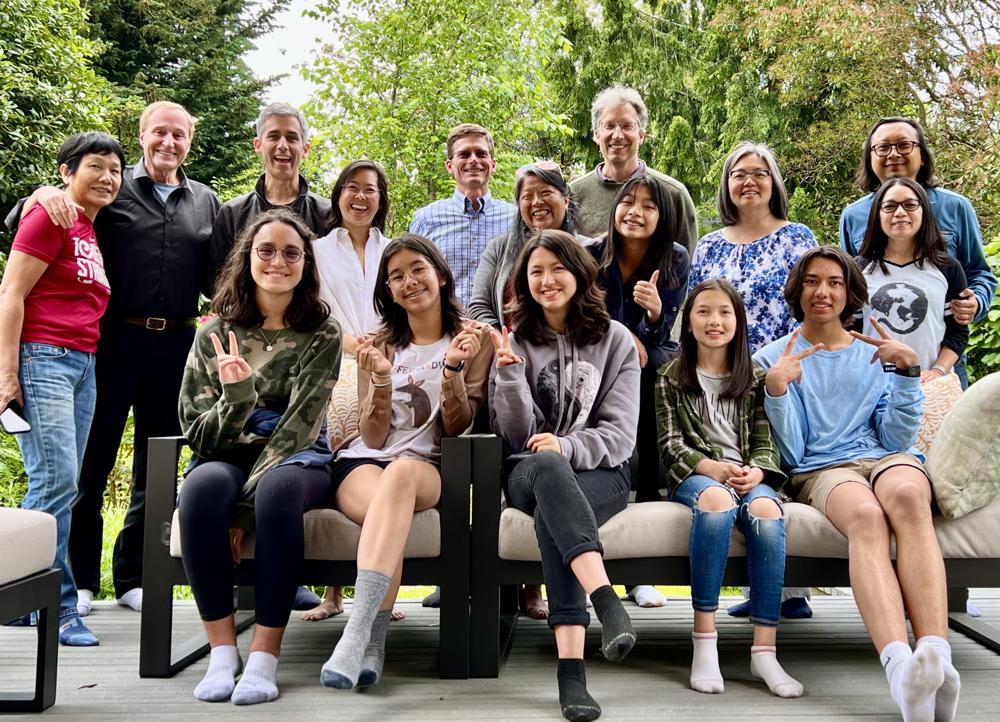
We host a small Fourth of July lunch at our house, reuniting a number of families that participated in a Mandarin language play group when Bree was a toddler. It’s fun to catch up with everyone.
In the evening, we attend a party on the houseboat of our friends Dan and Ted. Bree’s happy to catch up with the daughter, Maddie. Angela and Jan enjoy meeting a number of other couples.
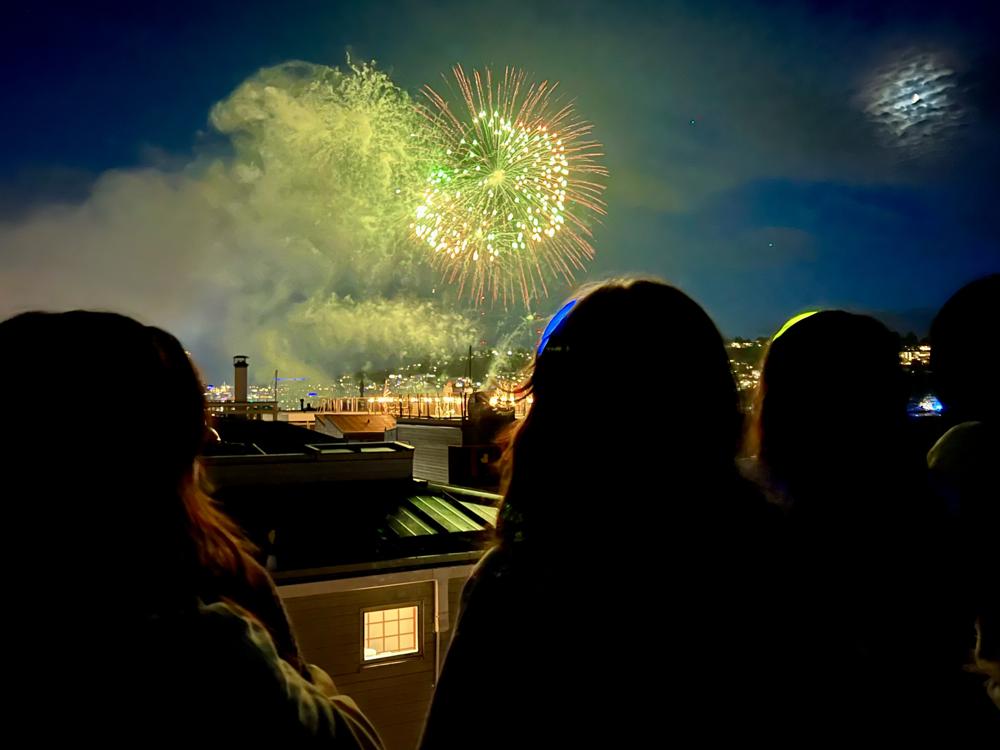
When it’s finally dark enough for fireworks, we go up to the houseboat’s rooftop deck to watch the large annual fireworks display over Lake Union. It’s been years since we’ve watched it.
Bree holds an early birthday sleepover with her friends Amari, Hank, Leah, and Marina.
Bree turns 15!
Jan and his sister Skye bring Lyn from the hospital back to her apartment in Seattle’s Wallingford district. Skye’s come up from Oregon to help stay with Lyn while she recovers at home. Jan spends his day with the two of them.
Lyn’s disorientation has cleared a bit, but her short-term memory appears to be impaired. She asks questions — often about where family members are — and, after hearing the answer, will ask the same question a few minutes later.

Angela attends the first of two back-to-back nights to see the K-Pop group Stray Kids in concert.
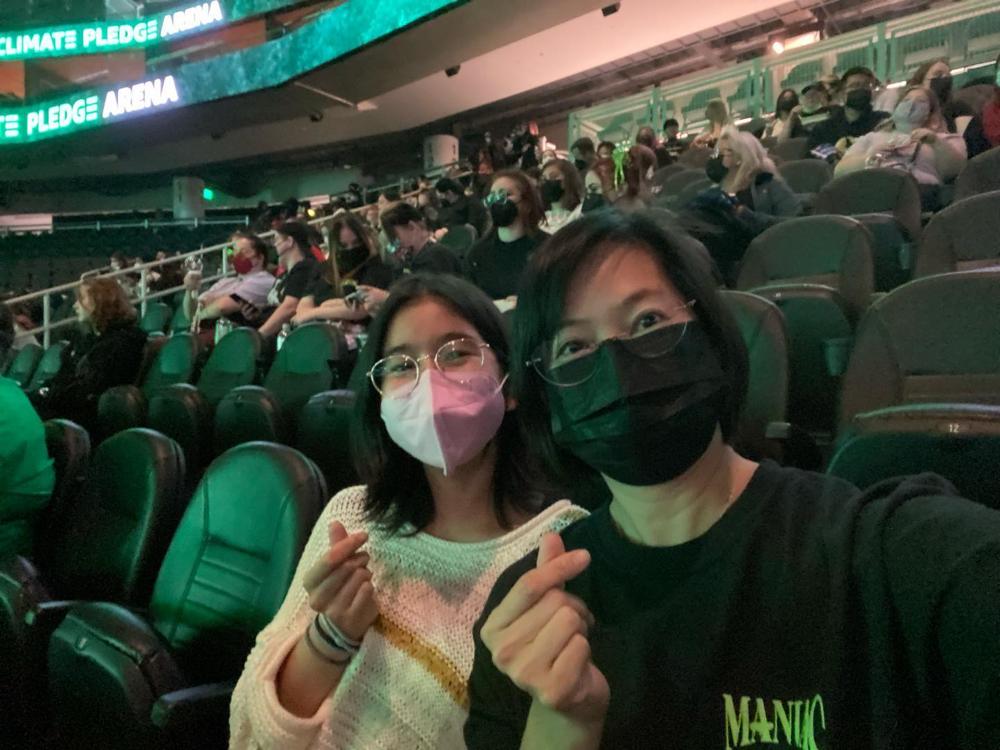
Angela attends the second Stray Kids concert, this time with Bree.
Jan moves Lyn to our house to help with her recovery. On a visit to our house, she’d seemed happier than she was in her apartment, so we’ll have her with us for the time being.
Her memory issue isn’t clearing up. She slowly seems to be acquiring the knowledge that she is in Seattle and not in Michigan. But she can’t remember things for more than a few minutes. She continues to ask where all her family members are — then asks again and again. We’re growing increasingly skeptical of the delirium diagnosis she received in the hospital.
Chris arrives from Oregon to help watch over Lyn at our house so that Jan can take a long-planned hiking trip in California.
Jan flies to California for a guided hiking trip in Sequoia-Kings Canyon National Park. Chris and Lyn drop Jan off at SeaTac, where he meets up with a young man named Alex who will be going on the same hike. They’re both heading to the park early so that they can acclimate a bit to the high altitude they’ll be hiking at.
Once Jan and Alex arrive in Fresno, Jan picks up a rental car; the two will carpool to the park and back. Before leaving civilization, they need to pick up gas fuel for their camping stoves – such fuel can’t be carried on planes, even in luggage. It turns out that all the stores in town are sold out of the fuel they need. After visiting several stores, they manage to find the right type of fuel, albeit in heavy cans larger than they need.
After dropping Alex off at the Lodgepole Campground, Jan drives the short distance to the Wuksachi Lodge. Some U.S. national parks have fantastic old lodges — but the Wuksachi Lodge is not one of them. The room is okay, but the food at the only restaurant in the park is terrible, like bad airplane food.
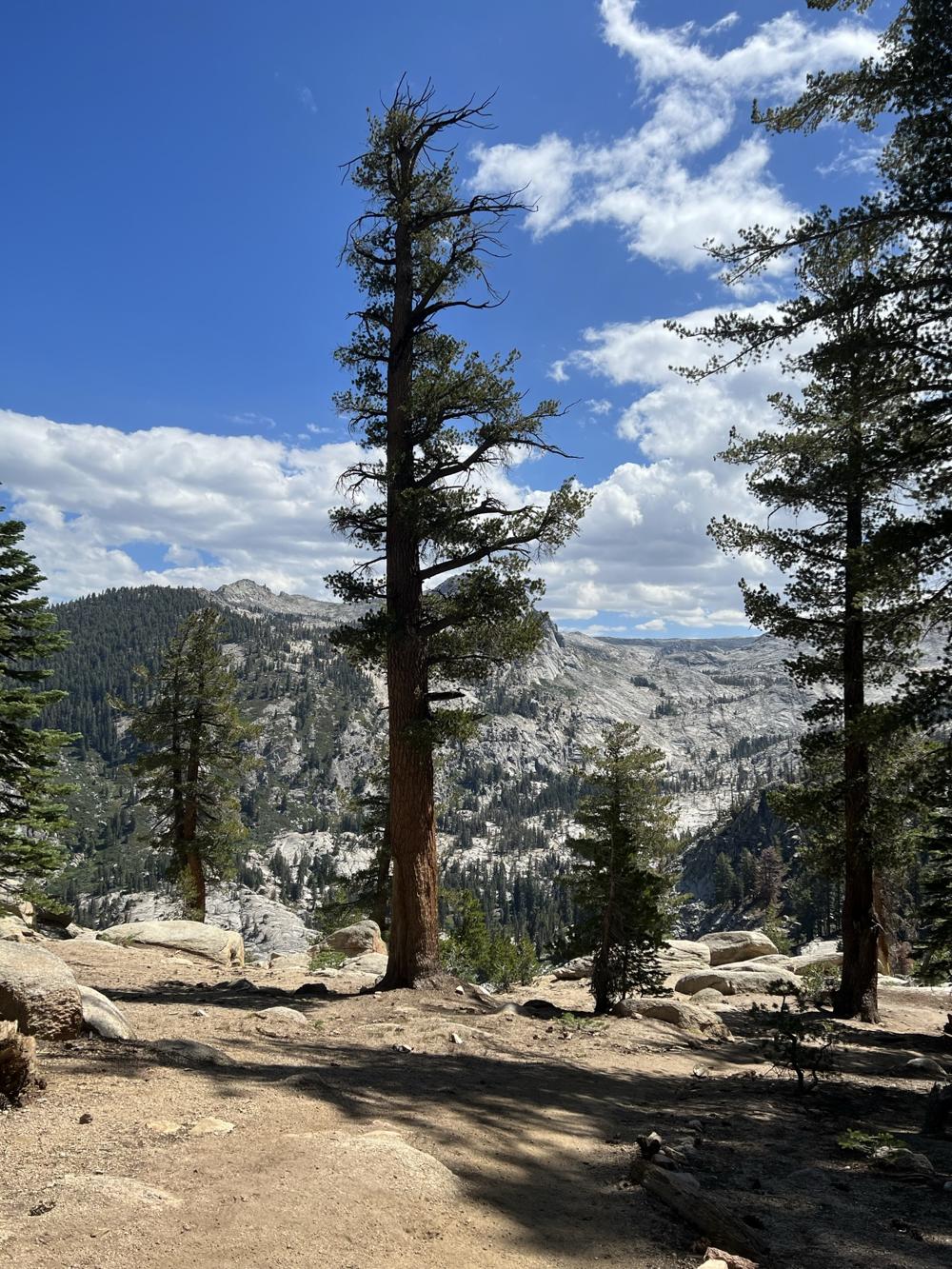
Breakfast at the Wuksachi Lodge turns out to be just as bad as dinner. After breakfast, Jan goes for a short morning hike along the Heather lake Trail. He turns back a bit short of the lake because hiking at the high altitude is slow going, and Jan didn’t pack a lunch. Wanting to avoid the terrible lodge food for lunch, he tries the Lodgepole Market. The food offerings there are decidedly mediocre, but on the plus side, the little market does have camping fuel in the right-size cans. Jan spends the remainder of the day trying to rest up for the start of the hike tomorrow.
Jan’s off-trail backcountry adventure, Day 1. I head to the Lodgepole Trailhead to meet up with the team from Andrew Skurka Adventures.
In the small world of long-distance hiking, Andrew Skurka is the most famous hiking adventurer. From Wikipedia: “Andrew Skurka is an American professional backpacker who is best known for his two long-distance hiking firsts—the 6,875-mile Great Western Loop and the 7,778-mile Sea-to-Sea Route.” He founded a company to guide people on long hikes, particularly off-trail adventures. I’m signed up to join Andrew, another guide named Nicco, and six other clients for a five-day trip in Sequoia-Kings Canyon National Park. We’ll be going far off trail, exploring remote regions of the huge national park.
Some of the people facilitating the trip greet me and do a gear inspection — they need to make sure everyone’s adequately prepared for the conditions we’ll be hiking in. We’re also given the ingredients for the meals we’ll be cooking. Most are already portioned out into individual serving bags, but each client is also given a sizable shared ingredient they’ll carry on behalf of the group. I get off lucky with my shared ingredient: two bags of nuts that will go into some of our dinners. One less fortunate person is given a heavy, 1 liter bottle of olive oil. Finally, we all have to pass a COVID test. Luckily, the tests are all negative.
Andrew welcomes the two separate groups of hikers that will be setting out at the same time for different destinations within the park. I meet the other clients in my group: in addition to Alex from Seattle, there are Claire, Fernando, John, Rory, Susan. Alex and John are around 30; the rest are my age. Everyone in the group was selected for the trip based on hiking experience or level of physical activity. Claire, for example, is relatively new to backpacking but runs 100-mile ultramarathons.
We also meet Nicco, our group’s other guide. He sports a hippie hiker look: skinny, long beard, no socks. He has no hiking poles, but has a small guitar strapped to his backpack. Before shouldering our packs, we weigh them. At 19.2 pounds, I think I have the lightest pack.
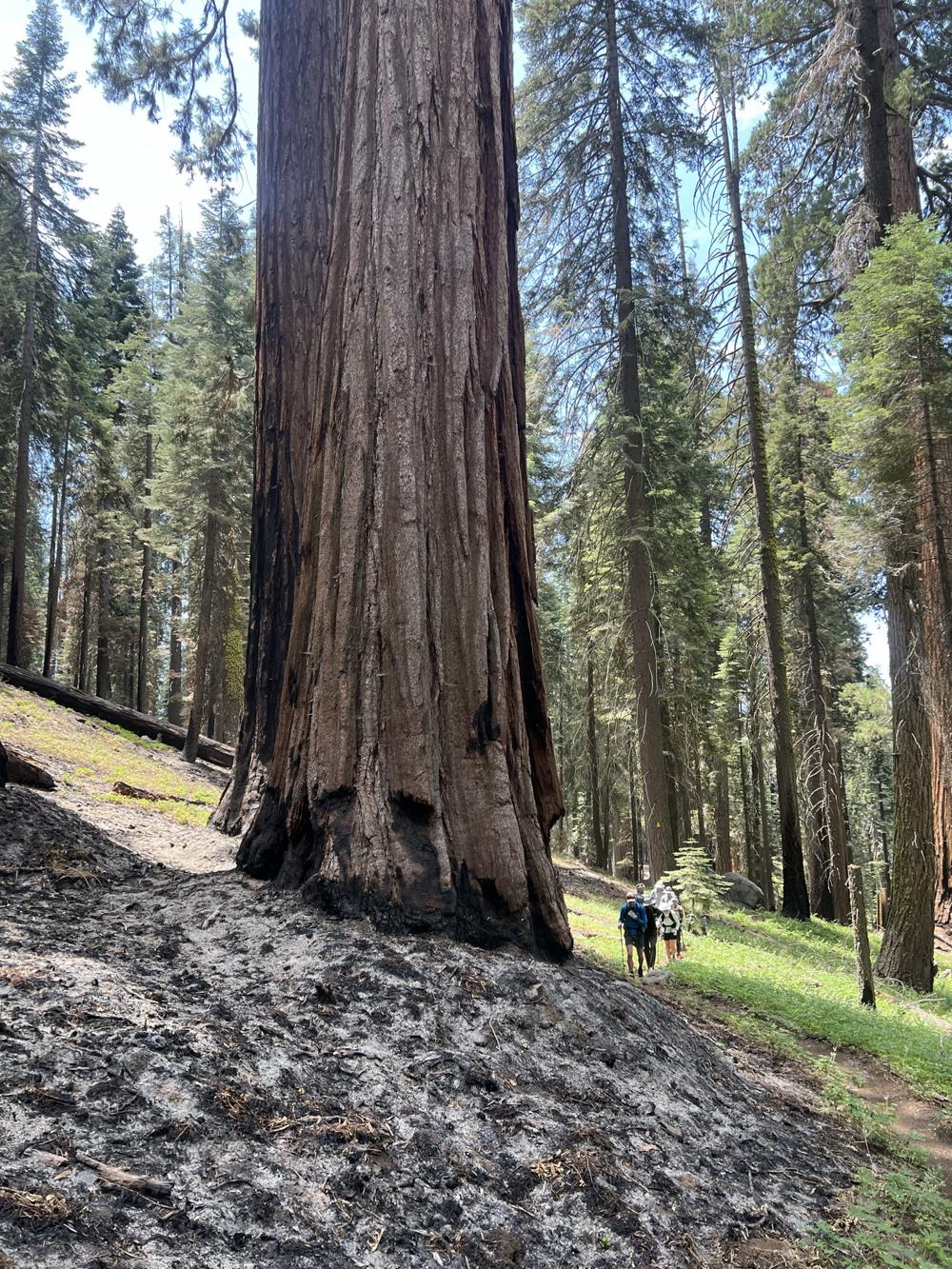
It’s finally time for the two groups to head out. Andrew’s route into the backcountry will start on trails, and we begin by hiking out through the Sherman and Congress Groves, home to collections of giant sequoia trees.
Leaving the sequoias behind, our group climbs slowly but steadily. We stop for lunch at a meadow and to top up our water bottles. Andrew gives a class on reading topological maps.
After lunch there’s more climbing, until we finally reach Panther Gap at around 8400’ above sea level. We have a great view to the south over the huge Kaweah Valley. I’d visited this valley with Chris back in 2017 on a hike of the park’s long High Sierra Trail, but I won’t be crossing any part of that trail on this trip.
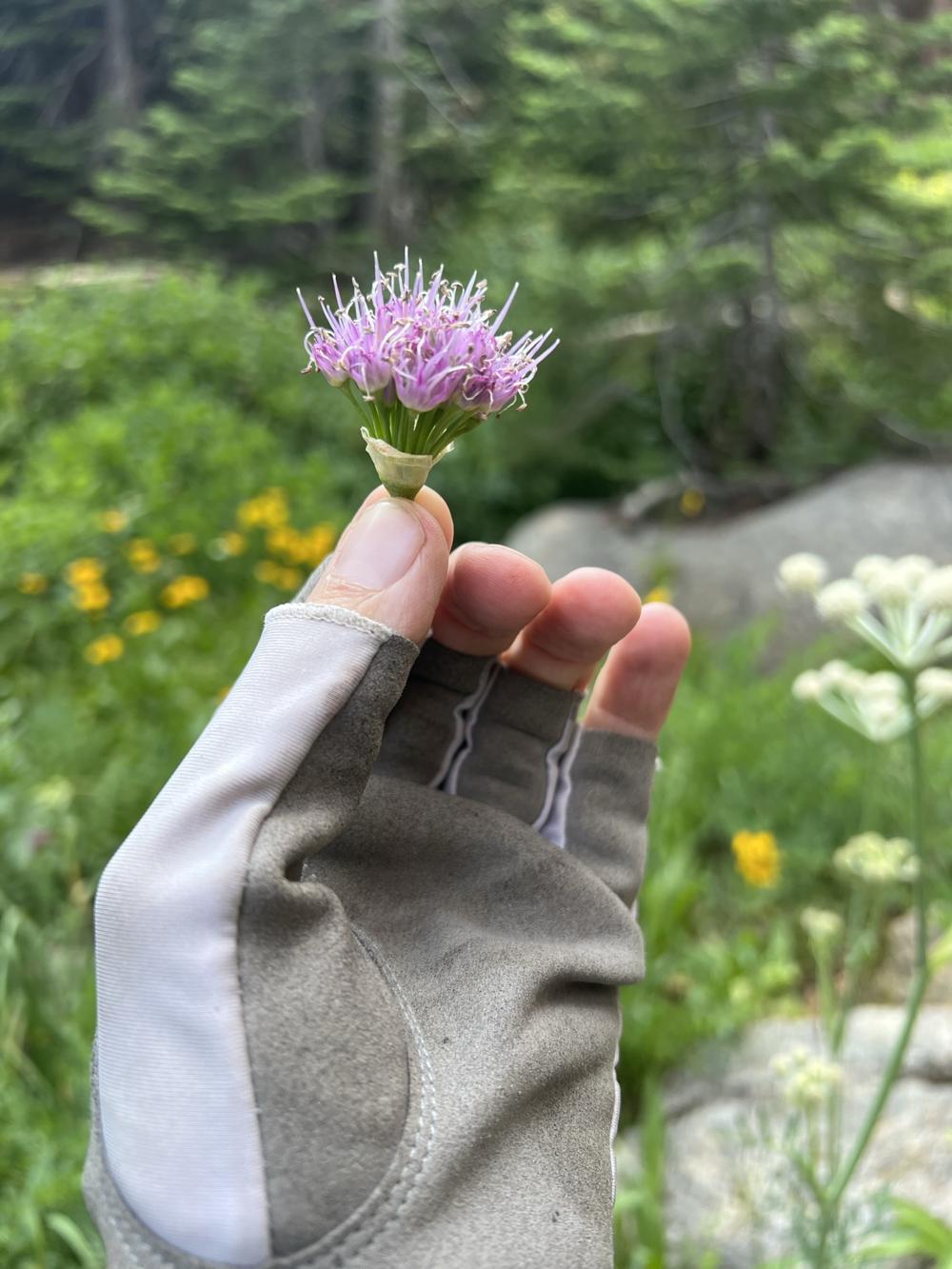
Andrew and Nicco occasionally pause to point out some aspect of local geology or botany. Nicco is particularly knowledgeable about plants, and often stops to identify wildflowers. At one stop at a stream to fill up our water bottles, he identifies an edible plant called onion flower. I pick a flower to add to my dinner, then Nicco goes ahead and harvests a bunch of onion flower plants for everyone.
We finally reach Alta Meadow, our destination for the day. After setting up our shelters, Andrew and Nicco give us more instructional classes covering various aspects of backcountry travel.
Our first dinner of the trip, a vaguely risotto-like dish that’s prepared with oats instead of rice, is surprisingly delicious. (In general, all of the food on the trip will turn out to be exceptionally good for backpacker food.) Nicco distributes the onion flower plants he’d harvested early, and the plant’s bulbs and flowers add a fantastic onion kick to the meal.
I usually don’t get a great night’s sleep when backpacking, but this night is worse than usual. Perhaps it’s the altitude, but despite being very tired, it takes hours to finally fall asleep. (Unfortunately, this pattern will continue for most nights on the trip.)
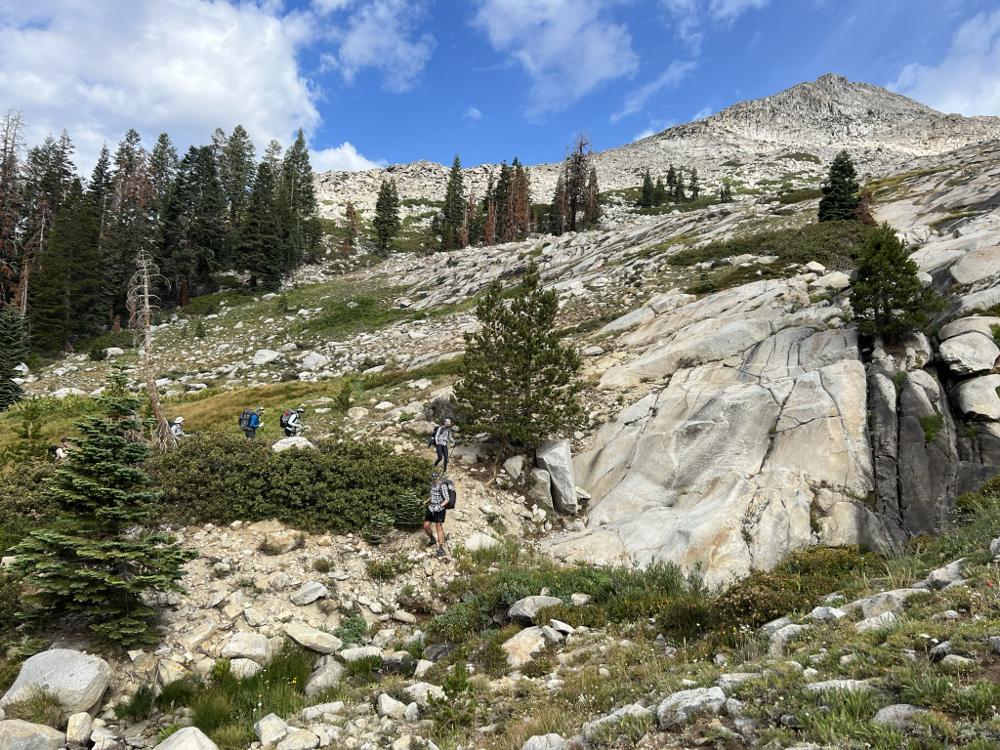
Jan’s off-trail backcountry adventure, Day 2. Everyone’s up before sunrise to pack up and have breakfast. We hike to a meadow, where the trail we’ve been following dissipates. From this point on, we’ll spend most of the day hiking off-trail on rugged terrain. I’ve occasionally had to hike off-trail for short distances, but never had that as the focus of a trip, and never in such ambitious territory.
We climb up a steep hillside that alternates between rocky meadow and trees. Each person takes a turn leading the group. I take my turn and lead the group up to a small gully, where we stop to take a breath. As we’re standing there, someone spots a bear on the other side of the gully. The bear looks to be a year old, and ignores us as it moves around looking for food.
We finally climb above the treeline to a ridge, then clamber over talus (a slope of large rocks). We eventually crest the ridge to reach Moose Lake — an odd name for a lake in a region that probably has no moose and, at 10,600’, is far too high for moose ever to visit. We take a break to swim in the cold lake, but don’t linger; the wind is picking up, and the clouds indicate we’re going to get some rain.
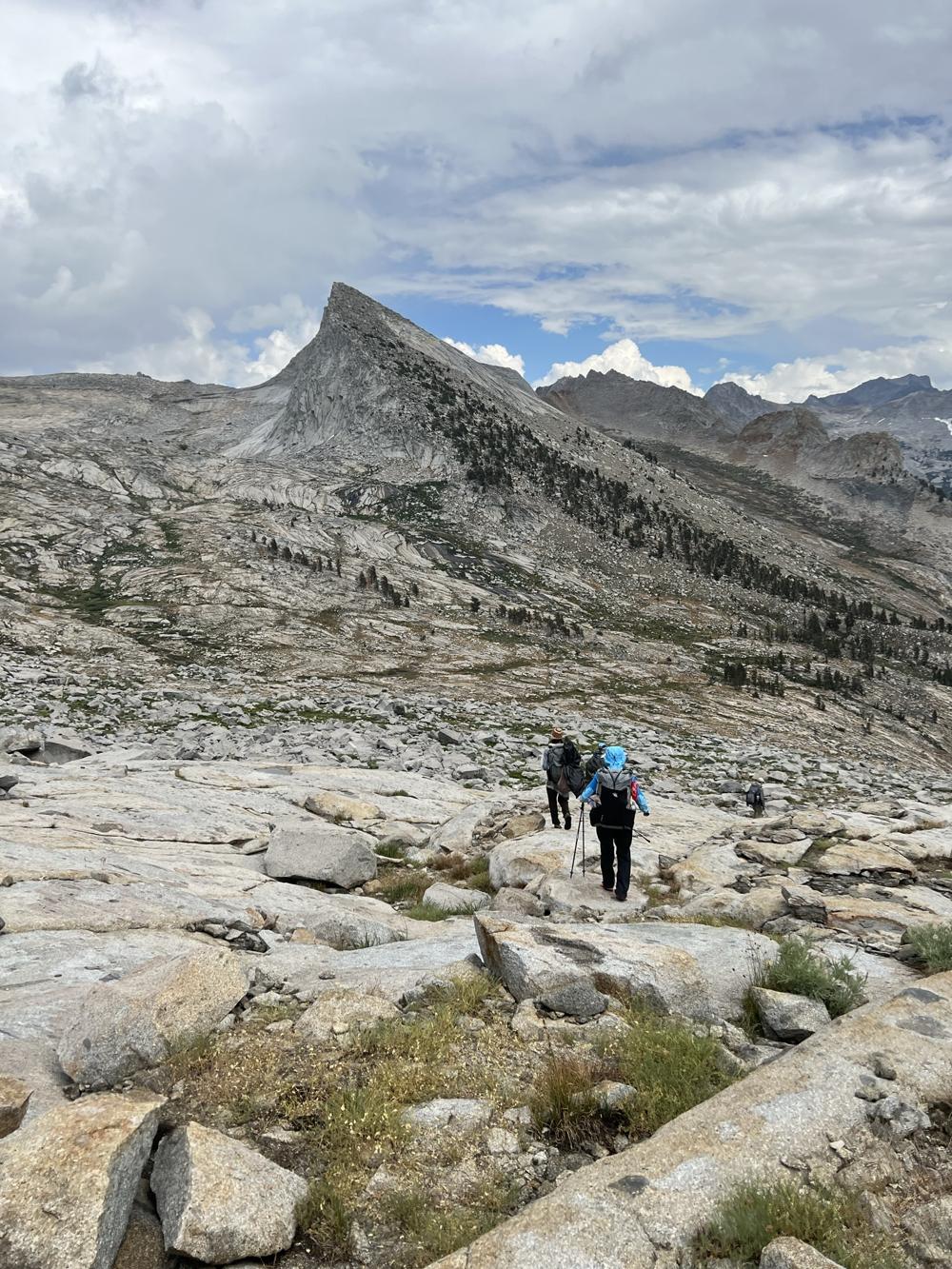
We make our way to the outflow from the lake, then pick our way down the rocky mountainside. Our next destination is Pterodactyl Pass at 11000’. We slowly make our way up towards the pass over the talus and boulders. At one point, Andrew crests a ridge and then shouts, “Okay, everybody get their rain gear on!” He can see a line of rain sweeping across the granite towards us. Everyone throws on their rain jackets and rain pants. Ten seconds later the rain hits us. We continue picking our way over rocks in the rain.
We reach Pterodactyl Pass. If you look at a nearby peak at a certain angle, the ridges in the area look sort of like a pterodactyl’s beak and wings. From there we descend to reach the remote Elizabeth Pass Trail. It’s a relief to step on a trail again. The cross-country hiking is fun in its own way, but requires an enormous amount of mental focus; by comparison, hiking on a trail is a breeze.
The trail hits a series of steep switchbacks, eventually reaching the bottom of the deep valley of Lone Pine Creek. By now it’s late afternoon and I’m completely exhausted. Andrew offers the group a choice: camp here in a grove of trees, or climb another 1000 vertical feet to camp by Lake Tamarack.
Andrew conducts group votes by having the clients close their eyes and make a thumbs up (keep hiking) or thumbs down (stop hiking) vote. I vote to stop. After everyone votes, he pulls Nicco aside for a chat. My guess: the group voted 4 to 3 to keep hiking, but Andrew feels that the group would be better off stopping, so put his thumb on the scale. In any event, I’m extremely happy that we’re going to camp here. (The next day we’ll learn that other campers at Lake Tamarack had already filled the plausible campsites, so our decision not to continue was even better in retrospect.)
Before dinner, Andrew conducts a tour of everyone’s shelters, talking about the pros and cons of the various tents and tarps.
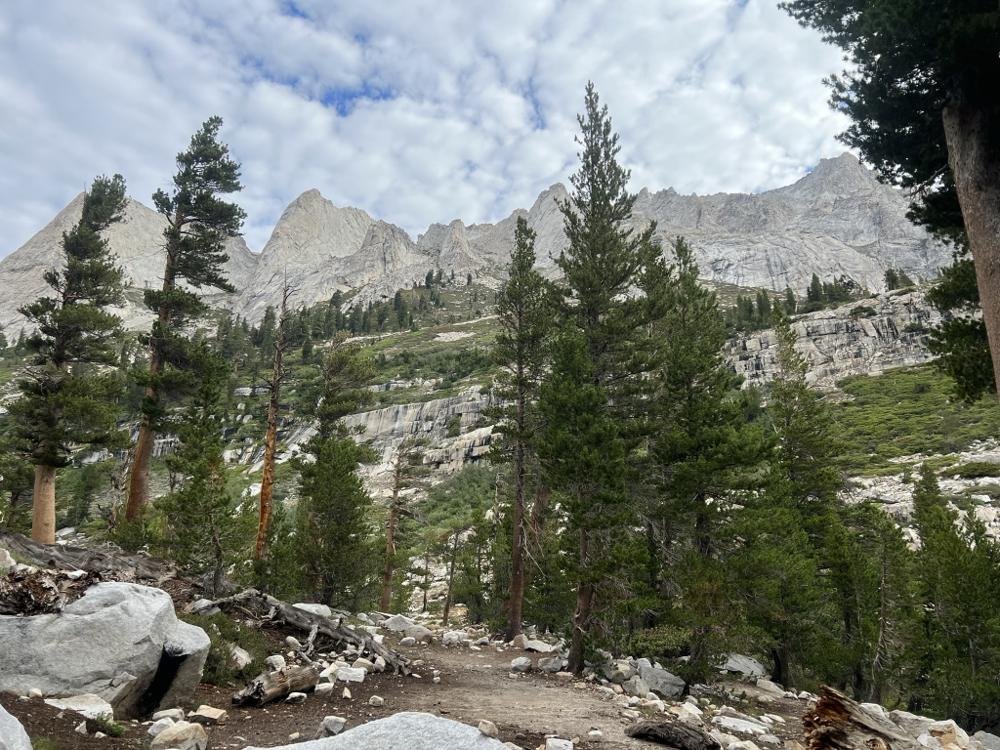
Jan’s off-trail backcountry adventure, Day 3. I wake up at 5:00 am to be ready to hike out at 5:45. This morning we have to make the climb to Tamarack Lake we’d put off yesterday. Since we’re hiking on a trail, it’s not too bad. We stop at the lake to have breakfast.
During breakfast, I can’t help looking at the rocky cliff above the lake — Andrew says there’s a break somewhere in that cliff that we can climb up, but I can’t see it. In recent years I’ve developed a fear of hiking anywhere there’s exposure to a fall. This fear has sometimes been an inconvenience, but given the terrain we’re covering on this trip, here that fear is a constant concern.
To reach the base of the cliff we have to cross the outflow of the lake on a log. As I’m making my way across, my water bottle falls out of my pack and into the creek, where it goes over a small waterfall. That’s not good! That’s my primary water bottle for this trip, and I also really don’t want to leave a plastic water bottle sitting in this wild creek for years. Happily, Fernando runs down to the pool below the falls, and spots the bottle floating just below the surface by a log. He retrieves the bottle and returns it to me.
Andrew leads the group up to the cliff, which turns out to be broken into stages. There’s only one spot where he needs to backtrack; there is a way up at that point, but in deference to my fear of a fall, he and Nicco search for a less exposed way up. The going is nevertheless very steep up to a meadow. We cross the meadow, then begin climbing a steep talus slope. The rock-hopping isn’t particularly scary or difficult, although with so many opportunities to misstep, it’s somewhat miraculous that we hop across talus for hours without any injuries.
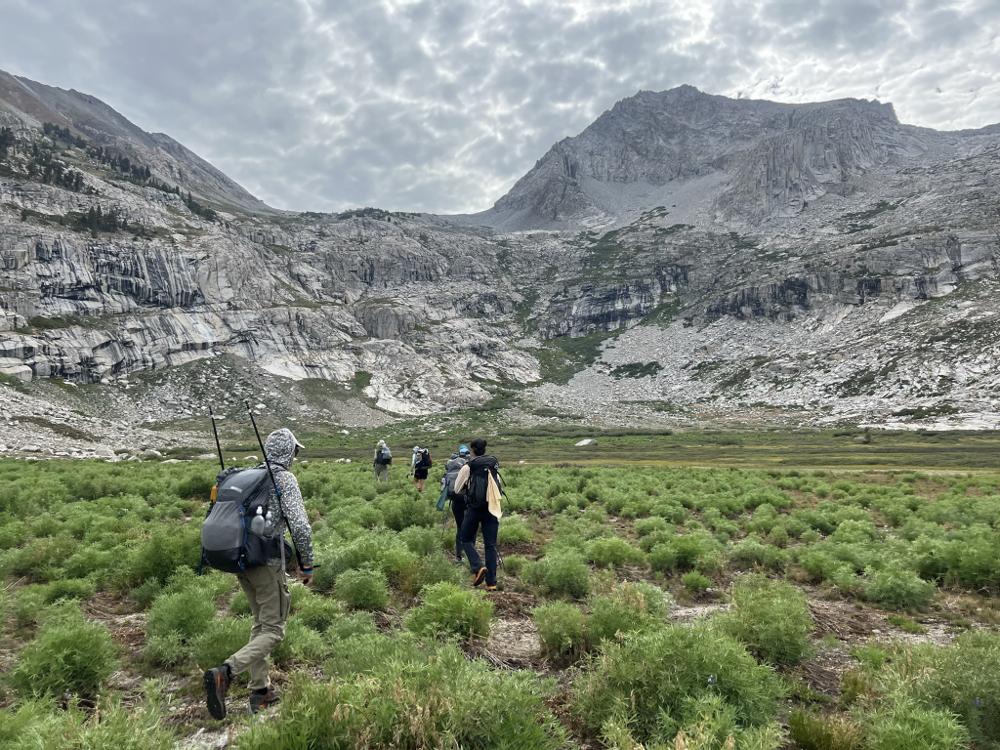
We reach the rocky wall below Lion Lake and stop for lunch. I take a quick rinse in the frigid creek.
Above Lion Lake there’s more talus, as well as some sections of loose scree rock that slides when you step on it. We step up, slide a bit, step up, until we reach a pass at 11600’. From the top, we can look down into Cloud Canyon. Our goal from this point is an even higher pass called Copper Mine Pass, but it’s somewhat tricky to reach. We have to descend a bit and cross a small snowfield, then pick our way across more loose scree. The rocky landscape is broken up in this area, overshadowed by a steep ridge of rock. The broken landscape makes it hard to find the specific point in the ridge where we can cross over to the other side. Andrew’s been through this pass before, and even he has to backtrack to pick up the correct route. This route turns out to be a very faint bit of rocky trail.
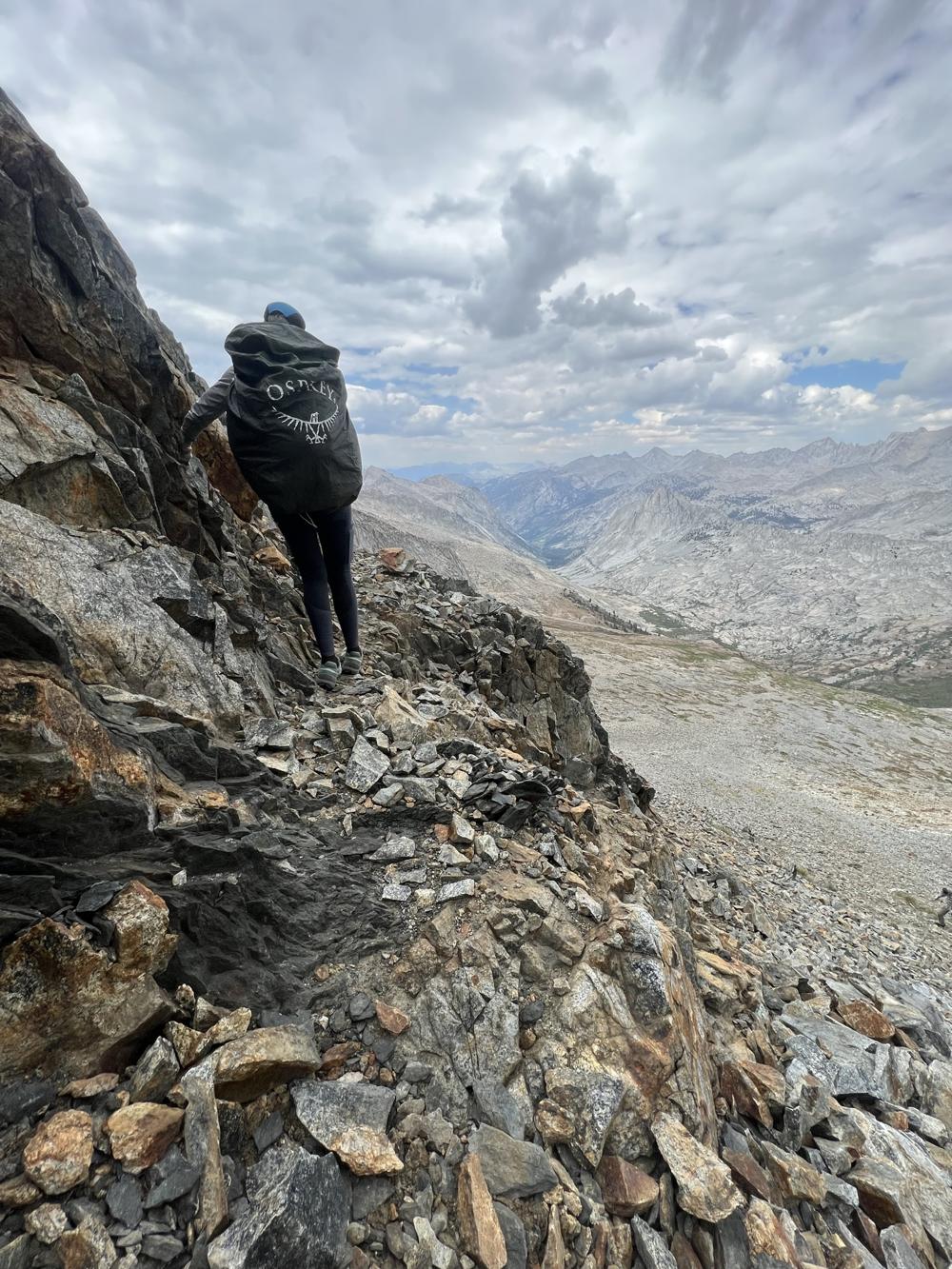
Between the loose rock and the occasional steep drop-off on the side of the trail, I’m pretty tense. I’m very relieved when we finally reach Copper Mine Pass at 12345’. This is the highest point we’ll reach on the trip, over 4000’ above our starting point today. The rest of the group is delighted to scamper up from the pass to a nearby rocky peak, but I’m happy to nap for a few minutes.
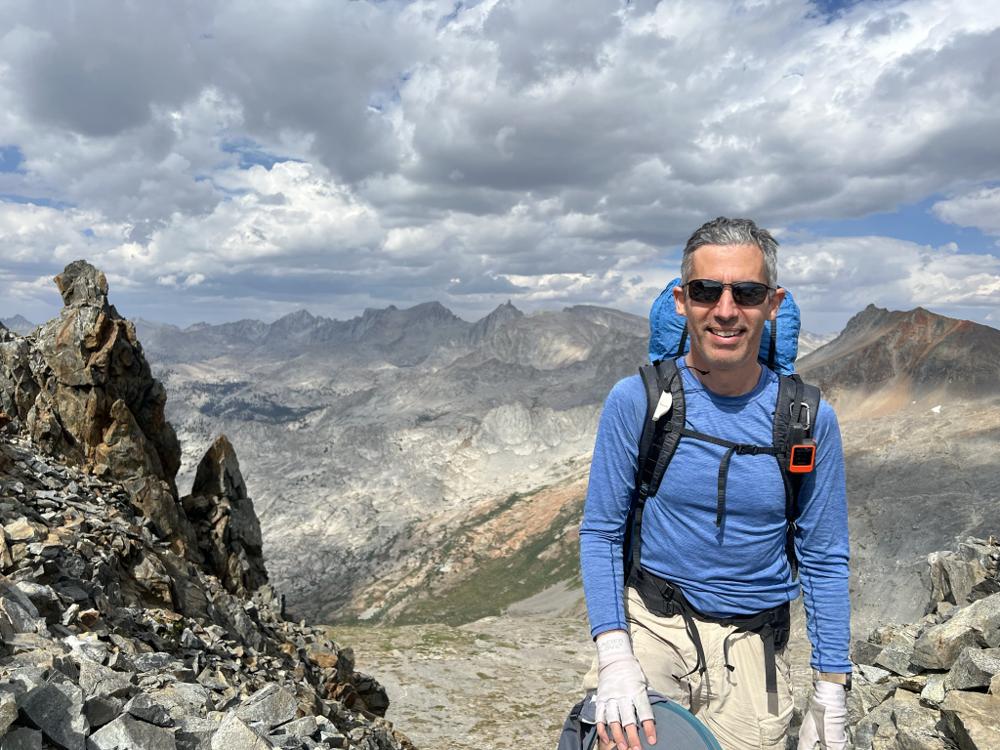
Below the pass there’s a faint trail, probably left by copper miners. It feels strange to find a trail at all in such a remote place. After descending for a while, we come to the entrance of the old copper mine that gave this pass its name. It’s not hard to see how people discovered copper here — we can see green streaks in the rock.
At this point Andrew offers the group another decision: 1) descend from here into Deadman Canyon and camp in the trees on the valley floor, or 2) stay high, cross a few more miles of rocky terrain, climb over another pass, and then camp in the high basin at Lonely Lake. Once again, I argue in favor of the easier option; we’ve already had a very hard day, and the clouds threaten rain again. Another argument in favor of dropping into the canyon here is that Andrew’s never been there, and our route the next morning will be new to him too. I’m happy when the decision is made to descend. (Later, Andrew will say privately that this group is a little too ambitious for their abilities, so he’s happy that there’s at least one person in the group who’s willing to advocate for the more conservative options.)
As with yesterday, taking the easier option proves to be the correct choice. We’ve just made it down to the canyon to pick up a trail when it begins to rain. Unlike yesterday, the rain continues for a long time. By now it’s 6:00 pm, and we’re still far from anywhere we can camp. We keep hiking in the rain down the canyon.
Andrew sees some trees across the creek where we might camp. There are trees further down the canyon as well; those look like they’re right by the trail. I opine to Andrew that people are fundamentally lazy, so if we’re going to find good spots to camp, we’ll probably find some right by the trail. We keep hiking in the rain, and finally reach the trailside trees at 7:00 pm. There are, in fact, great campsites right by the trail. Moreover, we’re delighted that the rain finally lets up.
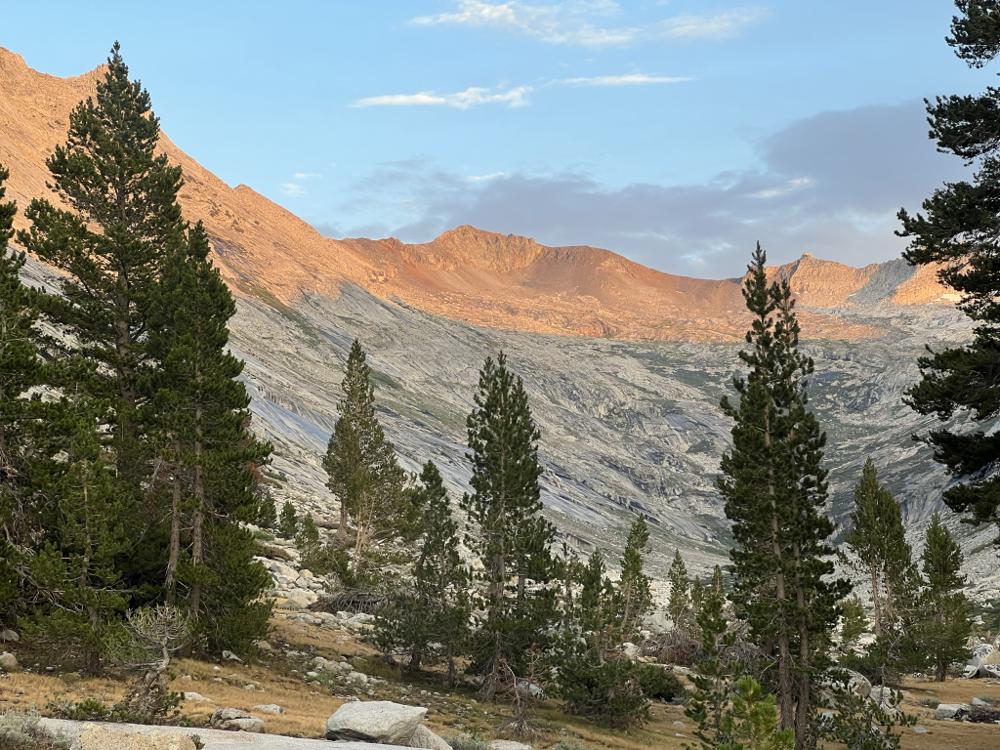
We set up camp and have a nice dinner sitting on a rock slab. At some point during the day, Nicco foraged some King Bolete mushrooms. He cuts them up and offers the pieces for people to add to their dinners. He adds, “Some of the pieces are clean, some have maggots in them.” I ask, “Um… can I have some pieces without maggots?”
I set up a long laundry line where people can dry out their gear. The other hikers like my use of tiny little office binder clips as laundry pins. After dinner, there’s an evening discussion that finally ends at 9:30. It’s been a very long day. We’ve climbed just shy of 5000 vertical feet today, and about 4000 of those vertical feet were off trail.
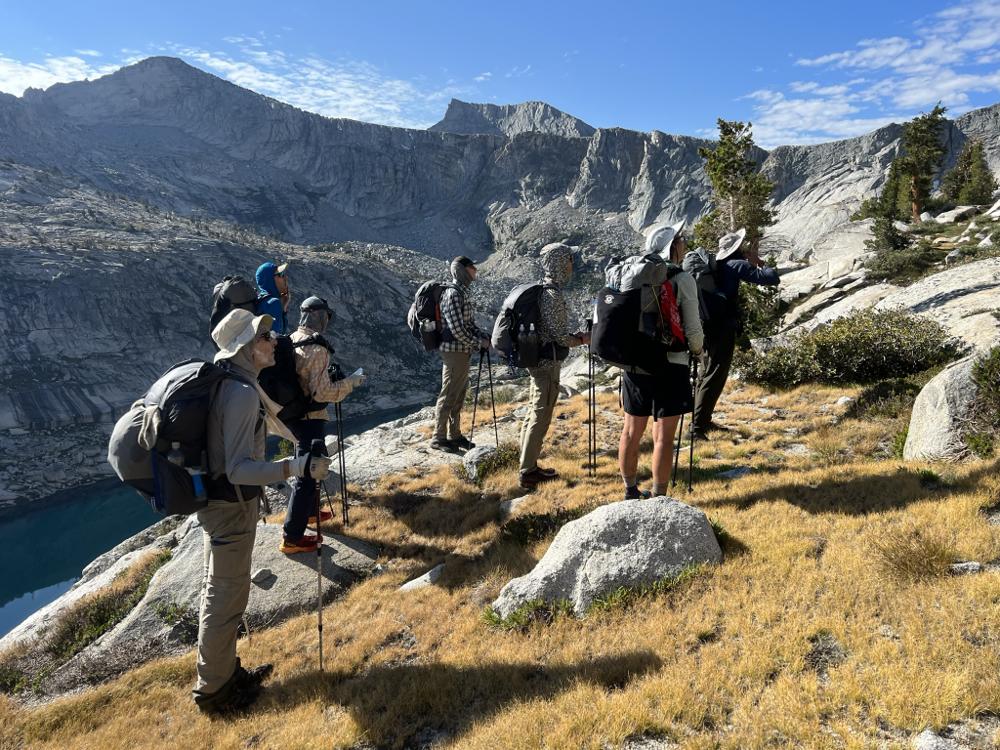
Jan’s off-trail backcountry adventure, Day 4. I’ve set an alarm, but I also put in ear plugs, so I don’t hear my alarm go off at 5:15 am. When I open my eyes at 5:45, I look outside to see everyone collapsing their tents and stuffing their packs. I have to race to be ready for breakfast by 6:00.
We cross a creek and begin climbing to Big Bird Lake. This morning’s terrain has long, sloping slabs of granite. If one can keep one’s body vertical, it’s possible to climb up these slabs even when they’re very steep.
From Big Bird Lake, there’s a steeper climb. It looks quite exposed, but turns out to not be too bad. We traverse at 10400’ to reach an unnamed lake, where we stop for a swim.
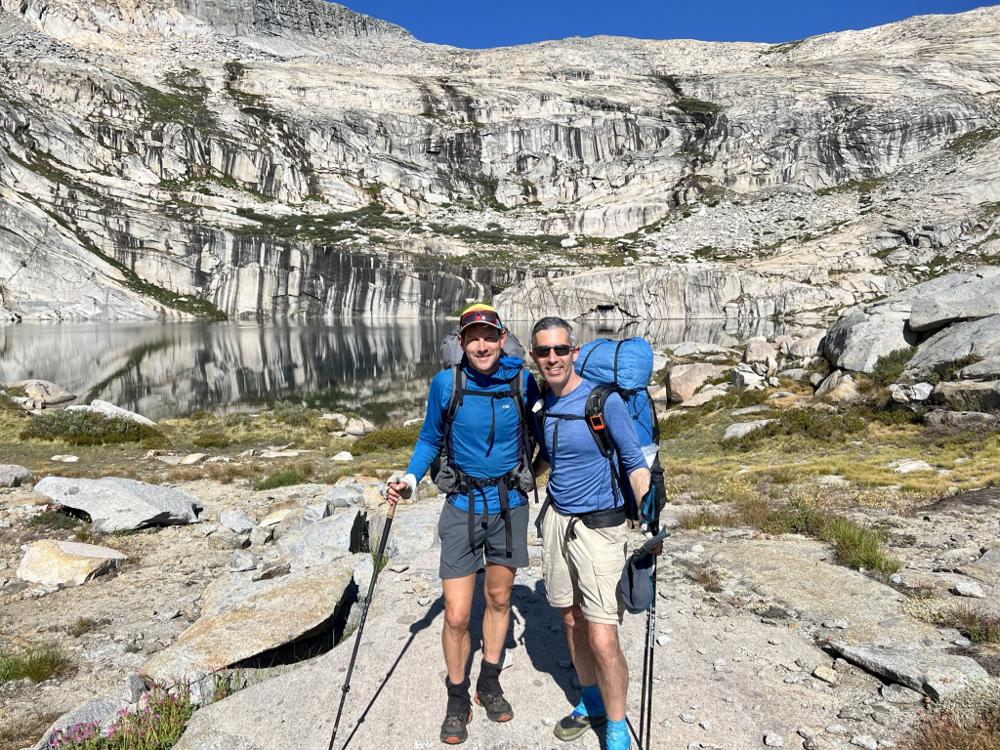
Our next goal is the ridge above the lake. Directly across the lake is an impossibly steep slope, but we make our way up to the right and reach the ridge.
We pass a small tarn, then walk up to the flat top of an unnamed peak at 11200’. We break there for lunch. While we’re eating, a cute marmot keeps walking around our group. We are probably sitting on top of his home.
We have huge views across the land in every direction, and Andrew points out a number of mountains as landmarks. Virtually everything we can see lies within Sequoia-Kings Canyon National Park; the park is mind-bogglingly big. We can see rain falling in several directions, but thankfully it holds off.
After lunch, Andrew conducts a class in compass use. Most of it is familiar to me, but because I (and nearly all hikers) usually use phone map apps for navigation, I’ve almost never tried to use a compass for real navigation.
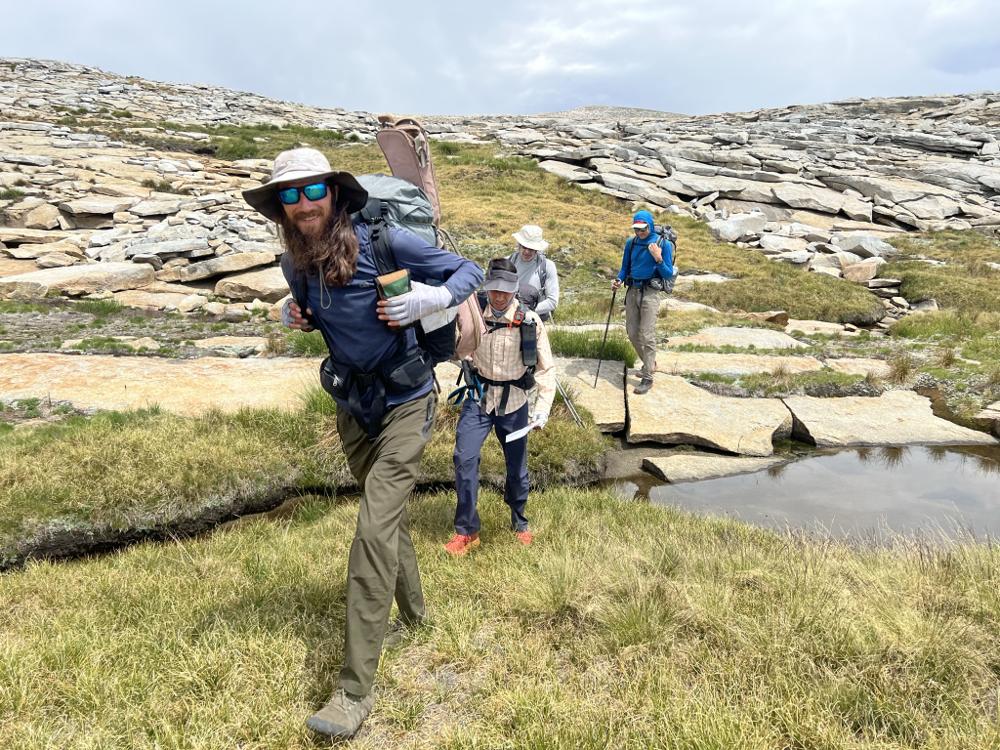
We’re now on a large plateau called Tableland. We drop a bit and cross the plateau to reach Azure Lake, one of the headwaters for the Kaweah River. We follow the river down rocky slabs into a canyon. As we descend, it begins to rain — our third day with rain in a row. At least the plants are getting some much-needed rain, Andrew points out.
One thing I’d never appreciated before about topo maps is how accurately they indicate where you can find tree cover. Our topo map shows a small flat spot that should have trees further down the canyon, so we make for that in hope of finding a good place to camp. We find the trees as promised, although we ultimately decide that the better campsites are on the adjacent flat rock slabs. Although I’ve had several occasions to pitch my tent in places like this where I can’t use tent stakes, Andrew shows me a much better way to use rocks to set out my tent’s guy lines. I’m learning quite a lot of new tricks on this trip.
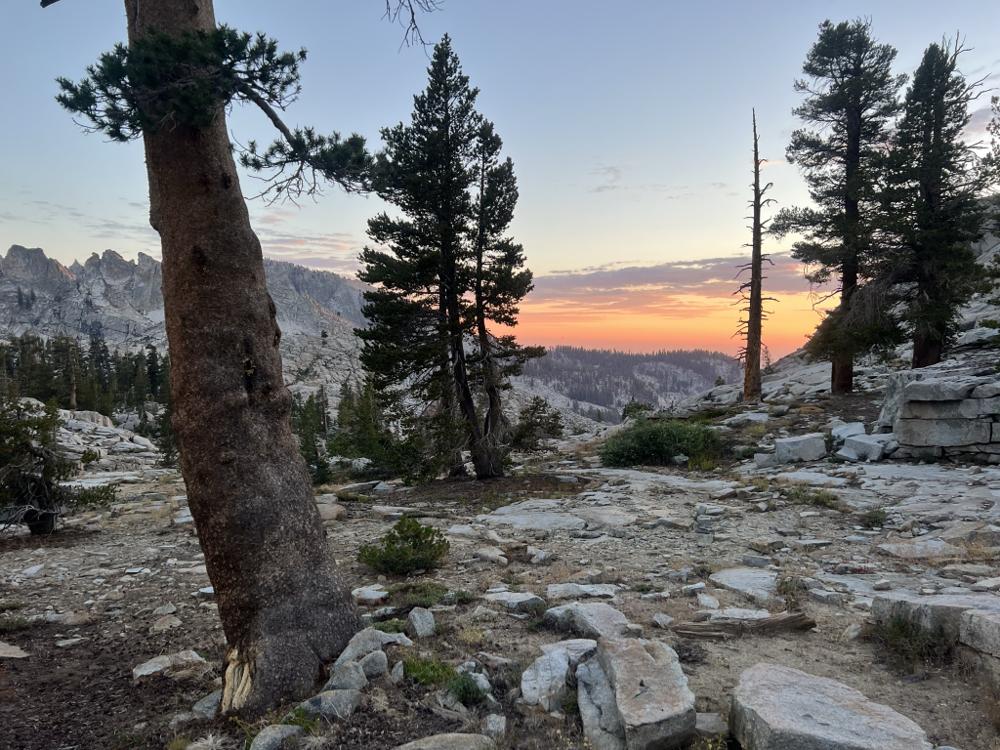
During dinner, I have the chance to return the favor. I demonstrated a technique I’d developed for measuring the amount of gas left in a fuel canister using a hiking pole as a balance scale. Everyone’s suitably impressed, even Andrew. During a short post-dinner class on knot tying, I show Andrew another (better) way to tie a clove hitch.
Meanwhile, back at home, Chris takes Lyn to see her primary doctor, who conducts a series of physical and cognitive tests. Physically speaking, Lyn is healthy. But the doctor does confirm that her short-term memory has been compromised, and that this would be “atypical” of the previous diagnosis of hospital-induced delirium. He provides referrals to some specialists.
It’s becoming clear that Lyn’s memory condition is serious, and it could take months to resolve — if it resolves at all. In the meantime, she is unable to live independently. Given that she generally can’t remember things for even a short while, it’s all too easy for her to get lost or confused. We’re unsure how we’re going to handle caring for her.
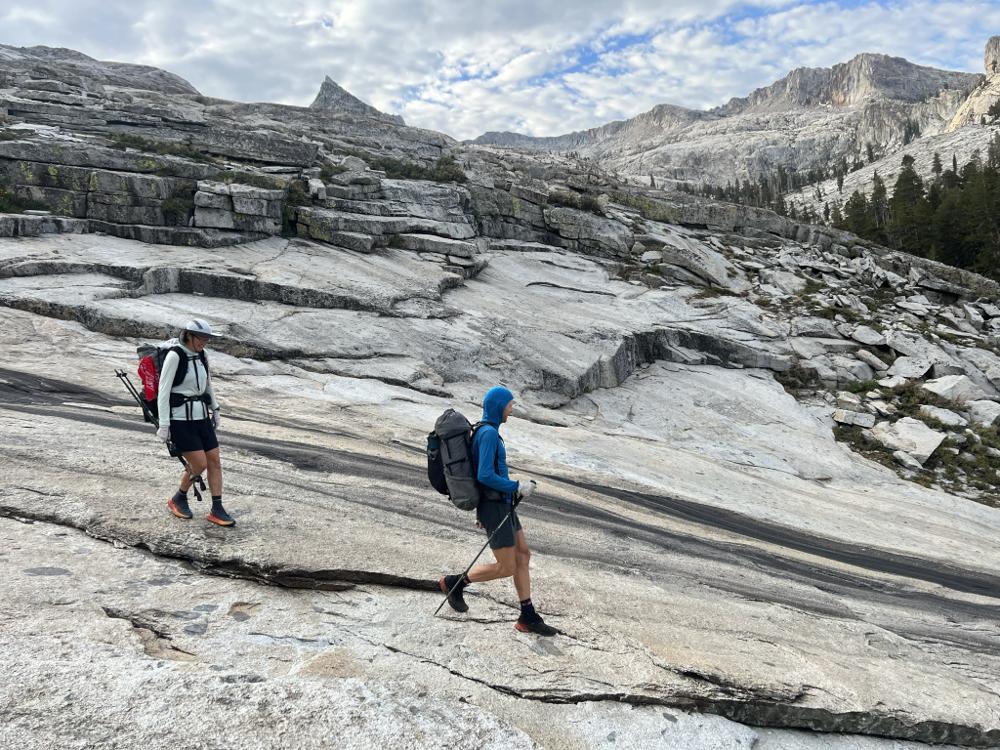
Jan’s off-trail backcountry adventure, Day 5. Just before my alarm goes off at 5:15 am, I hear the faint sound of music — Nicco is playing his guitar as a gentle wake-up call.
We only do a short distance of off-trail hiking down the canyon before we pick up an established trail at the Pear Lake Ranger Station. From this point, the group makes fast progress down the trail past Emerald Lake and Heather Lake.
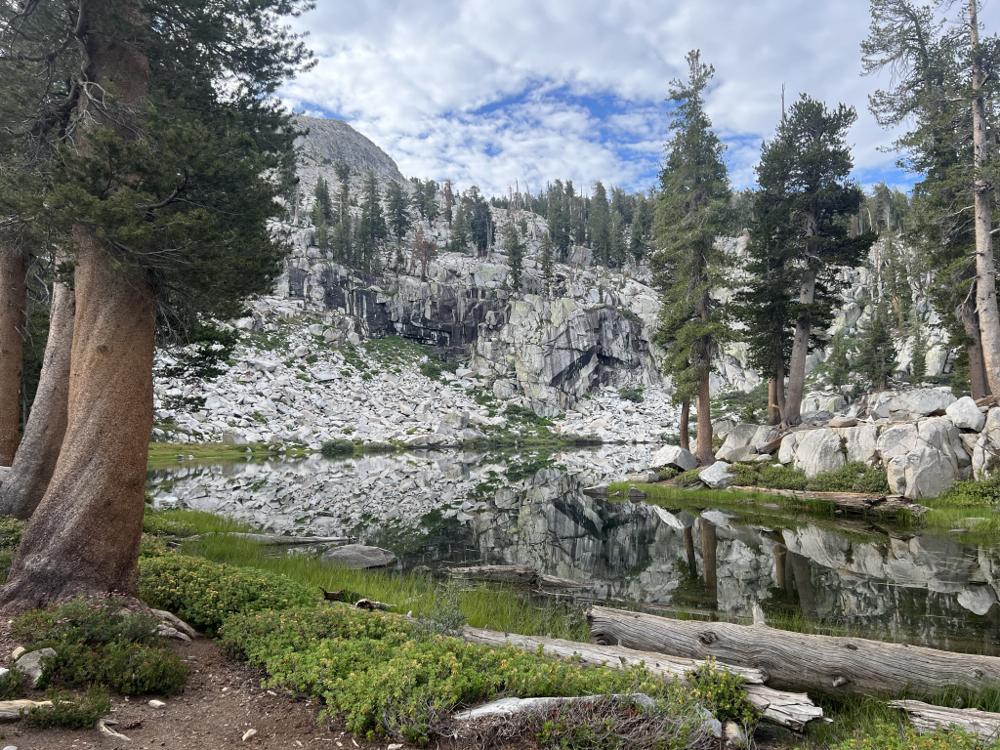
I’d visited the ridge above Heather Lake on my acclimatization day, but rather than climbing on that ridge, Andrew opts for the Watchtower Trail. This trail turns out to be blasted into a very steep cliffside, so I have one final stretch of fear-inducing heights to endure before we re-enter the forest.
From there it’s all downhill to the trailhead at Lodgepole Campground. We’re met by the guide who’s been handling base camp operations. He provides everyone with a cold beverage and, somewhat oddly, hot bacon. It’s nevertheless nice to eat real food for the first time in four days. The other hiking group also arrives, and there’s a bit of story sharing from our adventures.
People begin to start their journeys home, so everyone makes their goodbyes. I’m carpooling with Alex back to Fresno, and we make arrangements with Claire and John to meet up there for lunch. Andrew had recommended Castillo’s, but it’s closed for a vacation, so we make do with tacos at Las Mañanitas instead. They’re wonderful. Outside, Fresno is broiling at 103°.
Alex and I say goodbye to Claire and John, then I drop Alex off at his hotel. My flight out back to Seattle isn’t until tomorrow morning, so I’m spending the night in Fresno myself. I check in to the nondescript Doubletree Hilton, where I take a shower and then collapse.