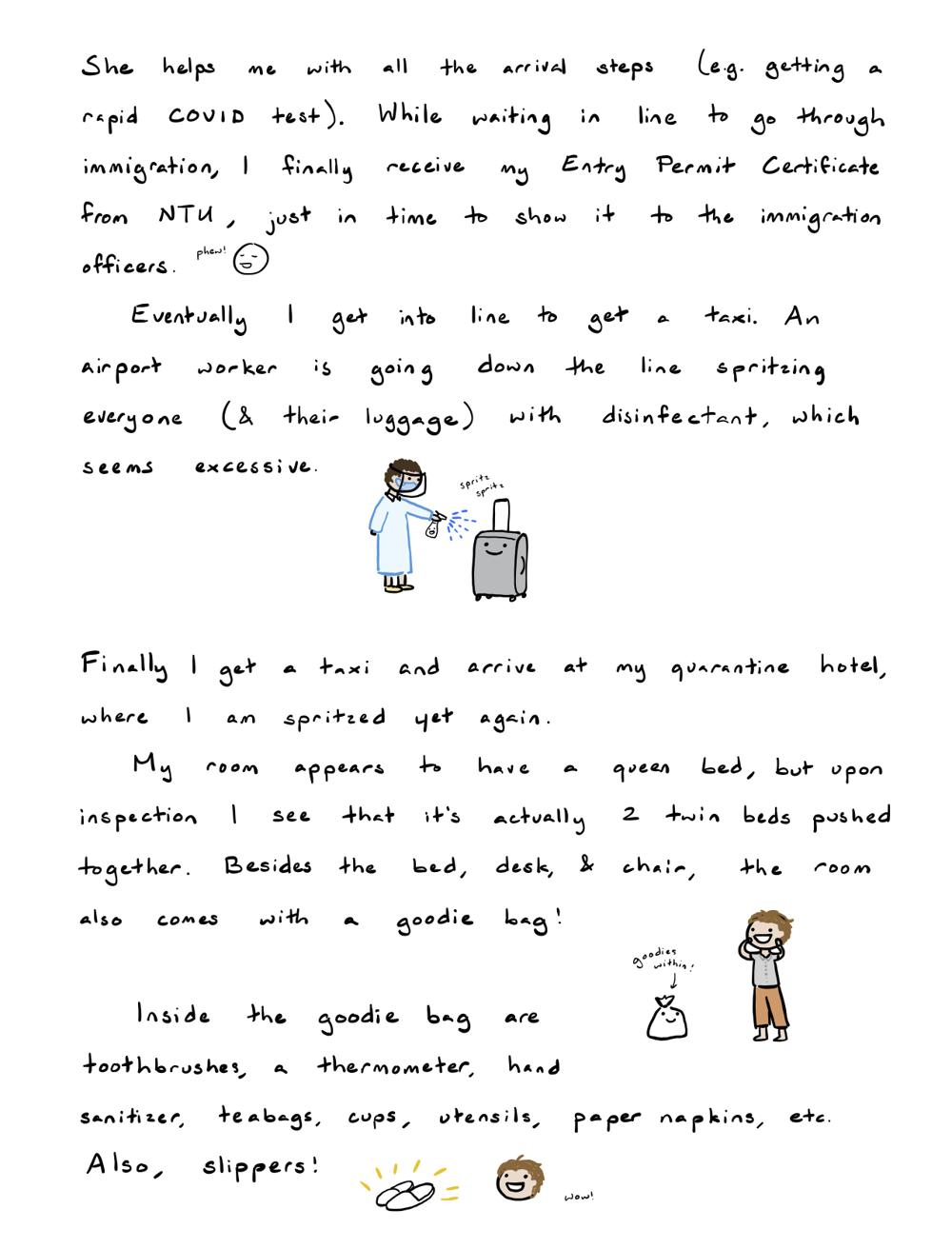
Liya starts an illustrated journal of her summer in Taiwan. You can find it online at liya.miksovsky.com.
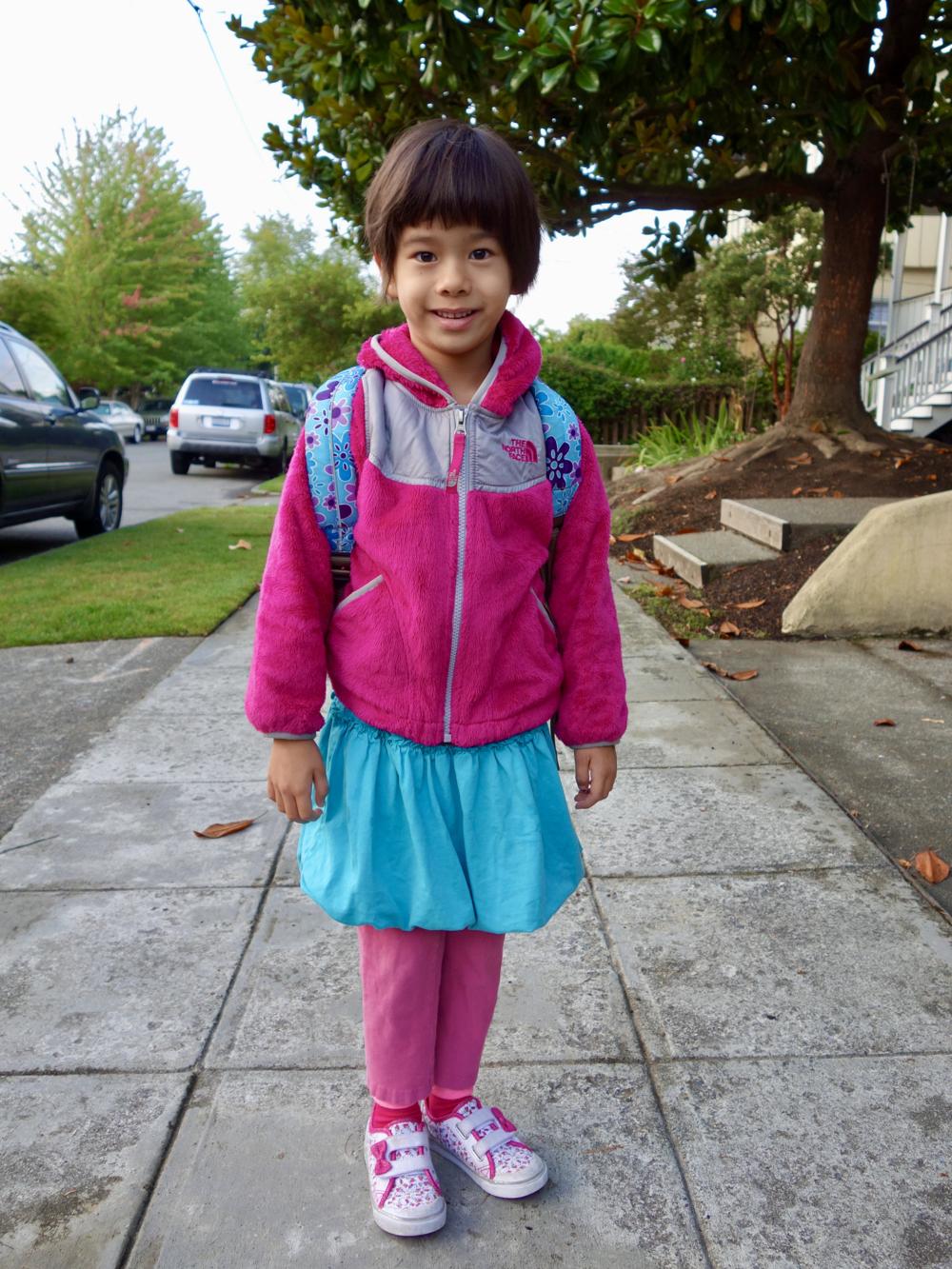
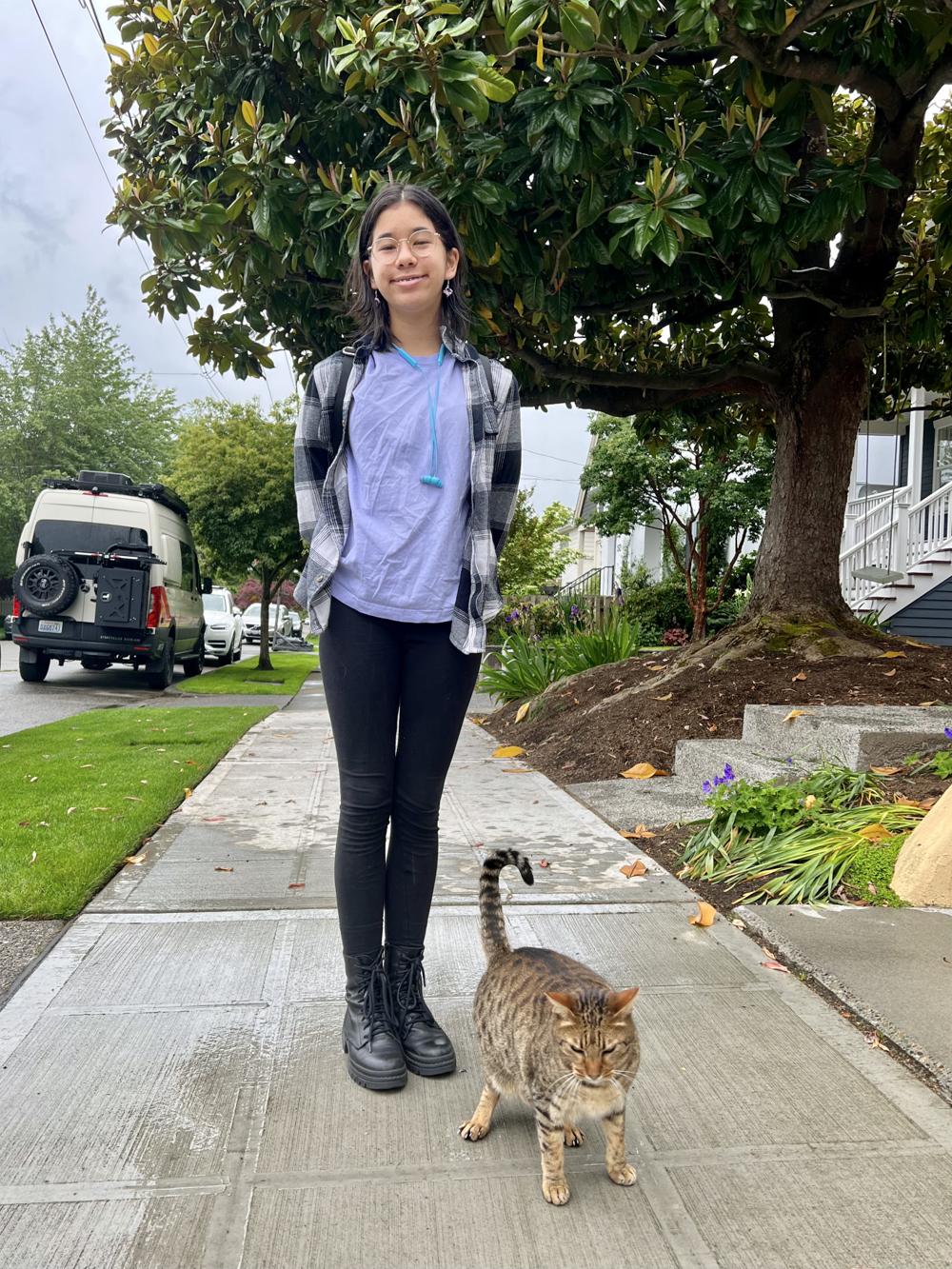
For Bree’s last day at her K-8 school, she lets Jan recreate some photos we took on her very first day 9 years ago. This evening we’ll say goodbye to this school our family has been going to for 15 years.
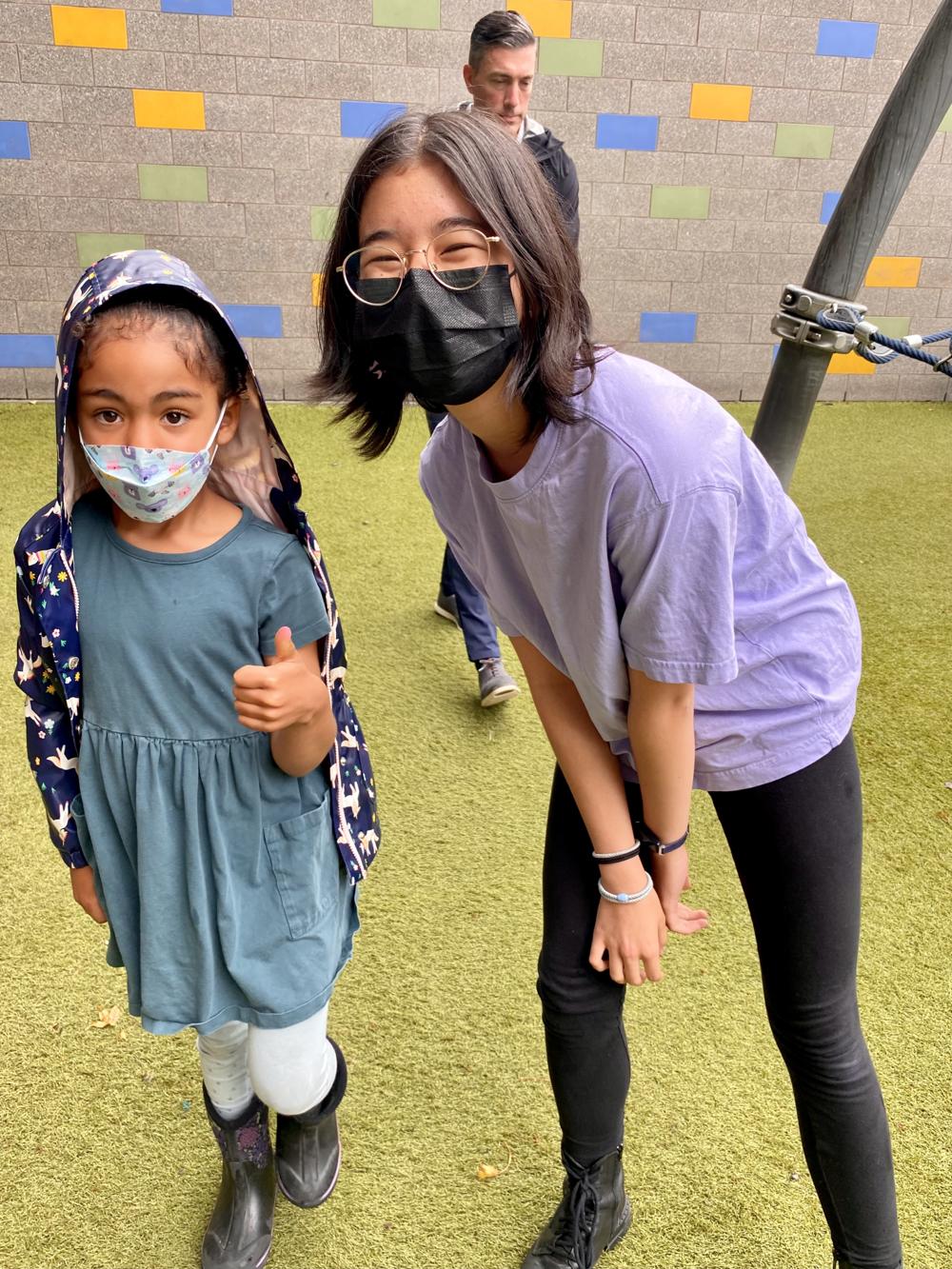
Bree says goodbye to her kindergarten buddy, Mila. The school’s pairing of 8th graders and kindergartens has been a fun part of Bree’s time there — on both sides of the experience.

Bree graduates from middle school in a ceremony held at the school. Lyn joins us. Rain forces the school to move the ceremony into the gymnasium. The event hits all the notes, and everyone keeps their speeches short. One memorable line is from Bree’s classmate, Maxine, whose speech includes the line, “It’s an open secret that we’re all a little sick of each other.” Ms. Meg, the art teacher was asked by the students to give the main speech, which includes a nice bit about “pause” — such as the pause between middle school and high school.
We celebrate afterwards with a good dinner at Isshoni, a Japanese grill on Capitol Hill.
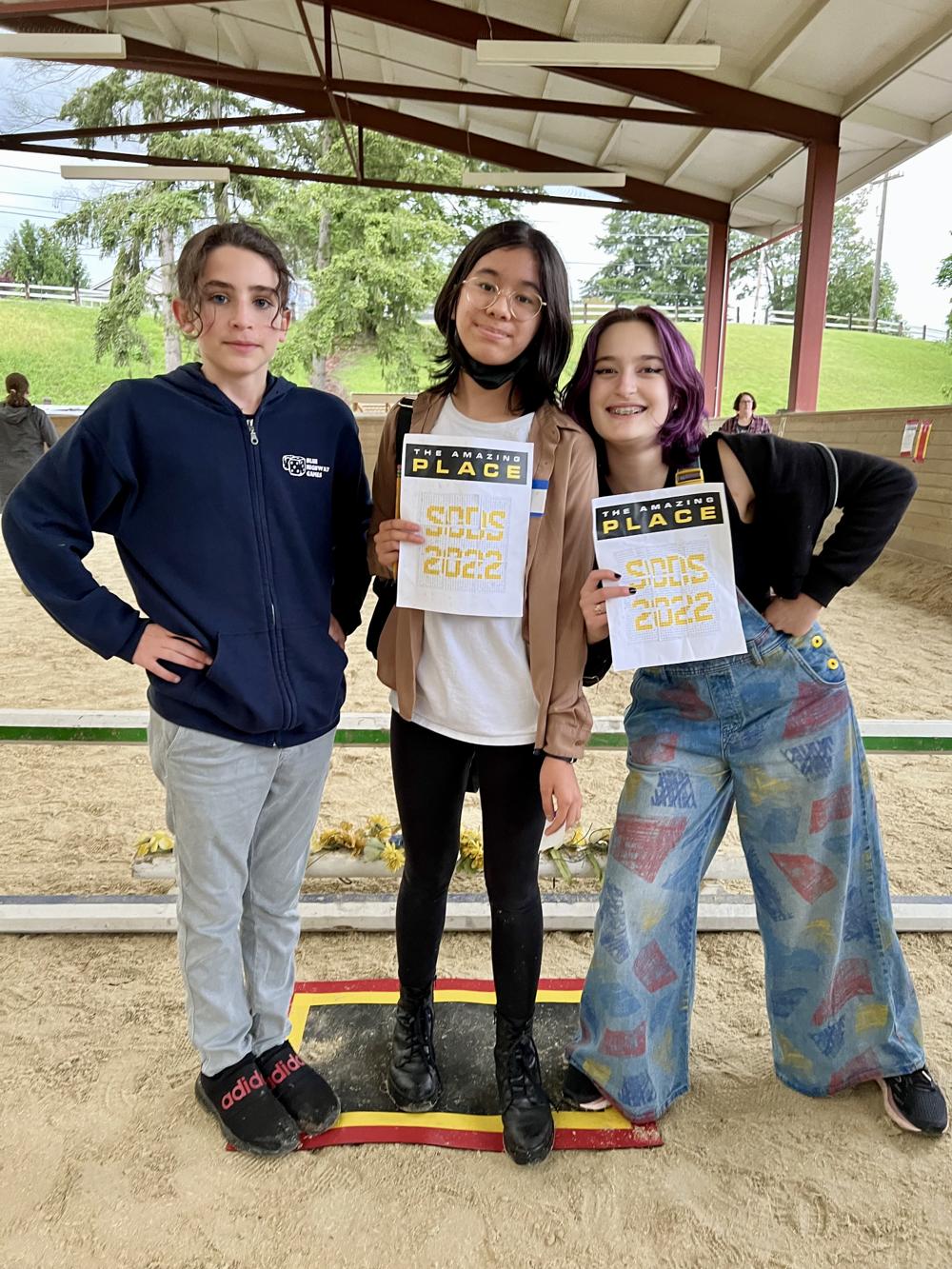
Bree’s class holds their post-graduation party at Seattle Farm — a real horse farm hidden at the southern edge of the city.
Jan and another school parent, Josie, have spent the past two months working on a short puzzlehunt activity for the graduates to do between dinner and dancing. Modeled after the TV show, The Amazing Race, the puzzlehunt takes the form of a stamp rally named “The Amazing Place” in honor of their wonderful school. Kids have to visit nine locations on the farm, one for each of the grades at the K–8 school they’ve just completed. At each location, they collect a stamp by completing an activity tied to the farm venue or to a memory from the corresponding grade.
The puzzlehunt is well received. All the graduates present complete the puzzlehunt, thereby entering a raffle for the grand prize: a sizable Trojan horse sculpture made out of candy with gummy bear people inside. As a digital Wheel of Fortune spins to select the winner, all the students lean forward, and when it displays the name of Bree’s classmate Peter, the boy and his friends are ecstatic.
The puzzlehunt is followed by dancing and marshmallow toasting around a campfire. Bree and her friends have a great time. The occasion is also bittersweet as it’s the last time the class will be together.
Anya returns from freshman year at Stanford. There’s a bit of drama just getting home — Anya’s phone has gone missing, then they miss the flight to Seattle, and finally the rebooked flight is delayed. But Anya eventually gets home safe and sound.
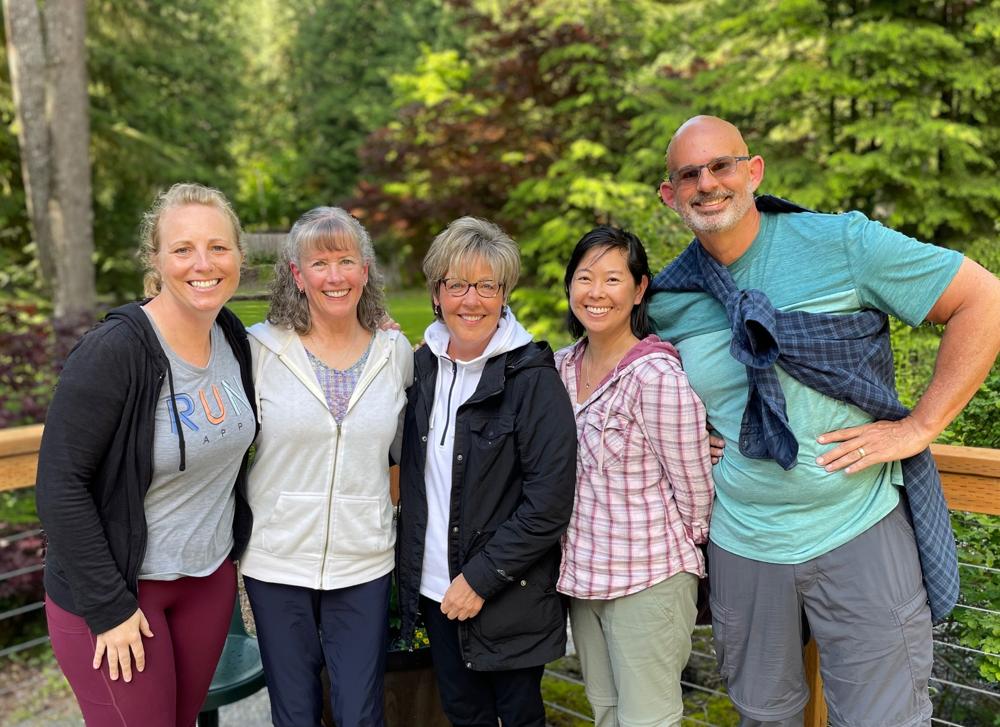
Angela completes a two-year program in Spiritual Direction: helping people to learn and grow in their personal spirituality. She’s had to do regular readings, essays, and occasional retreats. This weekend her cohort holds their final retreat in North Bend near Mt. Si. The photo shows Angela with the other members of her peer supervision group.
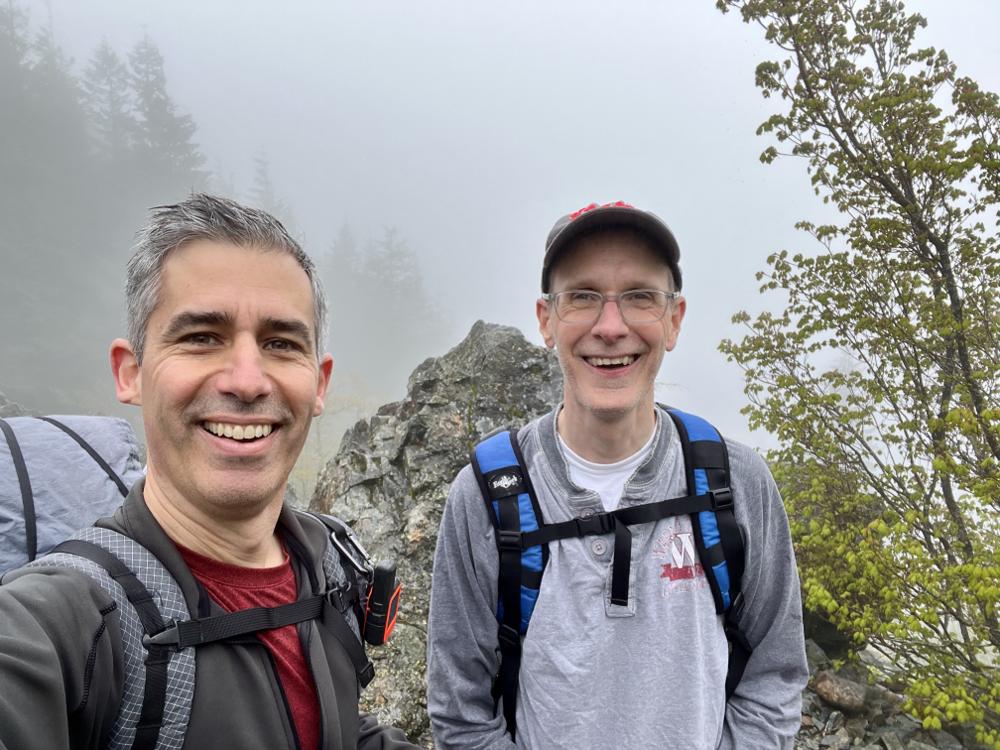
Jan invites his friend Chris to join him for a morning hike up Mt. Si. Jan’s looking to do some more elevation gain that he can get in the city, and the Mt. Si trail is a 3000’ climb over just 4 miles. He’s also hoping that he’ll finally have a dry Sunday morning hike — but no luck. It drizzles a bit, and only clouds can be seen from the viewpoints at the top.
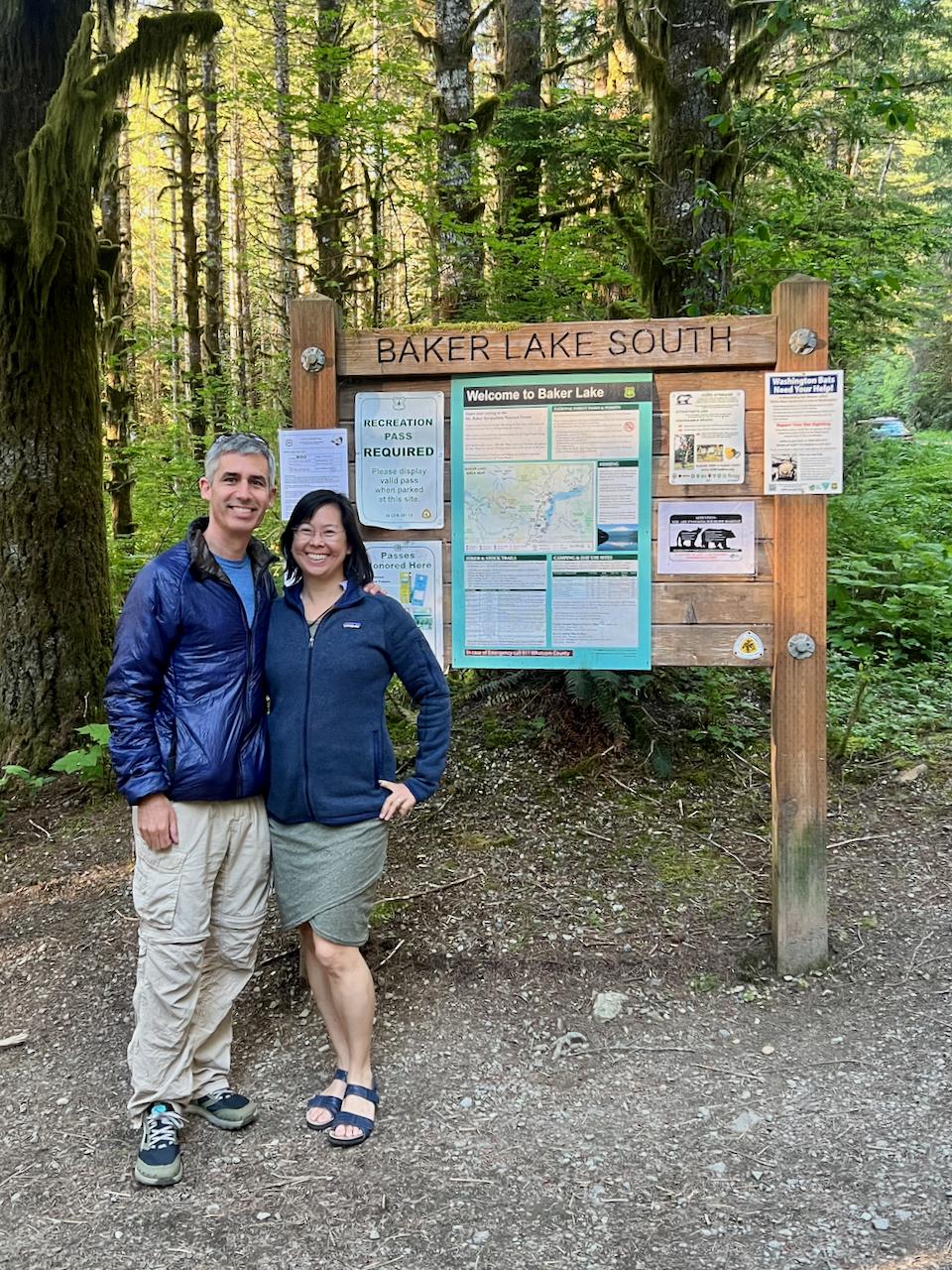
Jan’s 2022 Pacific Northwest Trail Hike, Day One. For this summer’s section hike of the PNT, I’m going to hike the portion that runs from Baker Lake to Puget Sound.
I drive with Angela to the town of Sedro-Wooley. We have dinner at the Magnolia Grill. It’s a nice evening to be outside, but a little too breezy and cold under their awning. I notice the restaurant is across the street from the office of the Pacific Northwest Trail Association office. They’ve closed up for the day.
We drive to the Kulshan Campground at the south end of Baker Lake, where I drop off my backpack. Tonight I’m going to hike a very short, 2 mile bit of the trail so that I don’t have to do it tomorrow morning. We drive over the dam at the south end of the lake, and stop at the Baker Lake Trail trailhead. I’ve been there before with Bree and others, so this is where I’ll pick up my footsteps.
Angela and I say goodbye, but as I start to walk away, she shouts — although we’d been careful to have her hold on to the car key, back in Sedro-Wooley I’d ended up with the key and had forgotten to give it back to her. She drives off and I walk back to the campground. It’s a nice evening for a walk.
When I reach the campground, I chat with the camp hosts: a pair of old men who are spending the summer there. I set up camp for the night and go to sleep early.
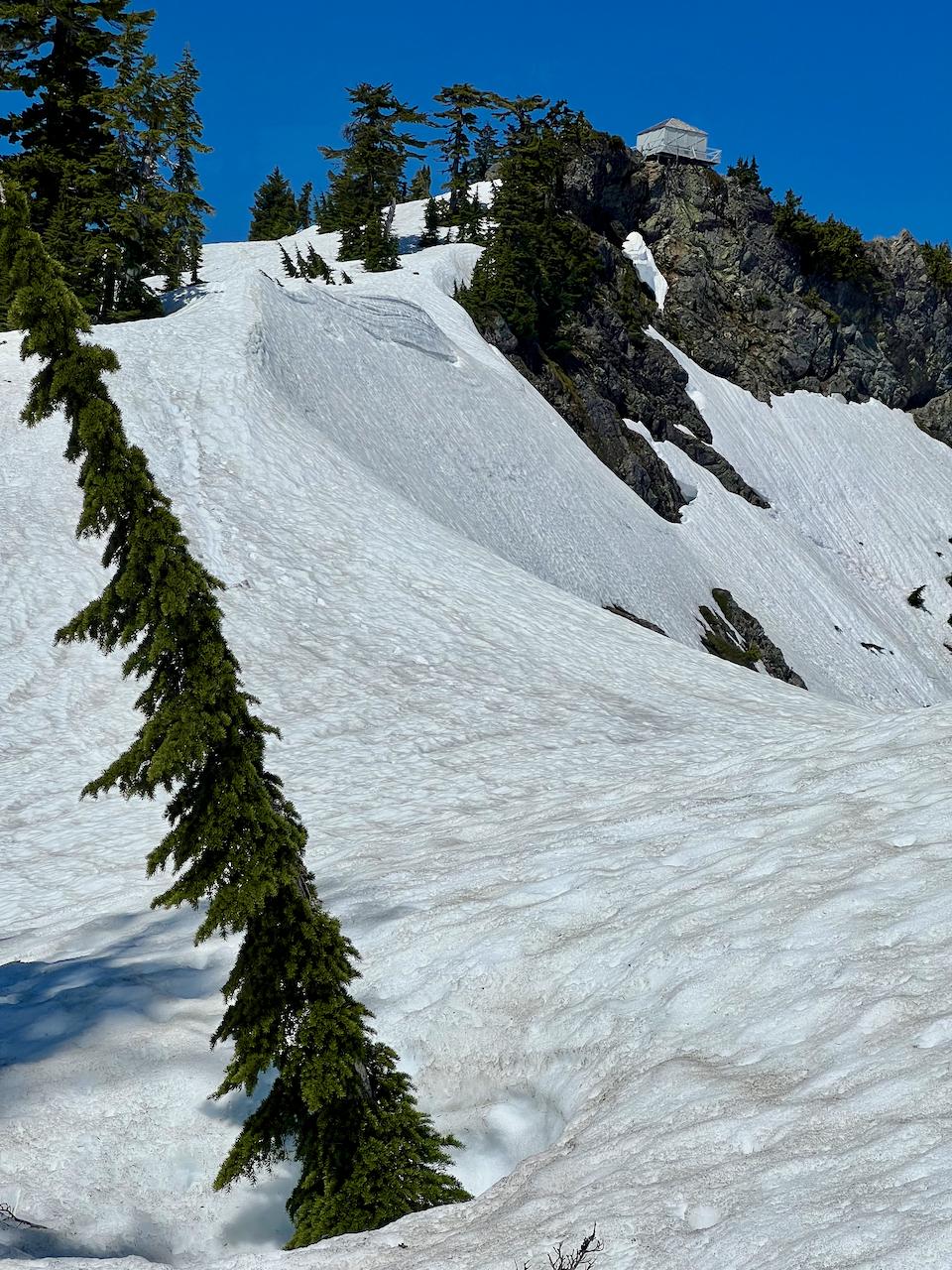
Jan’s PNT hike, Day Two. I’m up very early at 5:30 am. My goal today is to hike up to the Park Butte Fire Lookout and spend the night there — but it’s first come, first served. The weather forecast calls for sun this weekend for the first time in a long time, so I may have competition for spots.
It’s chilly on the road until the sun rises a bit. I make my way from the low level of the lake up a series of dirt roads. A few cars pass me on the way to the trailhead, but they all say their goal is to make for a base camp and climb to the summit of Mt. Baker. I eventually reach the Park Butte trailhead at 3000’. There’s snow on the ground above that point. The Pacific Northwest had a lot of late-season snow, so there’s more snow than unusual for this point in late June.
I’m not wearing boots appropriate for hiking in snow, just a pair of trail runners. I make do with a hiker’s trick of putting plastic bags over my socks, then slipping into my trail runners. On the bottom of the trail runners I wear microspikes, which are like snow chains for shoes. This arrangement works pretty well until I have to ford a river. Normally a small portable bridge would be set up over the river by this time, but it hasn’t been set up. As with many river crossings, it’s much safer to walk through the water than to try to hop on slippery, sharp rocks, so my feet get wet.
The trail is completely buried by snow, but given the number of mountain climbers making for base camp, it’s easy to follow their bootprints. My trail to Park Butte eventually diverges to the left, after which point I have to rely on my GPS and map to tell me where to go. Looking up at a glacier on the flank of Mt. Baker, I can see tiny dots of mountain climbers making their way back down from the summit.
I finally spot the Park Butte Lookout perched atop a rocky crag with a steep drop-off on three sides. Approaching the lookout requires traversing several snowfields. At one point I slip, but happen to do so right next to the exposed top of a pine tree, so I’m able to grab that and arrest my slide.
I finally reach the lookout around 12:20 after six hours’ hiking. I’m the first person to the lookout today, so I’m happy I’ll be able to spend the night inside. While I could camp outside, it’ll be much warmer inside the lookout.
The lookout is closed up, and it takes a long time to figure out how to prop open the storm covers on the windows that wrap all four sides of the lookout. When I’ve visited lookouts in the summertime, the covers are already propped open with long wooden staves — but I can’t find those staves anywhere. I eventually guess that the staves are stored under the lookout, which turns out to be the case.
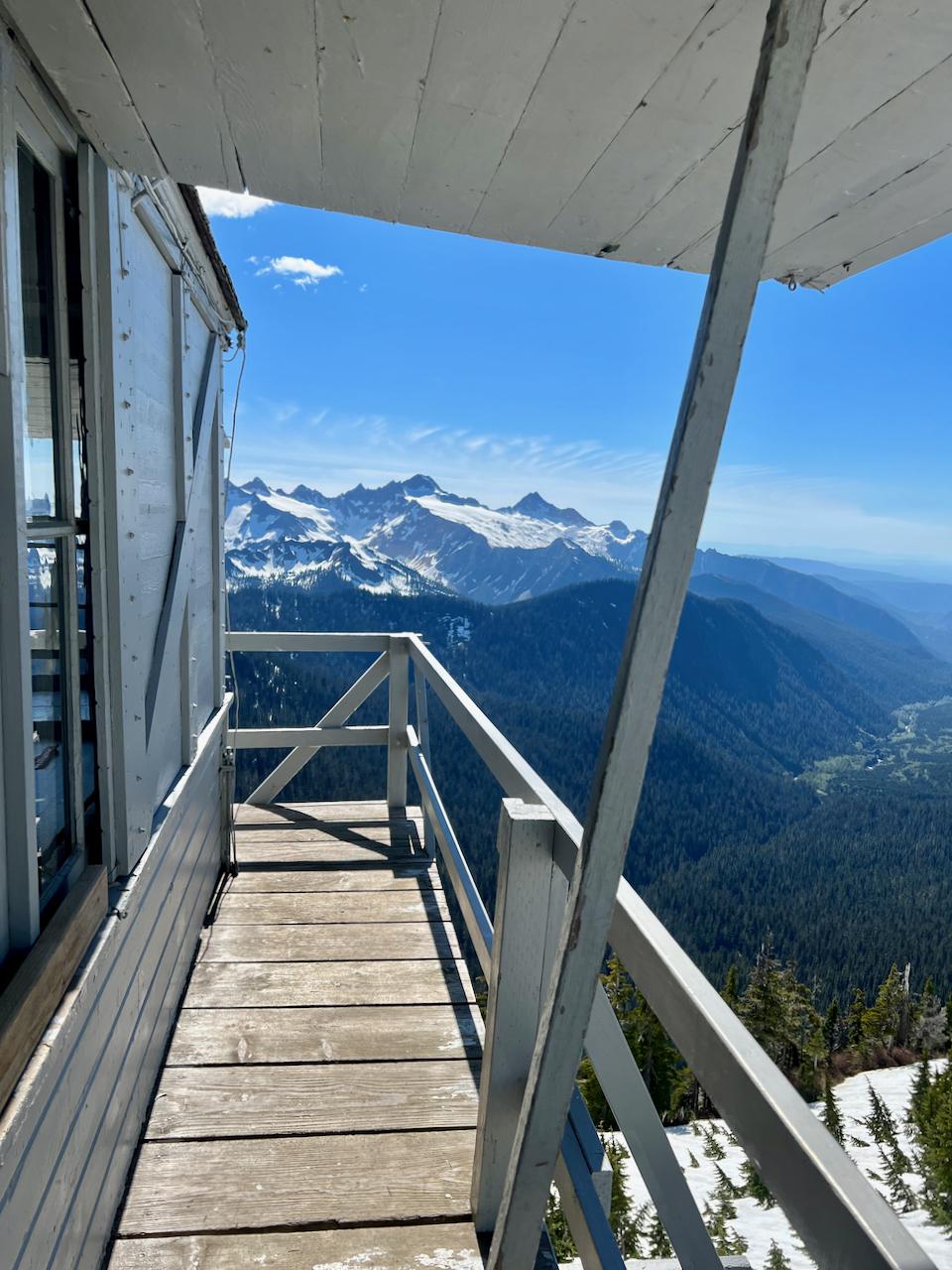
The storm covers turn out to be extremely heavy to lift and prop up, so I just open up a few before stopping to make tea and lunch. There’s no running streams this high up, so I have to make do with snow. After a nap, I finish opening up the window storm covers. I spend the rest of the afternoon reading out on the deck or inside the lookout. No one else shows up.
In a corner of the lookout, there’s an odd little stool with glass feet. The stool is labeled, “Lightning Stool”. Instructions explain that, in the event of a lightning storm, one can stand on the stool to be insulated from lightning strikes. One can only imagine the interesting discussions that result when a lightning storm comes up and the cabin is occupied by multiple people.
After I’ve finished dinner, I’m surprised when five guys show up late. Four are coming from Hope, BC: two are Canadians, one is from France, and the fourth from Ireland. They’re joined by a man from Seattle who couldn’t find the lookout and had just turned back when he’d met the other four. The four Canadians have large packs and are not traveling light: each of them pulls out 4–5 cans of beer and a heavy bottle of water.
I invite them all to stay inside the lookout, but only the Seattle guy does. Three of the Canadians sleep outside on deck, and one sets up his tent a short distance away. They’re still talking when I fall asleep.
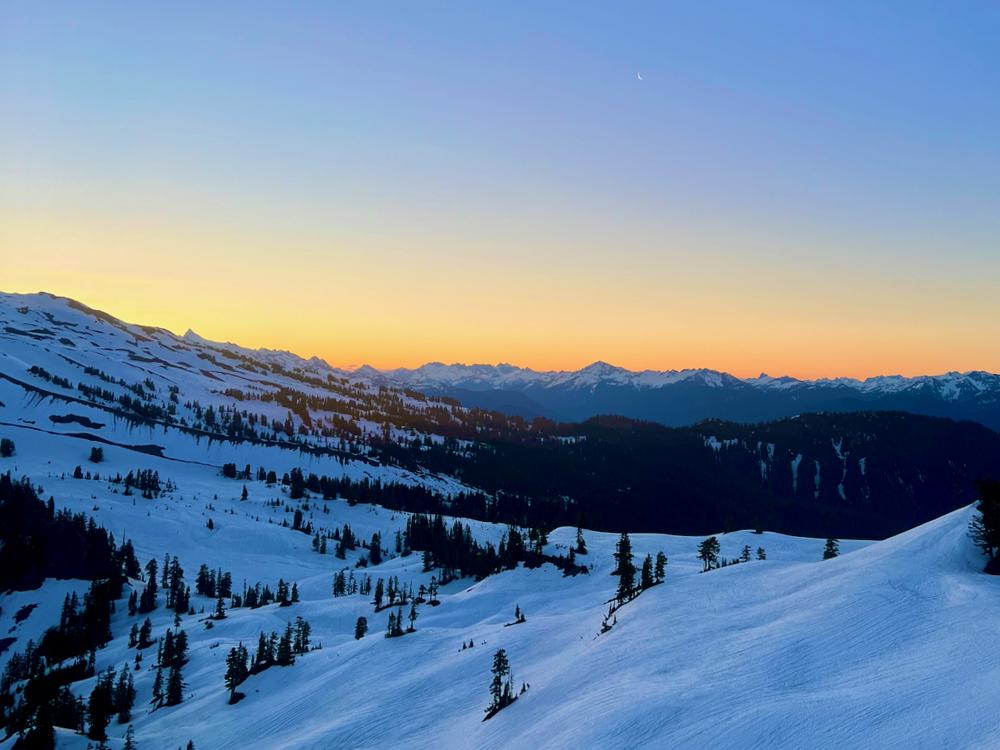
Jan’s PNT hike, Day Three. Everyone wakes up on the early side. We eat breakfast, then close up the fire lookout. I walk with the 5 other men down to a pass. From that point, they head east back to the trailhead, while I head west.
I’m expecting today to be difficult, and it is. The descent from the pass is steep, and it takes a long time to pick my way down a large snowfield. I reach a flat area called Mazama Park, which will probably be covered in wildflowers in a few weeks, but for now is still deep in snow. I take a short break at a wooden shelter there before continuing.
From this point, the trail traverses the side of a very long ridge pointing south towards Bell Pass. The trail isn’t visible, so it’s challenging to stay on the right route, which alternates between snowfields and trees. Very occasionally I’ll spot the sawed-off end of a log ahead, which makes me happy — someone had cut that log to clear the trail, so the trail must go past that point. At those points, I will sometimes see old bootprints, but then immediately lose them again.
The snowfields take time to cross carefully. Even taking my time, I slip at one point. It’s a mercifully short bit of snow, so I only slide a short distance down to some bushes. I’m glad it wasn’t a longer slide.
Around 9:00 am, I am about halfway to Bell Pass when I hear the sound of rushing water ahead. I come around a bend expecting to see a creek I will have to ford. Instead, what I see is much worse.
There’s a narrow ravine, maybe 6–8 feet deep, with steep sides. A swollen creek rushes through the ravine. Above the trail there’s a large waterfall. Below the trail there’s another large waterfall. At the point where the trail crosses the creek there’s… a thin bridge of snow over the rushing water.
This is a bad problem. I can’t trust the snow bridge to hold my weight, and it would be bad to fall into the creek. Beyond the immediate danger of being swept over the waterfall, the ravine itself is tall enough that I probably couldn’t climb out. The only place where one would normally be able to get down to the water and back up is exactly where the snow bridge is, and it’s currently difficult or impossible to climb up there.
I can’t see any safe way to cross the creek at this point, and it only gets bigger down below. So I’m forced to turn uphill and begin picking my way up the steep slope between trees and snowbanks.
After half an hour or so, I finally reach the mountain basin that serves as the headwaters of the creek. I make a circuit around the edge of the basin to eventually reach the other side of the creek. Sadly, the slope on this side of the creek is even steeper, and would be quite difficult to descend. I’m forced to climb further uphill to get out of the basin. I eventually reach the top. From there I can descend the long ridge towards Bell Pass. The ridge is steep but safe enough to go down.
Following the ridgeline, I eventually reach a point where I can get back down to the level of the trail. I’m elated when I finally see another sawn log end that lets me know I’m back on the trail. The detour around the creek took about 1½ hours, and was quite tiring. I’m glad at least that it’s a sunny day, and I was dealing with this setback in the middle of the morning instead of the end of the day.
I finally make it to Bell Pass and the snow line. It’s great to put away my microspikes and be back on a dirt trail. From that point, the trail makes a series of switchbacks and crosses over several creeks. These creeks would be easy to cross in mid-summer, but they’re currently full of snowmelt. The first crossing isn’t too bad, but the second is too fast to ford safely. I have to traverse it on a log covered with fragile branches. The branches are long enough to be in the way, but also fragile enough that I can’t hold onto them for support. I’m relieved that the third crossing is close enough to an old horse camp that it has a real bridge.
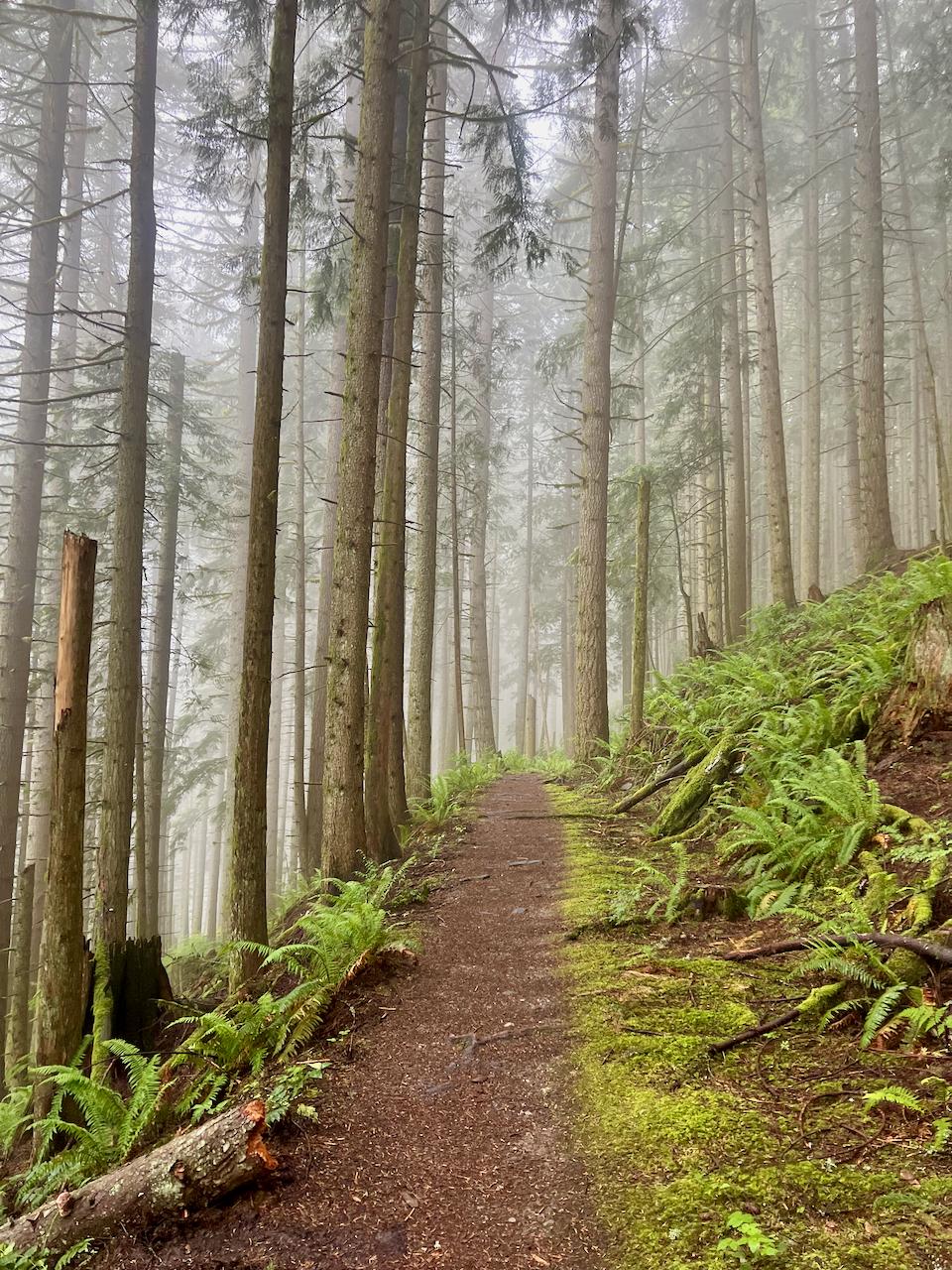
When I reach Pioneer Horse Camp, I take a short rest. Although I’m past the snow now, the next part of the trail won’t be easy either. The road to the campground has been buried in landslides in two places, so trail crews can’t easily reach this valley to do trail work. As a result, the next 8 miles or so of trail are in bad shape. The trail is faint, twisty, and would be hard to follow even without the trees that have fallen across it. There’s one of these fallen trees about every five minutes. Each tree takes a while to climb over or around. On the other side, there’s often no indication of where the trail is, so it usually takes several minutes of searching or backtracking to pick up the trail again.
A typical example:
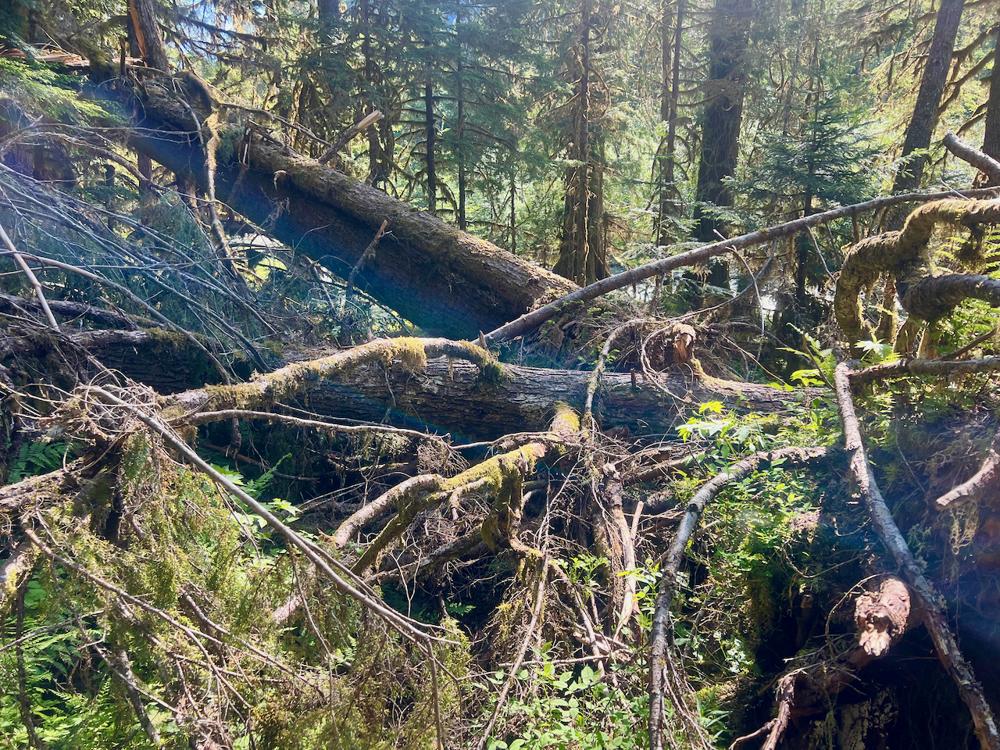
The bad trail eventually reaches a decommissioned logging road that’s choked in many places with alder bushes. At least the old road has the advantage of being straight, and so easy to follow (if not to walk on).
I finally reach a clear, active logging road. I stop to have dinner at that point and rest for a bit. I normally don’t hike after dinner, but today I’ve got more miles to do. I hike for another couple of hours climbing up through timber forests towards a ridge. This is all private property, so in theory I should get past this area before camping. But when I reach an abandoned logging road — there’s grass growing along it — I decide to camp there for the night. Today I walked for over 12 hours, none of which were easy.
Jan’s PNT hike, Day Four. The morning’s hiking starts with a short bit of trail, followed by the rest of the morning on logging roads. Logging roads are boring: they’re built to address the needs of logging trucks, not people. They don’t go to pretty views or pretty places. They’re made to collect logs, not to go somewhere efficiently, so getting anywhere often involves navigating a maze of roads going different directions. They’re meant to be traveled inside trucks, so they often go up or down more steeply than a hiker would want.
And timber forests are qualitatively not the same as natural forests. It’s the same difference between walking through a meadow and walking through a cornfield. In both cases you’re surrounded by plants, but it’s hard to call the cornfield “nature”. It’s the same plant for miles. Timber forests are the same. You spend hours walking past the same tree.
In the middle of the day, I break away from the Pacific Northwest Trail’s main route, and follow an alternate route down into the small town of Lyman. I’ve got a reservation in Lyman at an AirBnB yurt. I have lunch at the one restaurant in town. The owner of the yurt, Taylor, has volunteered to pick me up there, which is nice because it saves me another few miles of walking.
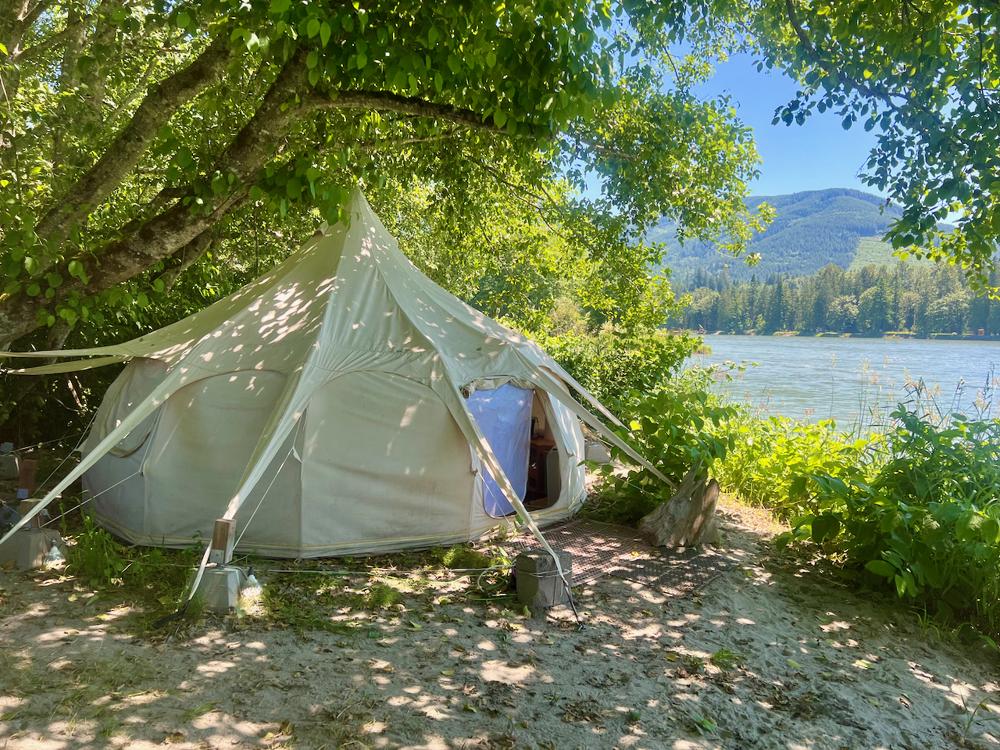
Taylor drives me out to the yurt, which sits on the banks of the broad and fast-flowing Skagit River. The yurt’s part of a collection of private camping spots that share a bathroom, which happily has both a hot shower and a clothes washing machine.
I spend the rest of the day by the river. It’s hot today (over 90°), but quite pleasant in the shade. Tomorrow is supposed to be hot again, so I decide I’ll stay on this alternate PNT route and walk to the town of Sedro-Wooley. I make a reservation at the one hotel there. The following day calls for yet more logging roads over steep hills, and I decide to skip that part as well. I book a tiny log cabin for rent just off the official PNT route near the small town of Alger.
Jan’s PNT hike, Day Five. Taylor is nice and gives me a ride back to where he picked me up to save me some roadside walking. I get a coffee from a drive-thru espresso shack, then walk to the Cascade Trail, a rail trail that runs down the Skagit River valley to Sedro-Wooley. This is a much more pleasant trail to walk on a hot day; in many places, the trail is shaded by a canopy of maple trees.
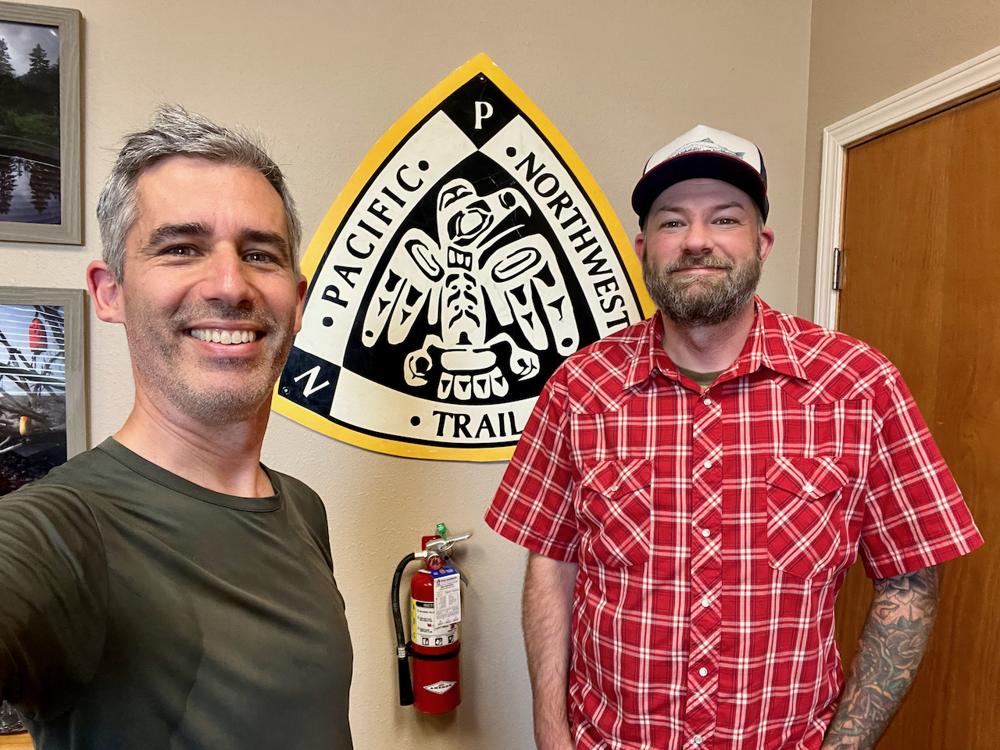
The Cascade Trail ends in Sedro-Wooley about a block from the PNT Association office, so I stop back there to see if anyone’s in. The head of the PNT Association, Jeff Kish, answers the door. The office is used to PNT hikers stopping by to say hi, so he invites me in and we chat for a bit.
Since this PNT “hike” has now turned into a town-to-town walk, I stop by the post office. I ship all my camping gear — tent, sleeping bag, air mattress, stove — back home. I keep my backpack, clothes, food, and miscellaneous gear with me.
I walk over the town’s one motel, the Three Rivers Inn. It’s not much to look at, but it’ll do. I’m looking forward to a dip in the hotel’s pool. Sadly, the pool’s closed.
I’m now in an area that’s heavily dependent on cars. A short walk in the mid-afternoon to get soft-serve ice cream from Dairy Queen requires sprinting across a wide, busy road. It might be less dangerous than crossing a creek in spring flood — but not by much.
Dinner is at the so-so Mexican restaurant across the parking lot.
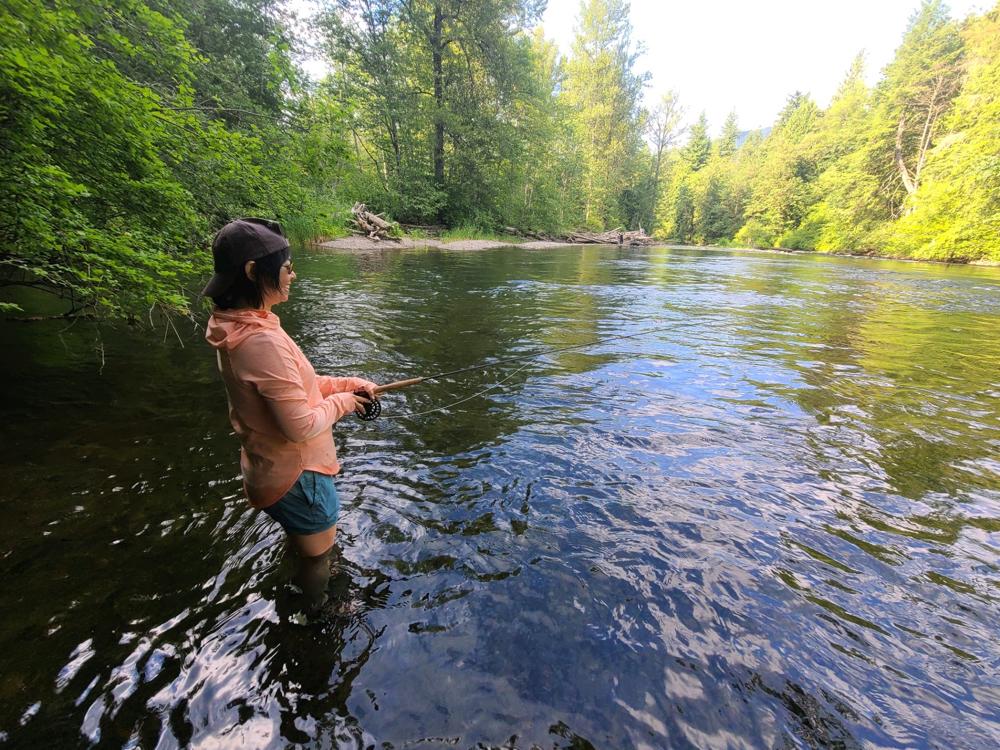
Meanwhile, Angela’s friend James takes her fly fishing on the Green River in Kanaskat-Palmer State Park.
Jan’s PNT hike, Day Six. I have to sprint across Highway 20 to get breakfast and pick up a sandwich for lunch, then begin walking northwest out of town. As soon as I get off the main highway, the road’s a lot quieter and safer. I walk all morning on country roads towards the town of Alger.
At one point, I look behind me and see — far back — a jogger coming my direction but barely moving faster than my walking pace. This jogger slowly gets closer and closer over the course of an hour. I usually eat my hiking snacks as I walk, but in this case I make an exception and sit down to snack so the jogger can finally pass me. It’s an old man huffing and puffing. As he passes, he smiles and says, “Oh, you can’t rest until you get to the bridge!” A short while later, he’s coming back the other way. A few minutes after that, I cross the bridge he’d mentioned. It spans the quiet Samish River. The river must be pretty windy, as I cross over the Samish at least two more times.
I finally reach the area of Cain Lake where my rental log cabin sits in a corner of the woods. In country areas like this, one constant pain are dogs that come racing across lawns to bark at me. Most of the time they’re fenced in — but not always. So when I hear loud barking start up ahead of me, it’s always a little unnerving.
I’m almost to the log cabin when I hear two dark dogs barking and running. There’s a fence between me and them. The dogs bark as they run alongside the fence to follow me. The fence eventually disappears into some bushes. It’s not clear whether the fence actually continues into the bushes to form a complete barrier, so I’m waiting to see if the dogs can escape. Apparently not; they keep barking but eventually fall behind. (The owner of the log cabin refers to these two dogs as “the hellhounds.”)
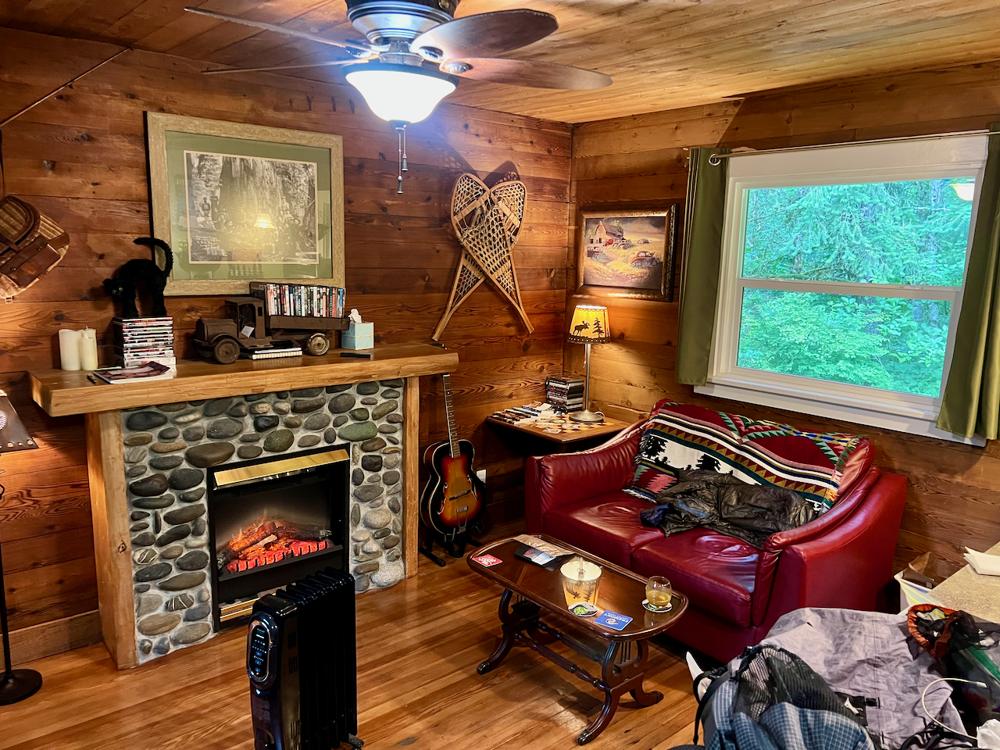
The cabin is snug and cozy. Today’s much cooler than yesterday, so I’m happy to get inside — even more so when it begins to rain in the middle of the afternoon.
Jan’s PNT hike, Day Seven. In the morning, the cabin’s owner, Delaney, gives me a ride back to the main road where I can pick up the PNT. I climb over a thin but steep, fin-shaped mountain called Alger Alp, then descend to Lake Squires. I walk on a road that eventually passes beneath the Interstate 5 highway. From there the road climbs up to logging roads providing access to Oyster Dome, the last big hill I’ll need to cross on this trip.
Trail conditions on the eastern side of Oyster Dome aren’t great, but on this trip I’ve faced far worse. I’m just happy it’s not raining.
I eventually reach the small lakes at the top of Oyster Dome. I’m looking forward to meeting Angela at the trailhead at the bottom of the hill. There’s a trail map at the top of the hill, and I’m puzzled by the distance it says I have to go. According to the information I’m carrying, I only have about 2.5 miles to go, but the map says it’s over 4.5 miles to the trailhead. The map is right, so now I’m late. I end up running the final two miles to the trailhead where Angela’s waiting for me.
We stop for a tasty lunch at Slough Food in the cute, ramshackle town of Edison. We pick up some baked goods at the Breadfarm Bakery next door, then head home.
Jan’s mom, Lyn, has brain surgery to address two aneurysms. These need to be “clipped” to prevent the possibility of their bursting and causing a catastrophic stroke. There’s now a comparatively easy endovascular procedure to do this through a blood vessel, but an angiogram indicates that the topology of the vessels in her brain won’t allow for that. Instead, surgeons will have to go in the old fashioned way through her skull.
It’s a major operation that lasts something like 7 hours from start to finish, of which she’s unconscious for about 5 hours. The neurosurgeons say that the operation went very well. After spending some time in a recovery room, she’s moved to the neuro ICU, where Jan is finally able to visit her. The Swedish Hospital covid policy is that each patient can only have a single designated visitor, so Jan will be the only one who can visit her during her stay. It’s expected that she’ll stay in the hospital for another 4 days or so.