Liya has finished her senior classes at Yale but has over a week before graduation. Most seniors take the chance to go on a fun vacation somewhere — Liya and her friends go to Aruba for a week in the sun.
We go to the East Coast for Liya’s graduation from Yale. It feels like her four years there have flown by!
Our flight takes us to Boston, and from there we drive down to New Haven. We pass by many opportunities for what would probably be a mediocre dinner in hopes of finding someplace interesting, and our patience is rewarded with a good dinner at the Cedar Street Grill in Sturbridge, MA.
Bree still has classes so can’t join us during the day, but in the evening we pick up Liya and then make the short drive to Wallingford. We pick up Bree and have a nice (if loud) dinner in downtown Wallingford at The Library.
After dinner, Bree brings us over to the Arts Center so she can take a moment to help Liya construct a silly hat, a traditional element of Yale’s upcoming Class Day event. Liya’s brought a crocheted octopus with her. Bree uses materials from the costuming studio to attach the octopus to a headband. Instead of positioning the octopus directly on top of the headband, Bree sets the octopus at a jaunty angle.
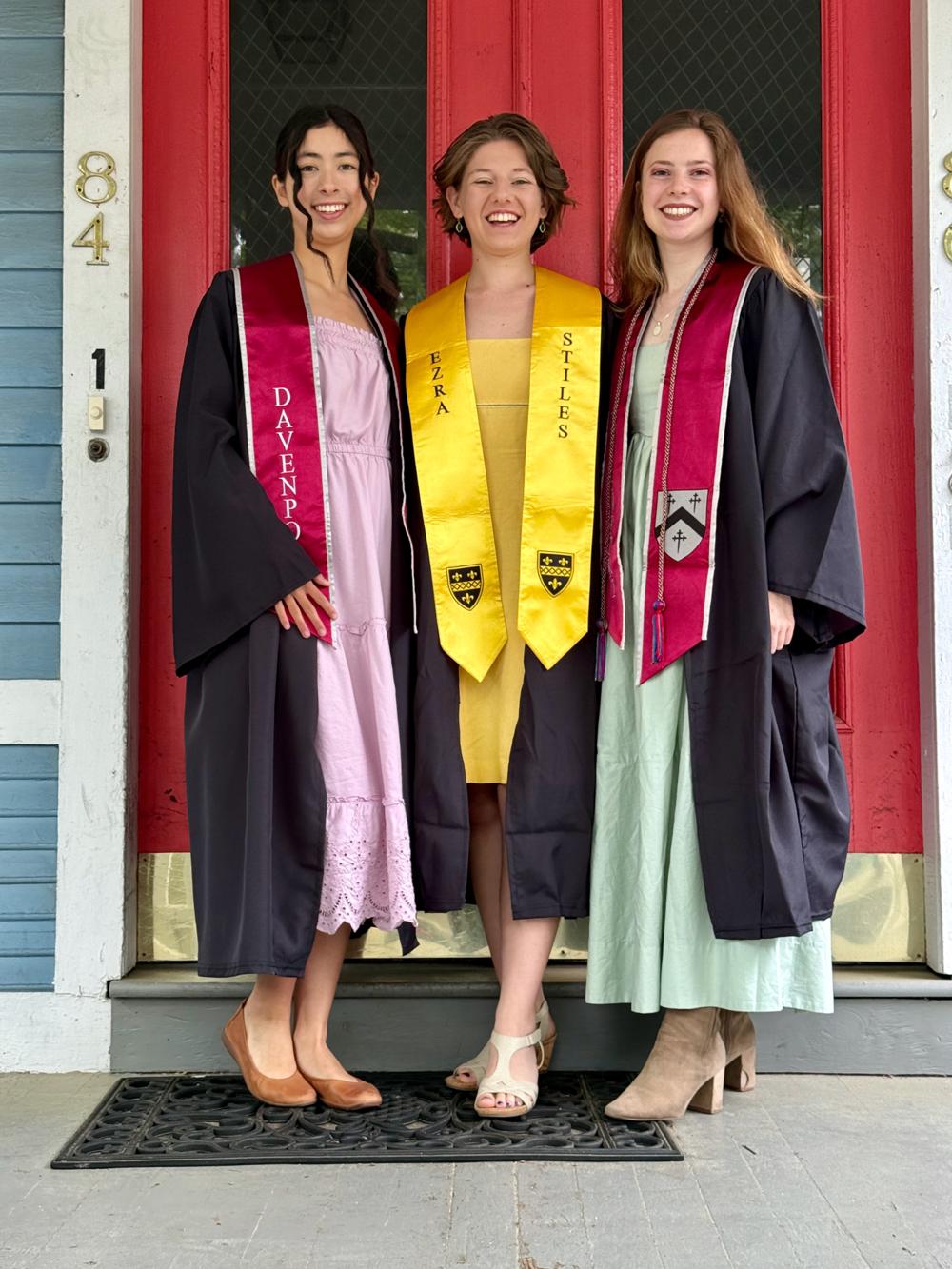
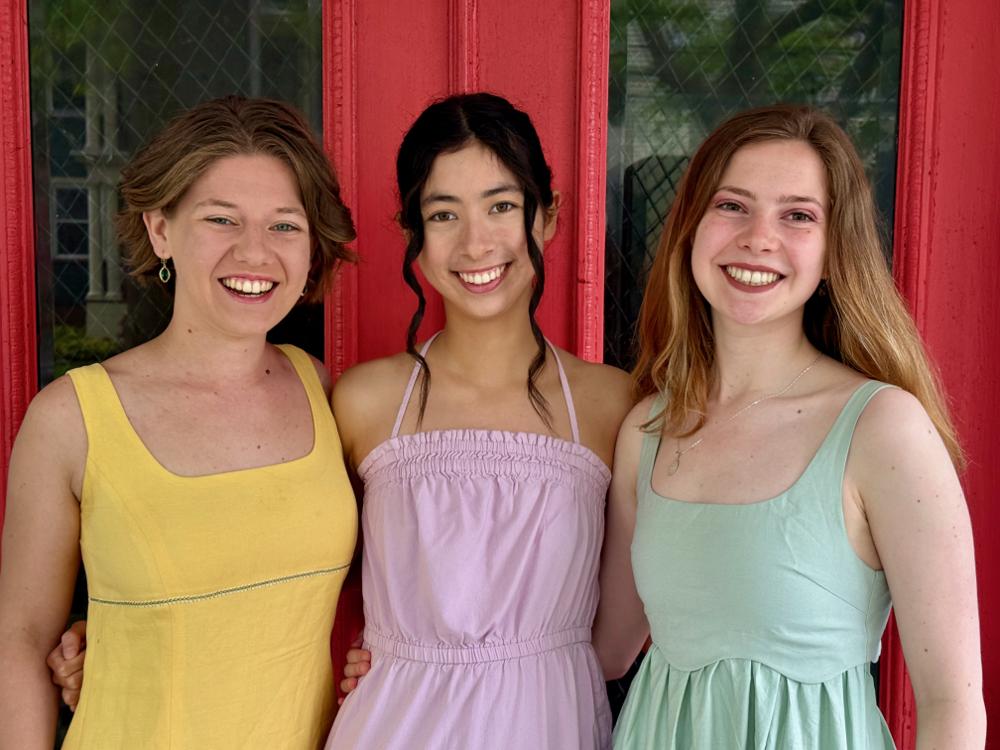
We meet Liya and her apartment mates in the morning so we can take some photos of them in their graduation regalia.
We collect Bree in the afternoon, then Liya takes the three of us to Dwight Hall chapel. Liya’s apartment mate, Jordan, is part of the Yale Slavic Chorus, and the group is giving their final a cappella concert of the year. Liya’s friend Simone is also in the group, along with a number of her other school friends, including a friend Liya made on a student camping trip at the very beginning of her time at Yale.
We have dinner at the Saltbrick Steakhouse in nearby Branford, which we’re all happy with. After dinner we return to Liya’s house for a party hosted by Liya’s friends who live in the apartment downstairs. It’s fun to talk with her friends including Caleb, Kaitlyn, Jordan, Sadie, and Simone.
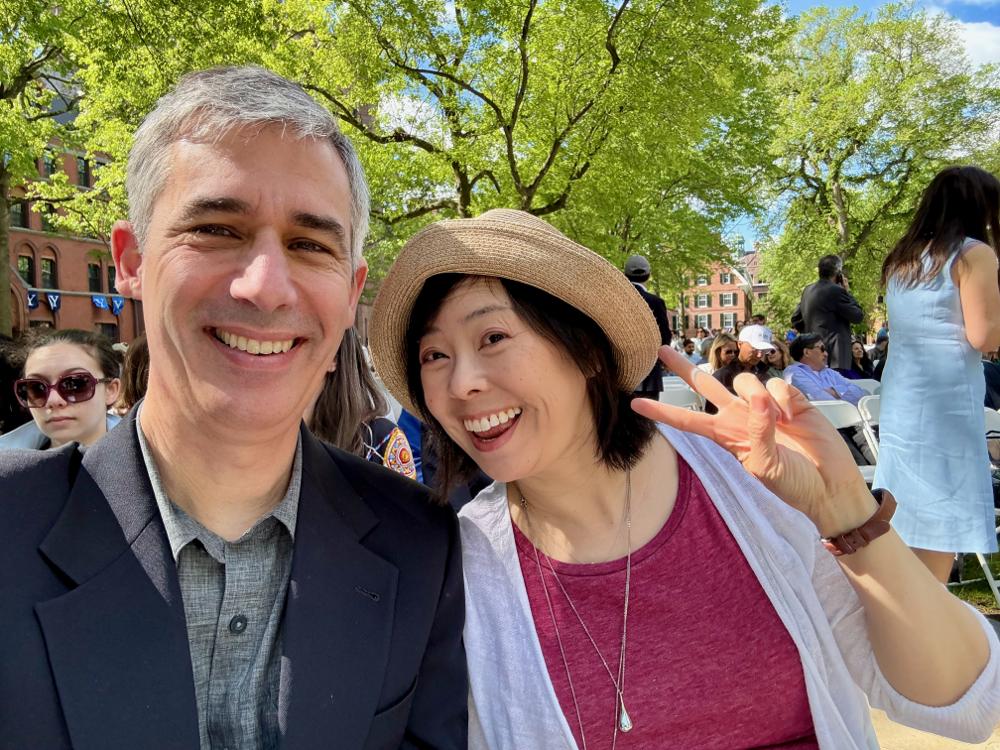
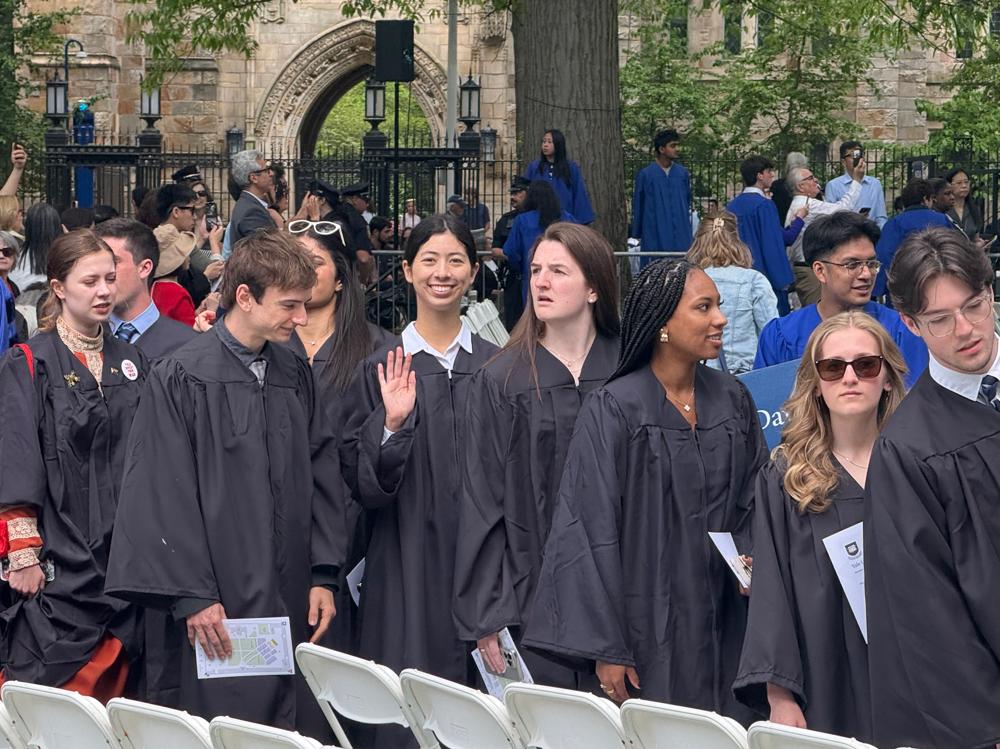
We’re up early to the first of the official graduation events, the Baccalaureate service held on Yale’s Old Campus. The quadrangle is packed with thousands of chairs, so while there’s seating for everyone, we arrive early so we can get a seat somewhere where we can actually see things. We manage to catch sight of Liya as the members of Davenport, her residence college, file into the quad.
After the service Liya manages to get a lunch table for the three of us at Choupette Crepêrie. We walk with Liya back to her apartment and hang out for a bit. Angela helps Jordan finish her silly hat for the Class Day ceremony; Jordan has also selected an octopus as the basis for her hat.
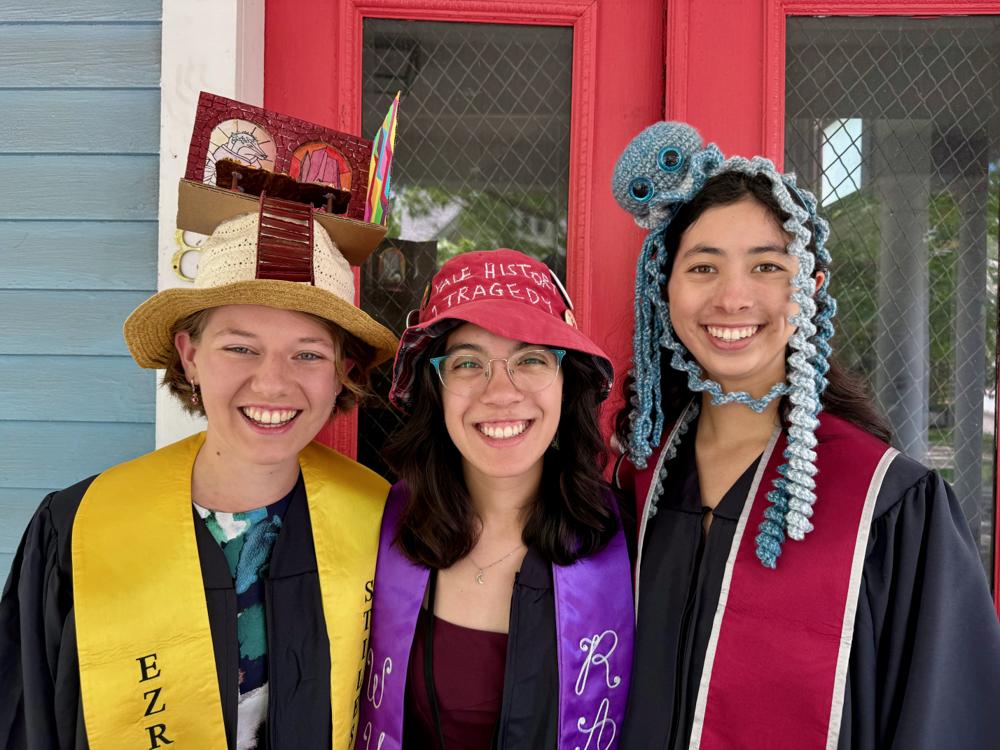
We find seats again in the Old Campus quad and watch the graduating seniors process in again, this time in very silly hats. One student has an elaborate reproduction of a Calder mobile that sits on Yale’s campus; another has a very tall reproduction of Yale’s Harkness Tower. We enjoy the speech by the Class Day guest speaker, Jacinda Arden, former prime minister of New Zealand.
Bree’s been working all day at the theater as part of tech rehearsal for this weeks’ upcoming performance of the musical “Disaster!” We go and collect her, then Liya, for a French dinner at Atelier Florian. Bree and Jan are very satisfied with the duck confit.
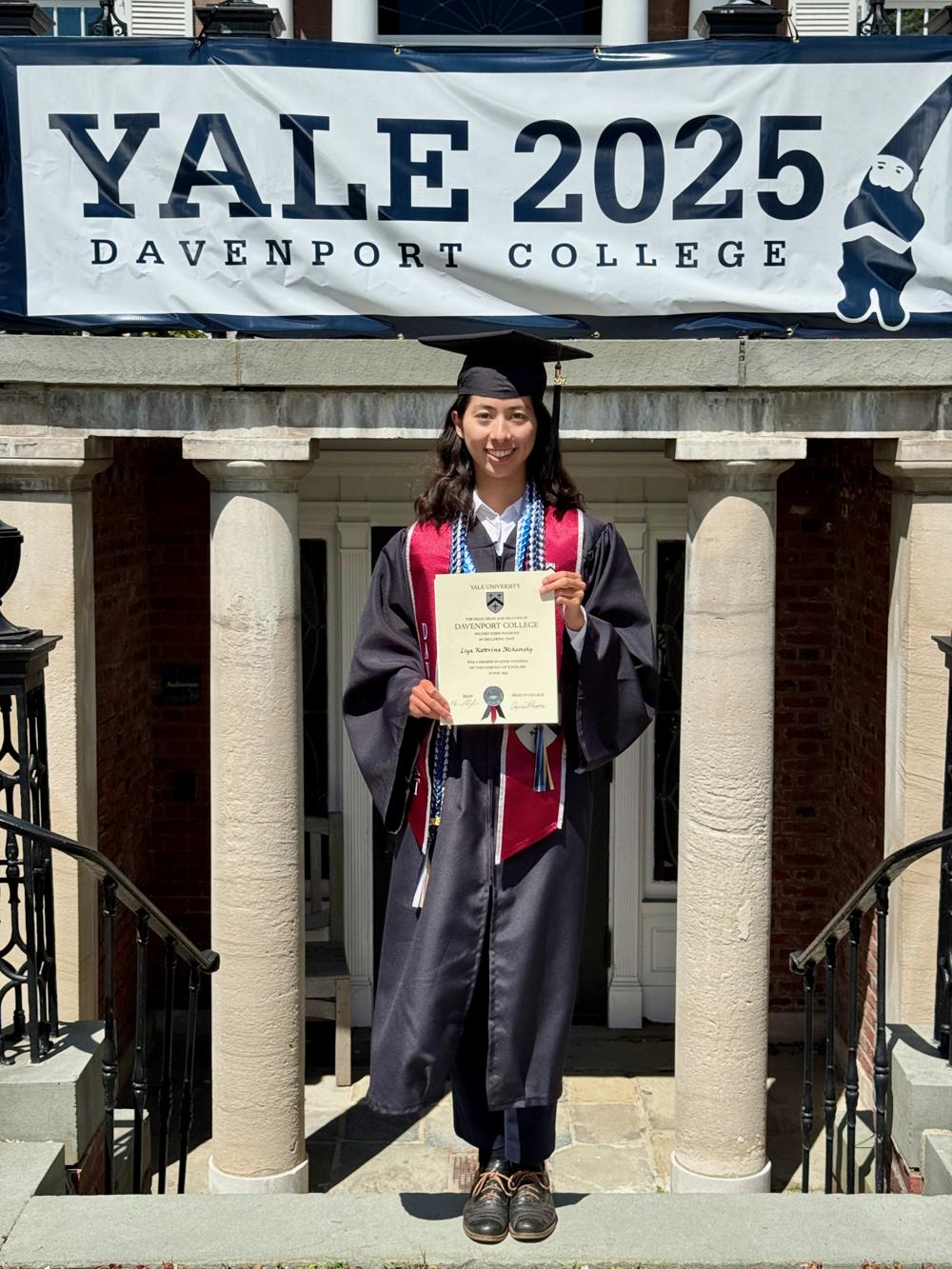
Liya graduates! We’re up early again to claim seats for the main Commencement event on the Old Campus. It’s a gorgeous sunny morning, a little cool and breezy but beautiful.
We end up sitting next to a nice couple from Eindhoven in The Netherlands. Their son is completing his MBA from a joint program in Paris and at Yale. He lives in a house of other European students who, at the beginning of the year, were all planning to work in the U.S. Every one of them have now changed their plans to work in Europe.
We manage to wave to Liya again as the long line of undergraduate and graduate students process into the quad through the Phelps Gate. The ceremony itself if a long sequence of official degree conferrals and honorary degree recipients, but it’s nice to sit outside in the shade of all the oak trees.
Liya is younger than Evan by nearly two years, but they were just a grade apart in school. Evan took a gap year between high school and college, so they’re both graduating this year. But because Yale’s school year ends before Stanford’s, Liya turns out to be the first of our children to graduate from college.
The Commencement ceremony is immediately followed by the fourth and final graduation ceremony at Davenport College. At this one, individual seniors from the college are called up by name to receive their diploma. We’re thrilled to see Liya receive her degree: a Bachelor of Science in Ecology and Evolutionary Biology, magna cum laude.
There’s a reception lunch in the Davenport dining hall. It’s not bad for dining hall food; Liya observes that on any given day the normal food wouldn’t have been quite as good but would have included more choices. This is Liya’s last day as a Davenport student; before leaving, she observes that she probably won’t be back in this dining hall again for a very long time.
Meanwhile, back at home, Evrim is concerned that Mojo is sick. Our local vet’s office is closed today, so Jan suggests waiting until tomorrow to take Mojo in. But Mojo’s condition is worse in the evening. Evrim observes that his paws are cold and his gums are pale, both signs of bad circulation.
She speaks with a local animal hospital who says Mojo needs to be seen right away — but they’re currently short-staffed and overwhelmed. Jan finds another animal hospital that confirms Mojo should be seen immediately, and they can see him now.
Evrim brings Mojo to the hospital. He’s quite dehydrated, so they inject some fluid under his skin. They also administer an appetite stimulant to encourage him to eat and an anti-emetic to help keep down food. They perform blood tests and an x-ray but can’t find any obvious cause of his illness. Since Mojo’s condition has stabilized, they discharge him and send Evrim home with some medications for him.
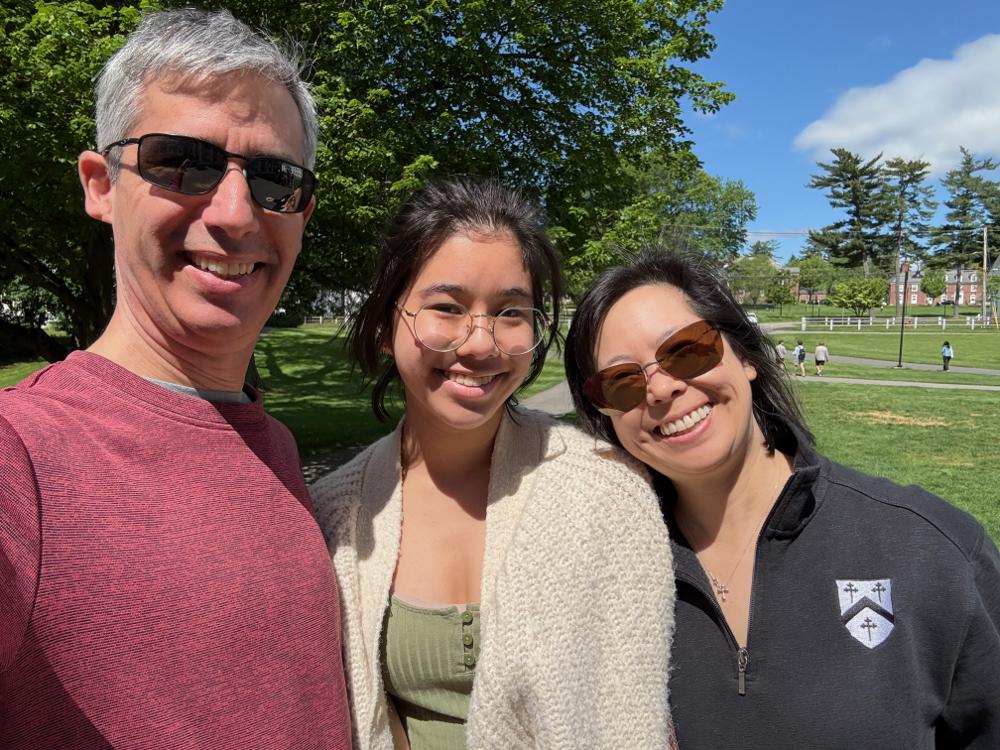
On our way out of New Haven, we stop to see Liya one last time and go on a short walk to a bakery. She’ll stay in New Haven for another week to spend some time with friends, and pack up her things. To reduce the amount of things she must ship or carry back herself, we take two large duffel bags from her as well as her cello.
After saying goodbye to Liya, we head north and make a stop in Wallingford to see Bree. She has a free period, so we have a cup of tea in her room before we need to get back on the road.
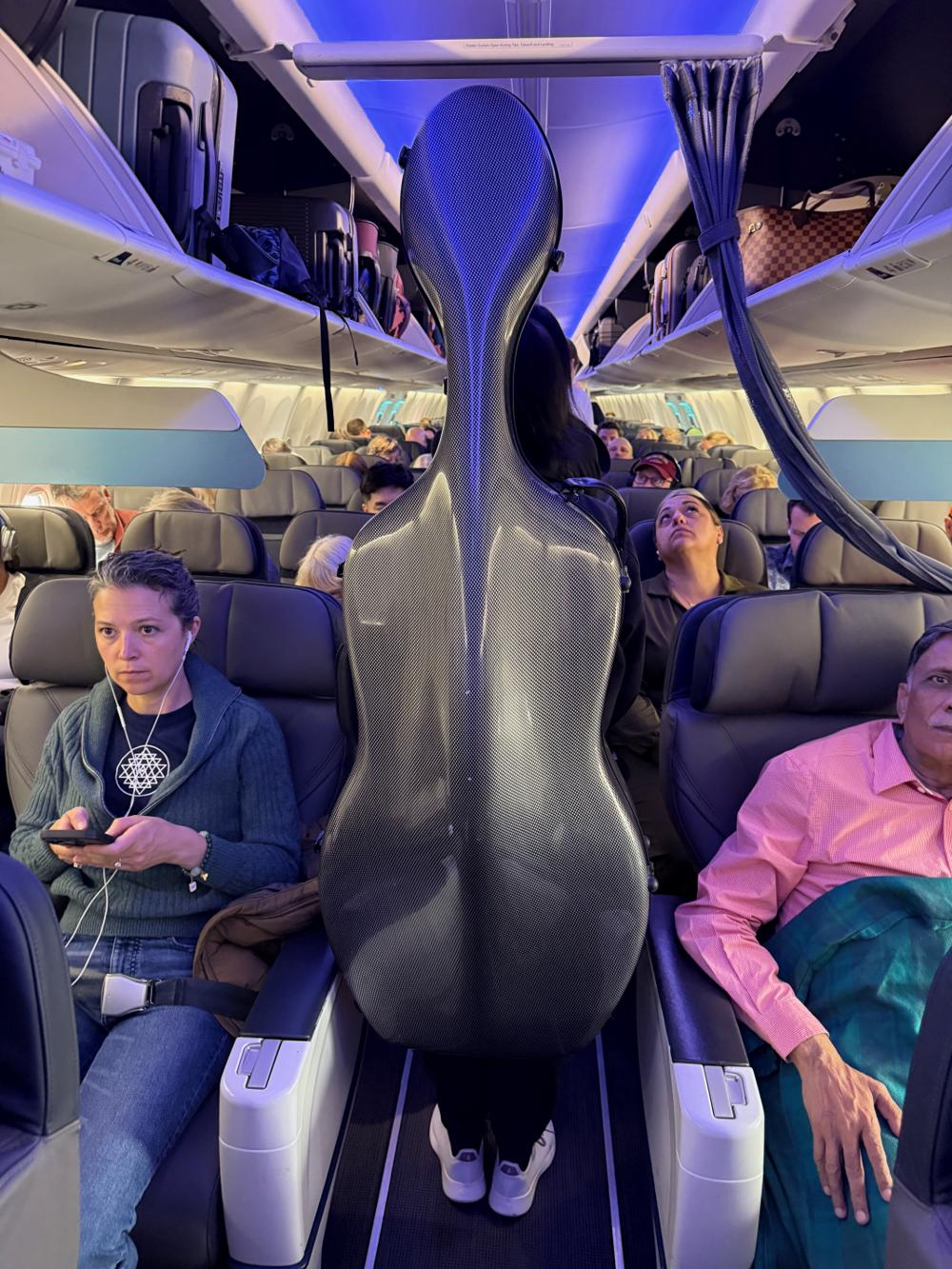
Getting through Logan Airport with Liya’s duffels and the cellos is a bit tiring — the shuttle bus dropped us off far from where we can check the duffels. The cello is light but bulky, and rather than trusting it to checked luggage, we’ve reserved a seat for it on the plane.
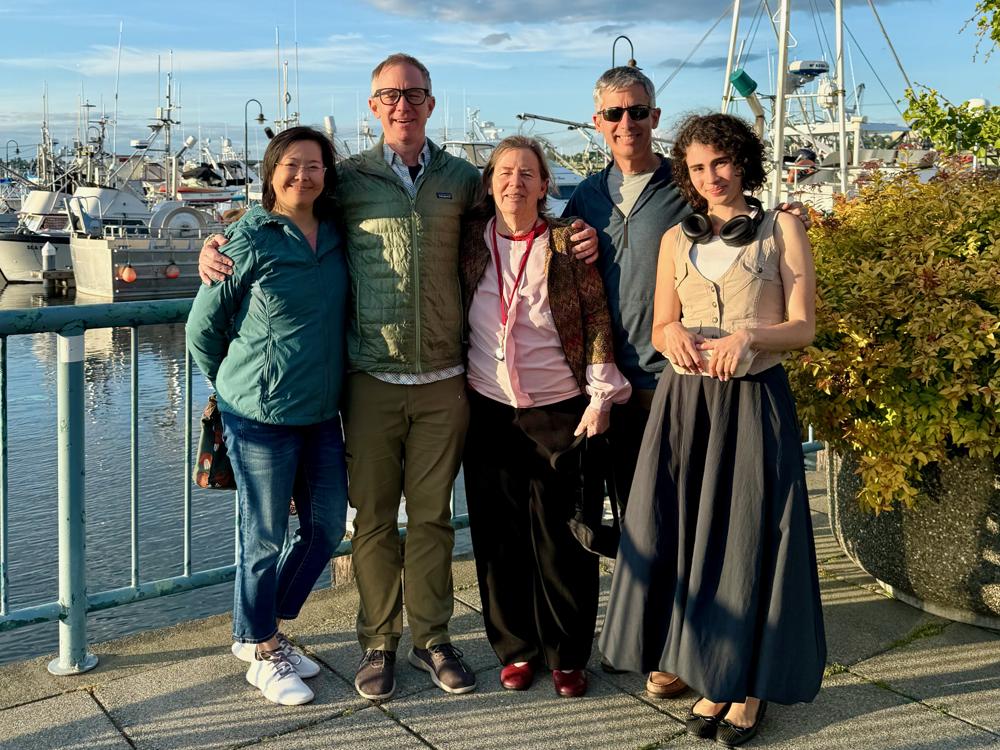
Chris arrives in Seattle, and we take him and Lyn out to dinner at Chinook’s.
A mountain bike has arrived from a rental shop in Spokane for Jan to use on the trip he and Chris will start tomorrow. Chris has brought his mountain bike from Boulder, and spends some of the evening reassembling it and getting it ready for the trip.
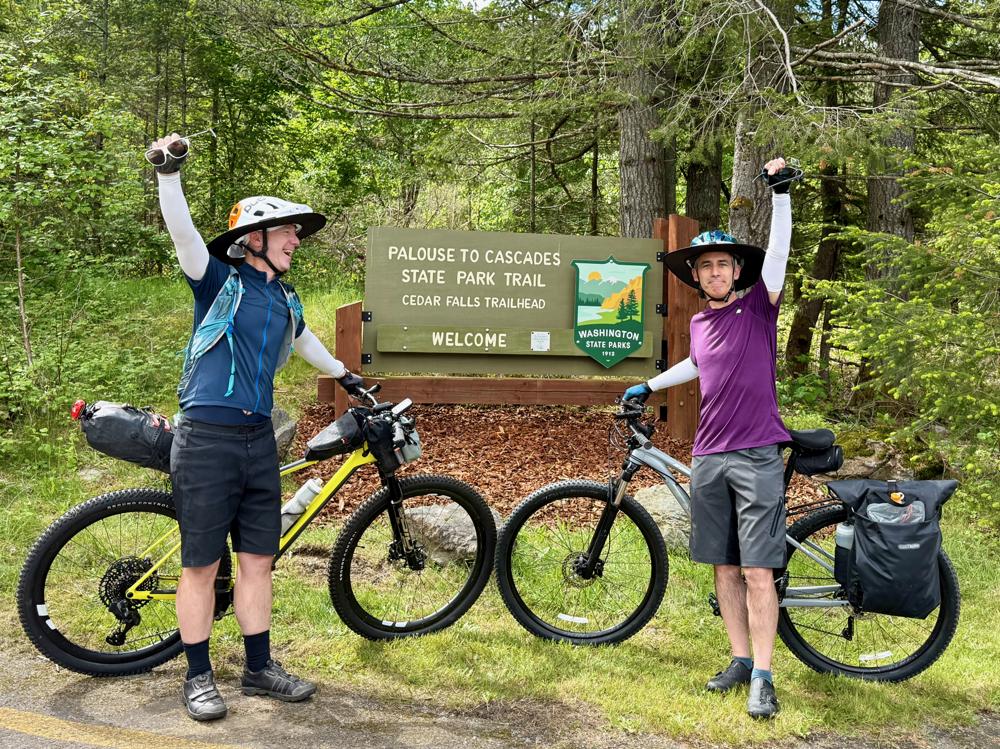
Jan’s Palouse Bike Trip, Day 1. For this year’s adventure, Chris and I are going to bike for six days from North Bend to Spokane, a distance of some 300 miles. Our plan is to mostly follow the Palouse to Cascades Trail, a rail trail that follows the course of the defunct Chicago, Milwaukee, St. Paul & Pacific Railroad (also known as The Milwaukee Road).
In the morning as we’re eating a final breakfast at home, Chris produces a surprise bit of bike gear: “Da Brim” hat brims for both of us that turn a regular bike helmet into something like a giant cowboy hat. It will provide welcome shade in very sunny Eastern Washington, at the expense of looking ridiculous. I dub the look, “Dork Sombrero”.
Before leaving the neighborhood, we buy lunch sandwiches at the bakery. Because the railroad bed is sometimes far from towns, for half of the days on this trip we’ll have to eat lunch in the middle of nowhere. Today is one of those days.
We put the bike rack on the back of Angela’s car, load up the bikes, then head up I-90 toward the Cedar Falls trailhead at Rattlesnake Lake in North Bend. About 10 minutes from the exit, I look in the rearview mirror and see Chris’ bike flopping around a bit — one of the two straps attaching his bike to the rack has come loose! I pull over and we reattach his bike.
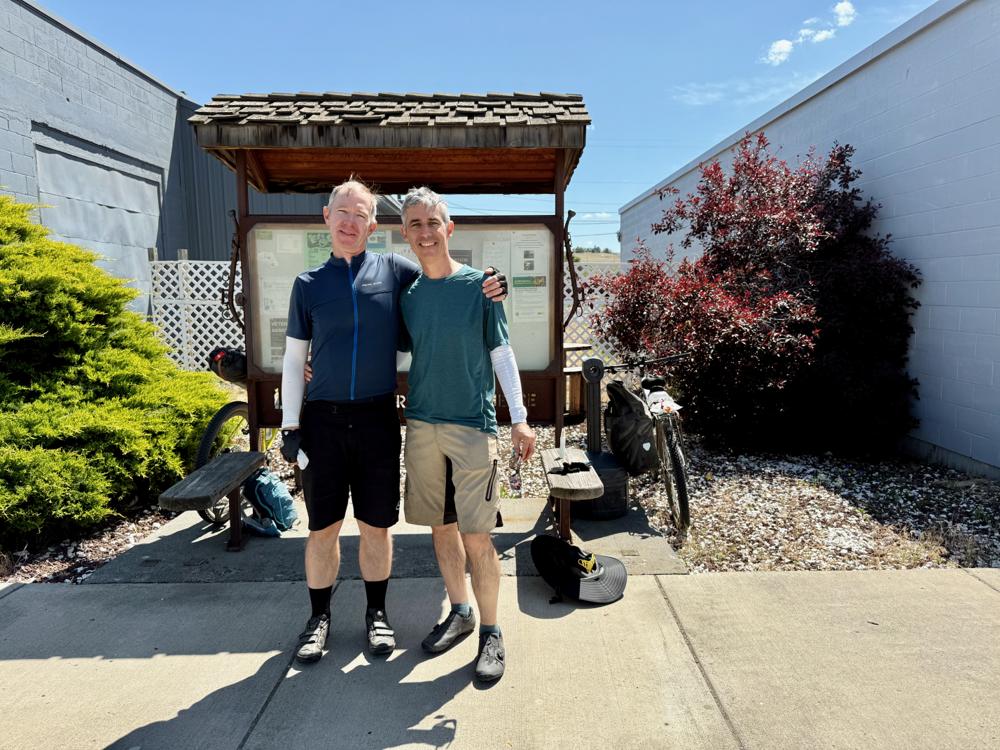
At the trailhead, we get ready to set out, then walk to the trailhead sign to get a photo. There we meet a man named Mufa, a solo cyclist just a week or so into a ride across the country. He was hit by a car on the third day, and had to take 10 days off recovering and getting a new bicycle. We wish him the best on his trip. We say goodbye to him, then say goodbye to Angela, then pedal to the start of the trail to begin heading east. It’s around 10:30.
It’s a sunny day with some clouds, in the 60s — perfect for riding. Here the railroad bed is packed dirt and gravel and easy to ride on. (This will change further east.) There are a number of other bikers and some hikers on the trail.
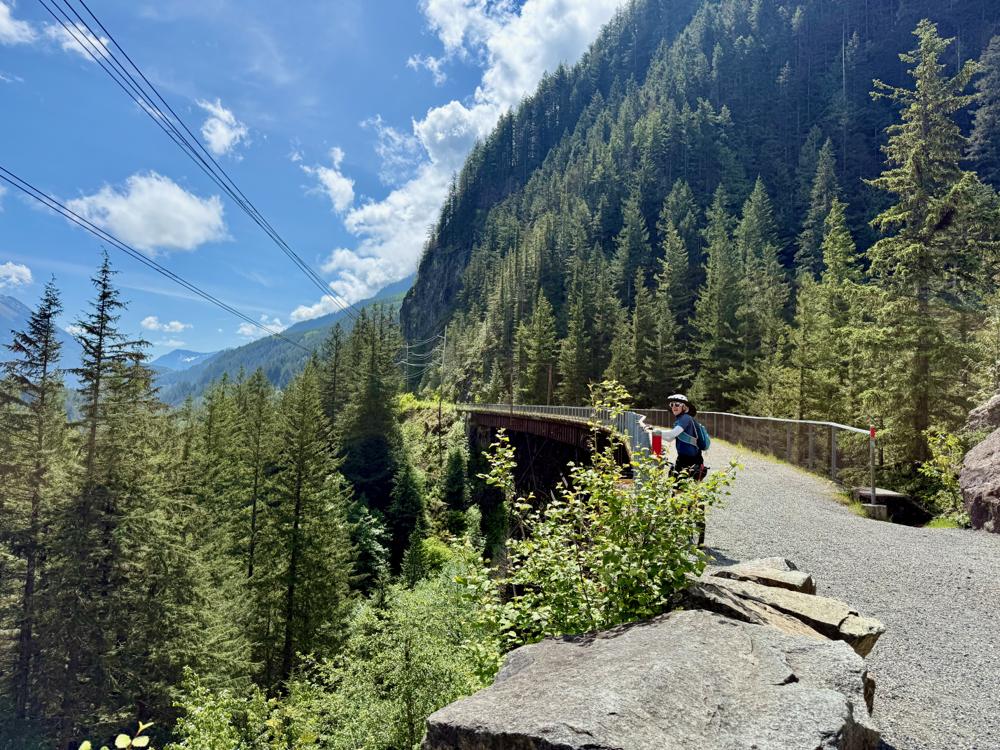
We’re heading up to Snoqualmie Pass, but the railroad grade has such a steady, shallow grade (1°, maybe?) that we don’t really notice the long climb. The railroad was cut into the side of the mountains, so there’s often rocky cliffs on one side or the other. It frequently spans rushing rivers with high trestles. If we look up the river valley, we can see a little bit of snow remaining on the mountain peaks.
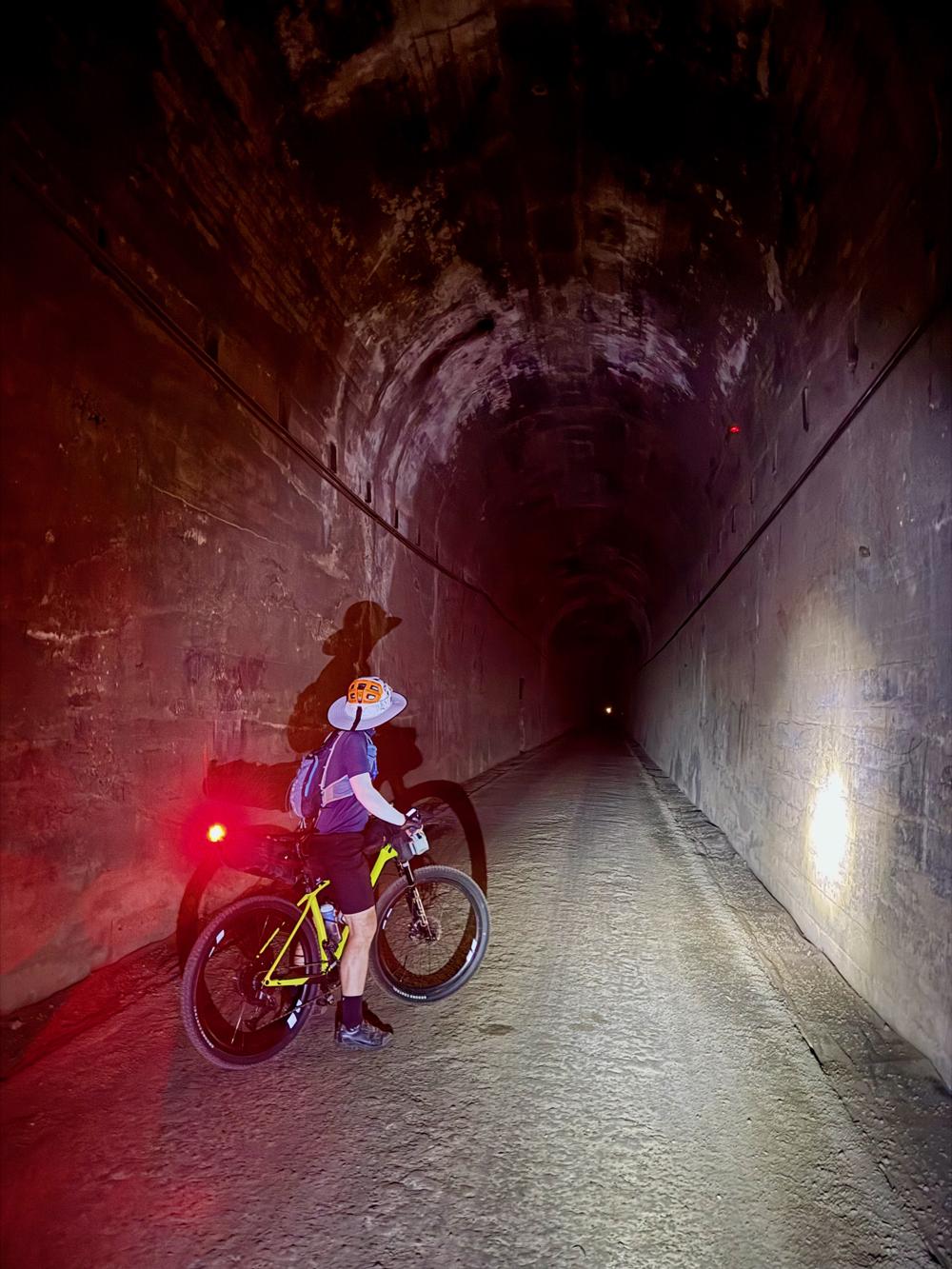
Around 1:00 pm we reach the Snoqualmie Tunnel. It’s 2.3 miles long, very tall, and completely straight; at the entrance one can barely make out the far entrance as a tiny prick of light. Inside the tunnel it’s dark, drippy, and spooky. It’s also very cold — 40℉? — and we’re freezing by the time we come out of the tunnel. We’re happy to warm up in the sun.
We have a late lunch by Cold Creek near Lake Keechelus. It’s noticeably drier on the side of the pass, and there are fewer people. We cross over the large Yakima River a few times.
At the outskirts of the town of Cle Elum, we pass a large camp of horse trailers. These are members of the John Wayne Pioneer Trail Riders Association doing their annual trail ride. We’d hoped to see them on the trail, but they’re all in camp for the night. Maybe tomorrow.
After passing the Cle Elum train depot, we leave the trail and head into the town. We climb a final hill to the Best Western where we’re staying the night.
Our dinner reservation is at The Orchard. It’s a mile away, so I’m hoping we can get an Uber or cab, but there’s no such thing in this town, so we get back on the bikes. Dinner at The Orchard is good, most likely the best meal we’ll have for the next few days. It’s cool and breezy on the ride back to the hotel.
Jan’s Palouse Bike Trip, Day 2. Chris says the hotel’s breakfast spread looks sad, so we head to Sunset Cafe in town. From there we pedal back to the Palouse to Cascades Trail and point east again.
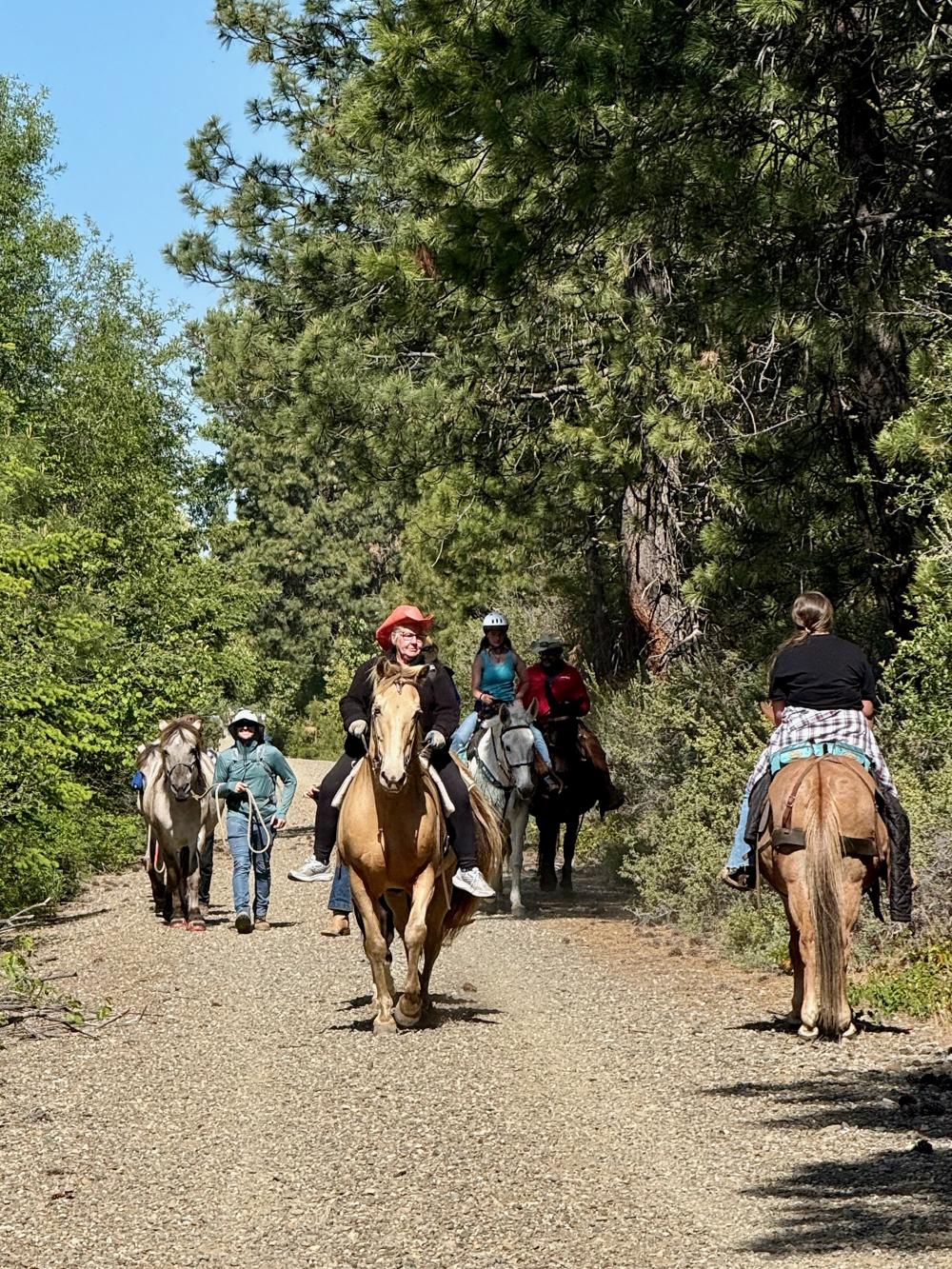
After ten minutes, we see a small group of horseback riders ahead of us on the trail. The trail group we saw yesterday evening is back on the trail this morning; their destination is the small town of Thorp.
Since horses are often scared of bikes, we slow down before we reach them and call out to let them know we’re there. They pull over and signal when it’s safe for us to pass. The horse groups are spread out, so we pass horses all morning. One man says that his horse is especially skittish around bikes, so asks us to stay still while he rides his horse back past us.
At one point we come to a tunnel that curves so that we can’t see through to the other end. As we’re in the tunnel, we hear loud booms echoing through the tunnel. We can’t tell what’s making the sound.
As we come around in view of the tunnel’s exit, we see a horse drawn wagon ahead of us leaving the tunnel. Some later explains that it’s a box wagon, which apparently is a particularly noisy kind of wagon. The horses really don’t like the tunnels, and the booms unsettle them.
The box wagon pulls over, and the two men in it ask us to wait to pass. It seems some piece of the rigging has broken. One of the men tells us there’s another wagon ahead of us, and to ask them for a piece of rope. The other man says not to be other because that wagon can’t easily turn around on the trail.
When we reach the wagons five minutes later, we explain the situation and offer to shuttle the rope back to the broken wagon. The wagon riders also give us a bag of tools to carry back. The first wagon is happy to receive the rope and tools.
We reach the town of Ellensburg and stop for lunch at the Palace Cafe. This is the last real town for a while.
In the afternoon we have a long slog across farmland. We begin a long shallow climb. The trail gets sandier, which requires more pedaling and so more effort.
We eventually reach the high Renslow Trestle over I-90. This trestle was only reopened to bike traffic a few years ago, so we’re grateful we can take it. There are no trees for miles, so we stop to rest in the shade of a railroad cut after the trestle. After this point, the trail is still going uphill and gets even sandier. In some places the bikes fishtail, and it requires real work to make any progress.
I notice that Google Map is saying we still have 29 miles to go; I’d thought we only had a little more than 20 left. Chris checks his mileage plan, and it seems he forgot to account for a long 7.5 mile deviation at the end of the day from the trail to reach the closest motel in Vantage. We pass a couple of cyclists going the other way, then no one else for hours.
We finally reach the crest of the climb at the Boylston Tunnel. A sign says the tunnel is closed, and points to a detour that requires more sandy climbing. We wonder if the tunnel is, in fact, passable. We regret having not asked the other cyclists about it. We can see some bike and horse tracks in the dirt going past the “Trail Closed” sign into the cut that leads to the tunnel, so we decide to chance it.
There are many rocks that have tumbled into the cut, and a large pile of tumbleweeds. We enter the tunnel, which is mostly clear, although there are occasional fallen rocks. At one point there’s a low pile of rocks across the trail but we can get the bikes over it. We’re very happy when we see the exit and emerge back into daylight.
The railroad cut on the other side of the tunnel is choked with bushes, but people have tramped down a narrow path through them. This is followed by a boggy area with muddy puddles and I get my feet wet. Finally we bike past the other end of the trail closure and are back on the trail proper.
Now we’re finally going downhill towards the Columbia River, so it’s easier to make progress. We still have a long way to go to the river. We look out over the rolling hills and the long ridge of the Saddle Mountains to the south, and can we see the dark shapes of railroad cuts leading far into the distance.
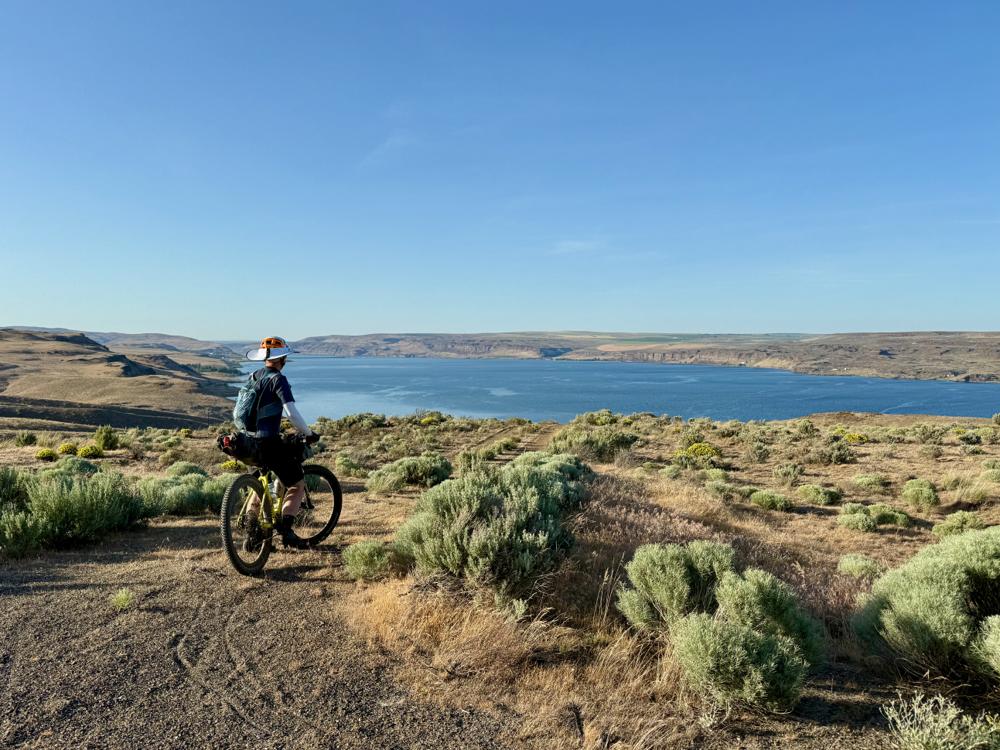
After a long time the Columbia River finally comes into view. We reach a point where abandoned road called Doris Road leads steeply to our left. This represents a shortcut that could save 3 miles off the rest of the day. But we know that at the bottom of the road is a gate and a short strip of private property. It’s unclear if we’ll be able to cross that, and it would be hellish to have to make the steep climb back up to the trail.
We decide to chance the shortcut. The gravel road hasn’t been used for many years, and there are many bushes growing in the middle of the road. There’s enough space to bike, though, and we quickly make our way down the road.
We eventually come to the expected closed gate, which is holding back a wall of tumbleweeds. We can see a structure beyond the gate — an office? house? — but there’s no one in view. There’s enough space for us to slip the bikes under the gate, then we quickly cross to a gap in a fence and through some brush to reach a road alongside the Columbia River. Whew!
From there we head north, making one final climb before coasting into the tiny town of Vantage. There’s a single burger restaurant called The Ranch. It closes in half an hour, and we don’t want to risk missing out on dinner, so we stop for dinner right away instead of going to the motel first. After not seeing anyone for hours, it’s dizzying to enter a restaurant is full of very loud vacationers — “Summer Water People”, Chris calls them.
Chris and I order burgers. “Do you have a salad?”, Chris asks. “No, just burgers and steaks.” I’m too exhausted to eat much.
We bike the short distance to the ancient Vantage Riverpoint motel next to the RV park. No one’s there, but Chris calls the indicated phone number and someone drives over a few minutes later to check us in.
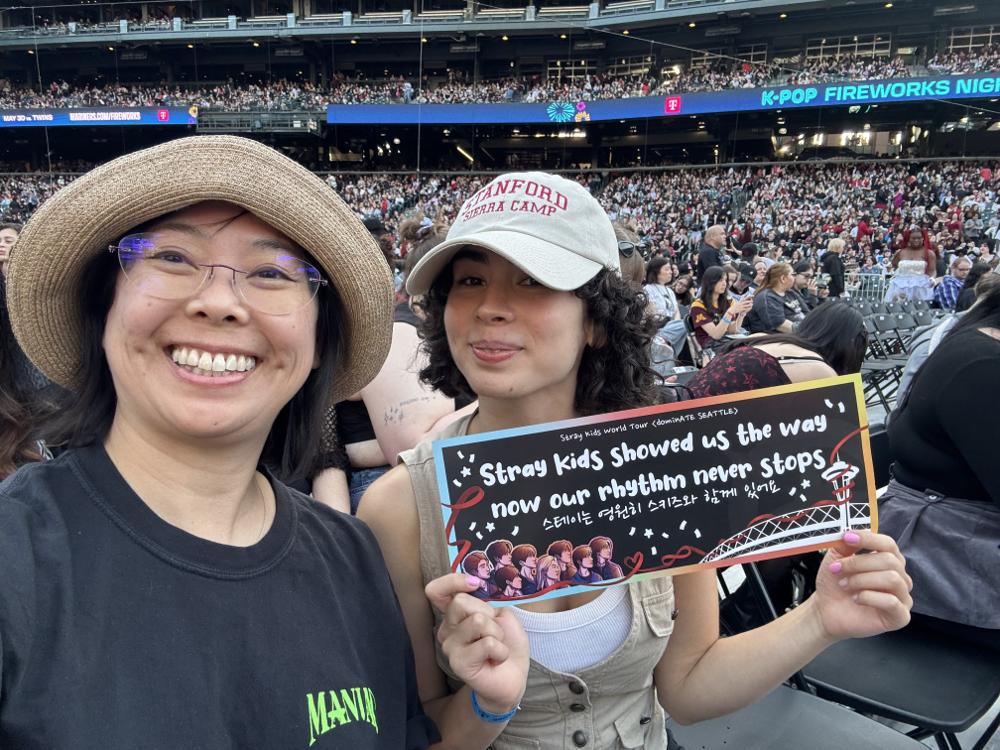
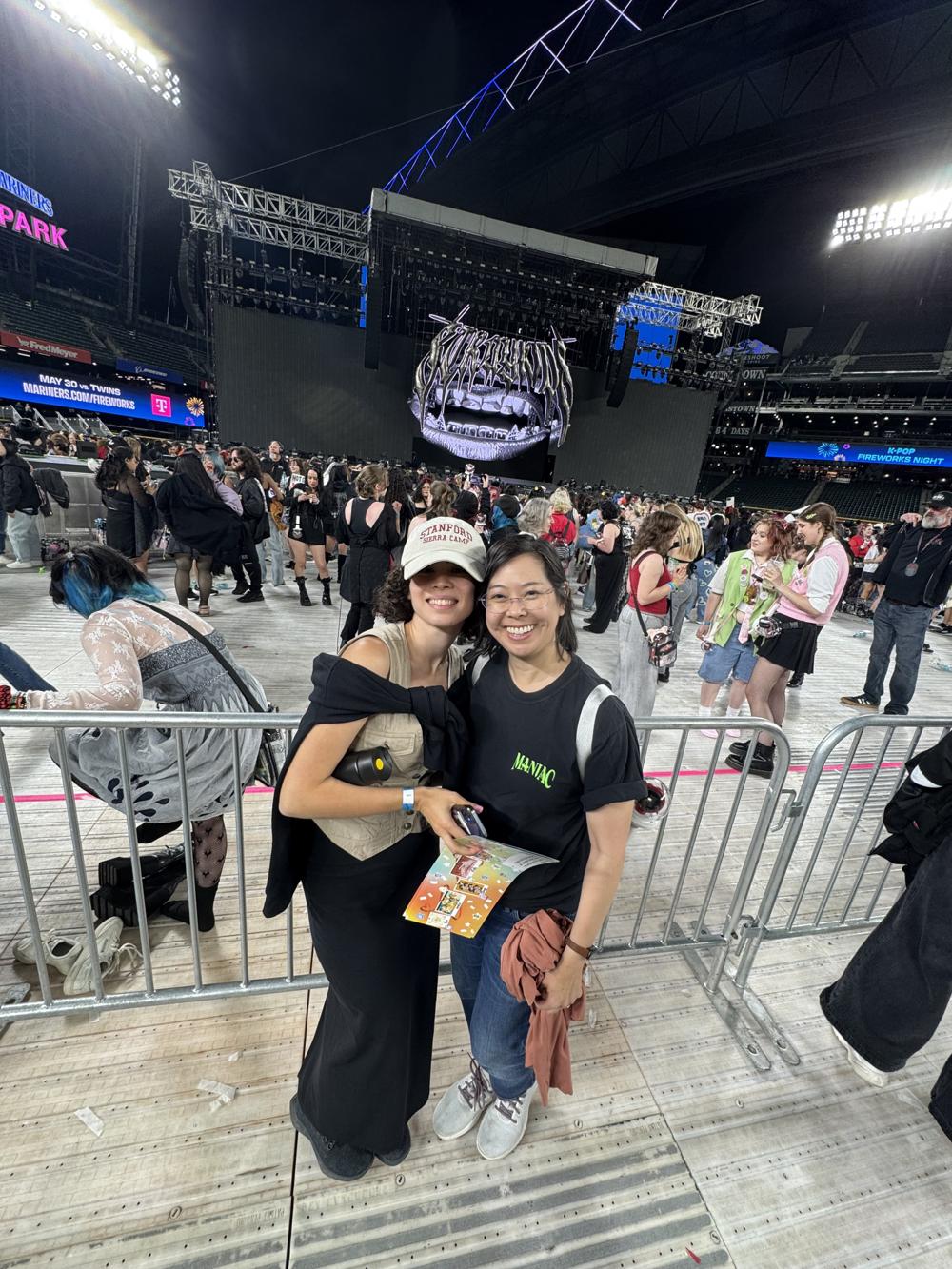
Angela and Evrim go to the Stray Kids concert at T-Mobile Park! Fireworks, amazing dancing, and an energized crowd made for a fun time. On the way out, they run into Marina and Lika, then Kim Chen and her family, who gives them a ride home! That’s God working in K-Pop.
Jan’s Palouse Bike Trip, Day 3. Today was supposed to be our “Easy Day” of 40 miles — but again Chris didn’t account for the distance back to the trail, so it’s going to be longer.
Although Vantage is tiny, it’s blessed by a decent coffeehouse where we can get breakfast. However, there aren’t any real options to pick up a lunch, so the best we can do is what’s on offer at the Chevron mini-mart.
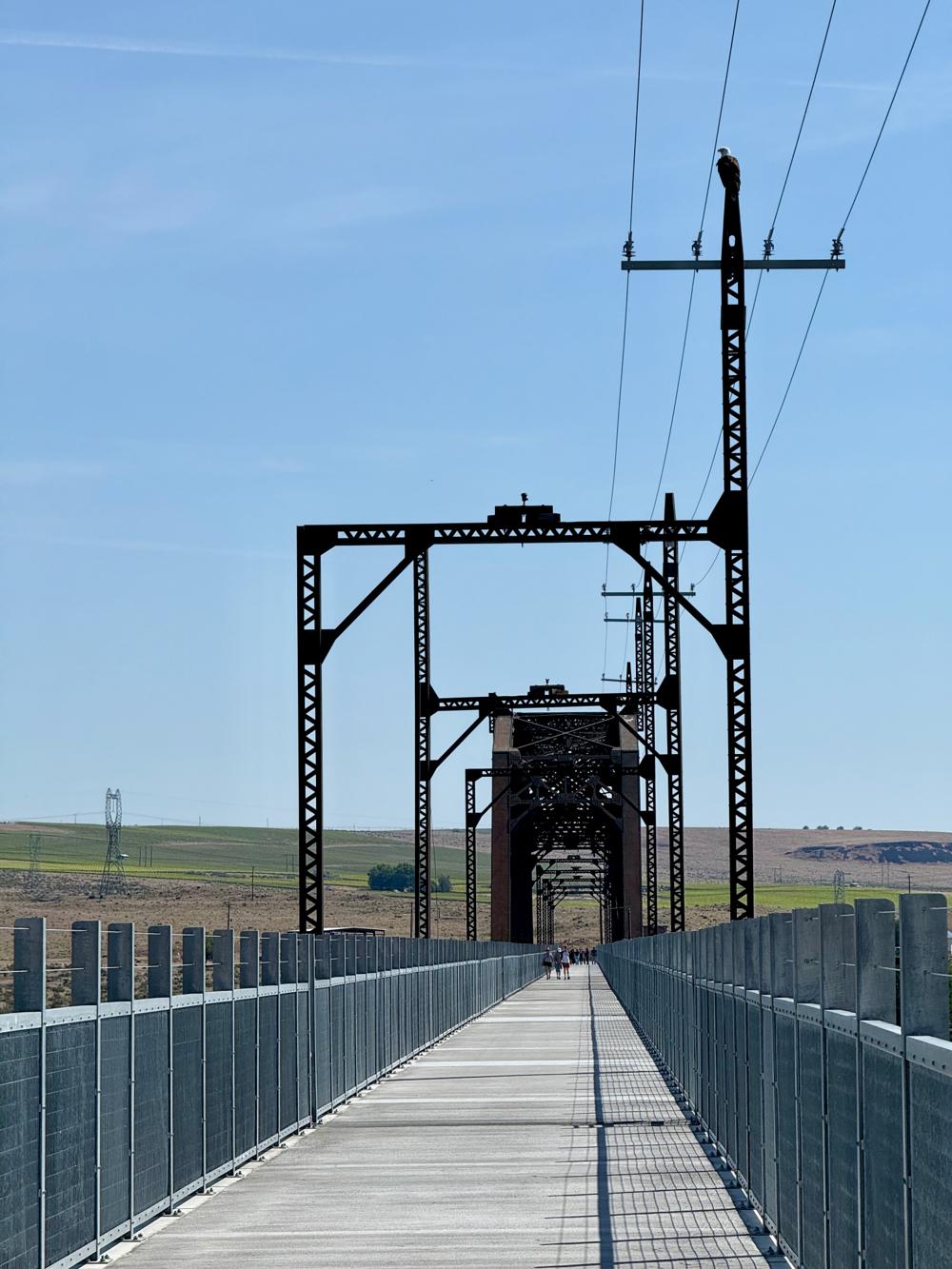
We have a very pleasant morning ride down the west side of the Columbia River, but it’s already getting warm and will get much warmer. We pass by the huge Wanapum Dam, then reach the Beverly Bridge. There’s a brand new pedestrian and bike path over the bridge, saving us from having to brave the I-90 crossing. A number of families are going for walks along it. A huge bald eagle is perched atop a beam in the middle of the bridge.
This morning the Palouse to Cascades Trail follows the east-wise course of the Saddle Mountains ridge. The trail runs parallel to an old road. The paved road will likely be easier biking, so after the bridge we decide to take the road. First we have to pass through a small hamlet. We’re immediately beset by three dogs that run out of their yards, barking loudly as they chase us.
We make fast progress on the road for a while — then see a “Pavement Ends” sign. The road turns to gravel. It’s not terrible, but it’s not great either. The gravel surface has some washboarding: crosswise ridges of gravel formed by water and tires that make for a jarring ride. Sometimes it’s possible to find a strip of packed gravel for a bit, but it always disappears and one has to hunt for the next strip of packed gravel.
The road passes through a nature reserve with occasional ponds. When we stop, we can hear lots of birds. There are also giant farms with “pivots”: gigantic automated sprinkler pipes rolling on wheels around a central pivot, producing enormous green circles on the landscape.
After several hours we want to stop somewhere for lunch in the shade but there’s very little shade to be found — the only trees are on private property. We finally make do with at the corner of a farmhouse yard, where a tree has grown out over the fence. We have to sit on the ground but at least we have shade.
Chris sees an unchained dog at the next house, but happily the dog is too sleepy to be bothered to harass us. We see another cyclist pass by on the road. After lunch, we eventually catch up with the other cyclist as he rests in the shade of a road cut.
The afternoon is many more miles of gravel road to finally reach pavement again. This is a county highway, so there are occasional large trucks and traffic. It’s pretty hot (86°F?) now.
We enter the small town of Othello. At one point Google sends us down a dirt road by an aqueduct. This turns out to be a private road, but there’s no one around to care. We reach the Quality Inn and check in.
Like many towns in farmland, most of the dining options in Othello are fast food chains or Mexican restaurants. We opt for Taqueria Almonga, where we sit outside at a picnic table. As we’re eating, a man drives up in a huge pickup truck and leaves it running as he goes inside to get his food. This event happens several more times; it seems no one is concerned about someone driving off with their truck. We see storm clouds coming, and there’s a brief bit of light rain, but we’re under an awning and the rain’s gone by the time we’ve finished.
After dinner we stop by the Lep-ri-kon Market for fruit and snacks.
Jan’s Palouse Bike Trip, Day 4. It’s Memorial Day, and only place open for breakfast is McDonalds, so it’s breakfast sandwiches for us. Before leaving town, we stop at a tiny convenience store to pick up lunch.
The railbed in this area must still be in active use, because the official trail route this morning goes on country roads. We head north out of town following a Google Maps route, but the road turns to gravel. Eventually we come to a farmhouse where dogs begin barking, and a woman comes out of the house to yell at us: “You’re trespassing!” We backtrack and find another road — which also comes to a sign saying, “No Enter”.
We give up and return to the official route, which follows a paved county road. In Eastern Washington, we encounter different kinds of biking options, each of which has its trade-offs:
We follow the paved county road into the small town of Warden. There’s a police SUV parked at the edge of town — keeping watch over the small population, apparently. Somewhat miraculously, we find a small drive-thru espresso stand that’s open on the holiday morning. We have a break at a bench under the awning of a derelict trucking business.
On the edge of Warden, we rejoin the Palouse to Cascades Trail. After pedaling for a while, Chris slams on his brakes — there’s a snake lying directly across the trail in front of him. A short while later, this happens again. Now instead of looking at the scenery, we’re carefully scanning the trail ahead for snakes.
The railroad eventually parallels the paved Lind-Warden Road. Once again we don’t see the point of staying on the gravel trail when the paved road is right there so we switch to the road. It’s much faster but of course includes hills.
We reach the top of a big hill, and we’re about to settle for eating lunch in the sun at the side of the road — when we see the tiny town of Lind in the distance. It’s only 7 miles away, so we decide to just have a snack and try to reach Lind for lunch.
Like many small towns in the area, Lind used to be bigger and is now dying. Most of the town’s storefronts are boarded up, including a faded “Empire Theatre” building from back when the town had enough people to justify a movie theater.
Chris explores a street once block over from the main street, and sees a handful of bikes in front of a door for Jim’s Market. This small market is open today, so we’re able to buy some better food items to supplement our convenience store lunch. Some other cyclists are shopping inside. They’re doing the PTCT in the other direction (heading west). We make sure to advise them that it’s possible to go through the Bolyston Tunnel they’ll reach in a couple of days. Another cyclist is heading east like us; he’s stopping to recharge his e-bike. We eat lunch outside at a bench next to the market.
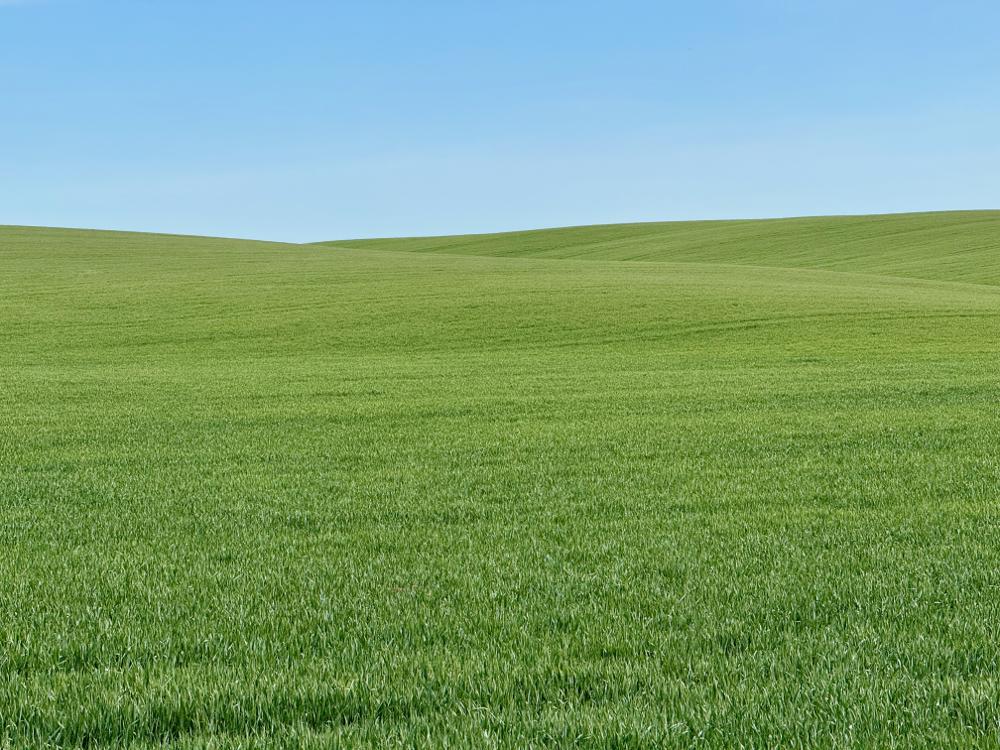
The only lodging for many miles around is in the optimistically-named town of Ritzville, so we have to leave the trail route and follow a mix of gravel and paved country roads for the rest of the afternoon. We pass immense farms. Some fields are baked brown, others are vibrant green oceans of wheat. Far off we can sometimes see a small copse of trees, which always indicate the location of a farmhouse. At one point we come to an enormous expanse of some green plant with white flowers, which turn out to be snap peas.
We finally see the cellphone towers and gas station signs of Ritzville off the distance. As we approach one intersection from the south, we see the e-bike rider we met in Lind coming from the west. He reaches the intersection before us, waves, then heads north towards town. He’s going very fast on the e-bike and is soon out of sight.
We reach Ritzville around 5:00. It’s a visceral relief to once again be in the shade of green trees.
There aren’t many promising dinner options in town, so we have Mexican food again at Mi Jalisco next door to the hotel.
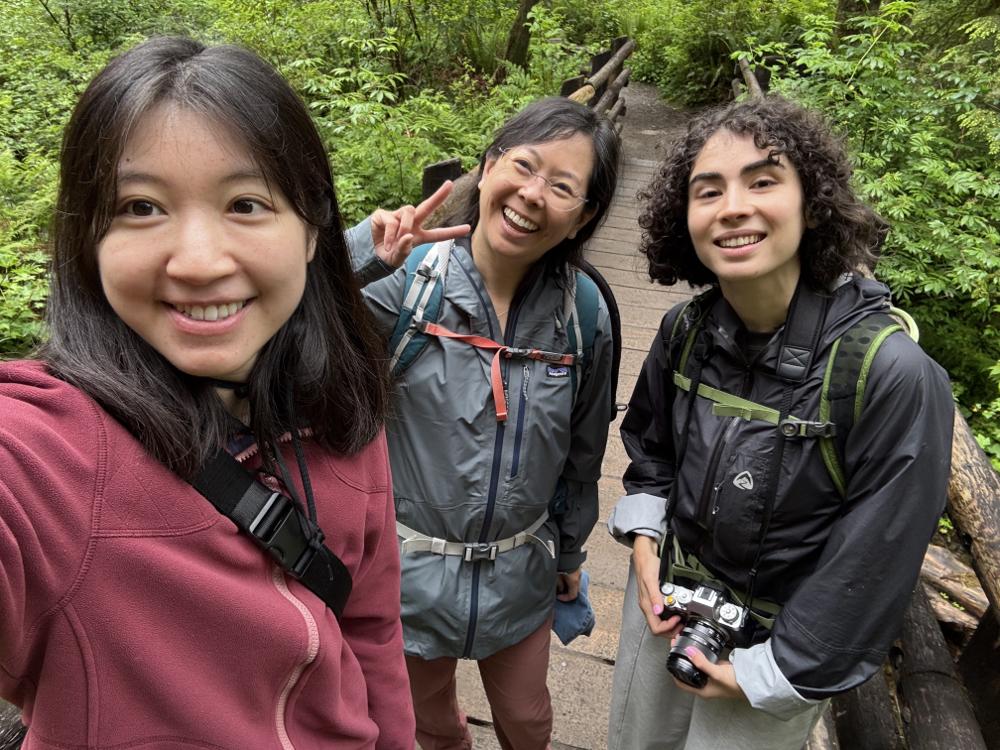
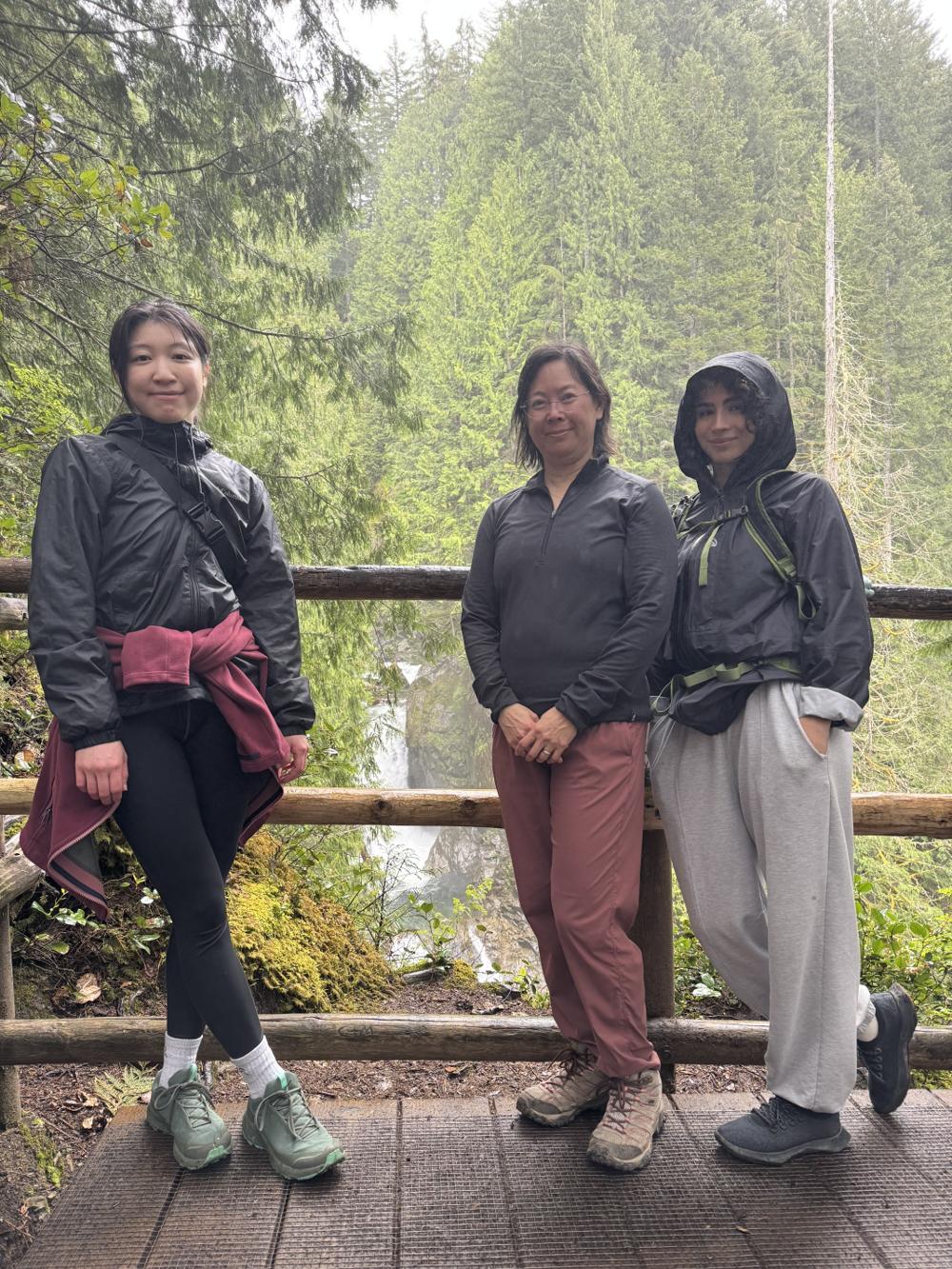
Angela goes hiking at Wallace Falls with Evrim and Angela’s cousin Lesley. It’s Evrim’s first hike in the Pacific Northwest. She has been getting into photography but sadly her camera isn’t working. Next time we’ll have better photos!
After the hike, they check out foodie Lesley’s recommended Korean beef soup restaurant Jang An Sullungtang in Lynnwood. Highly recommend both the restaurant and following all Lesley’s food recommendations.
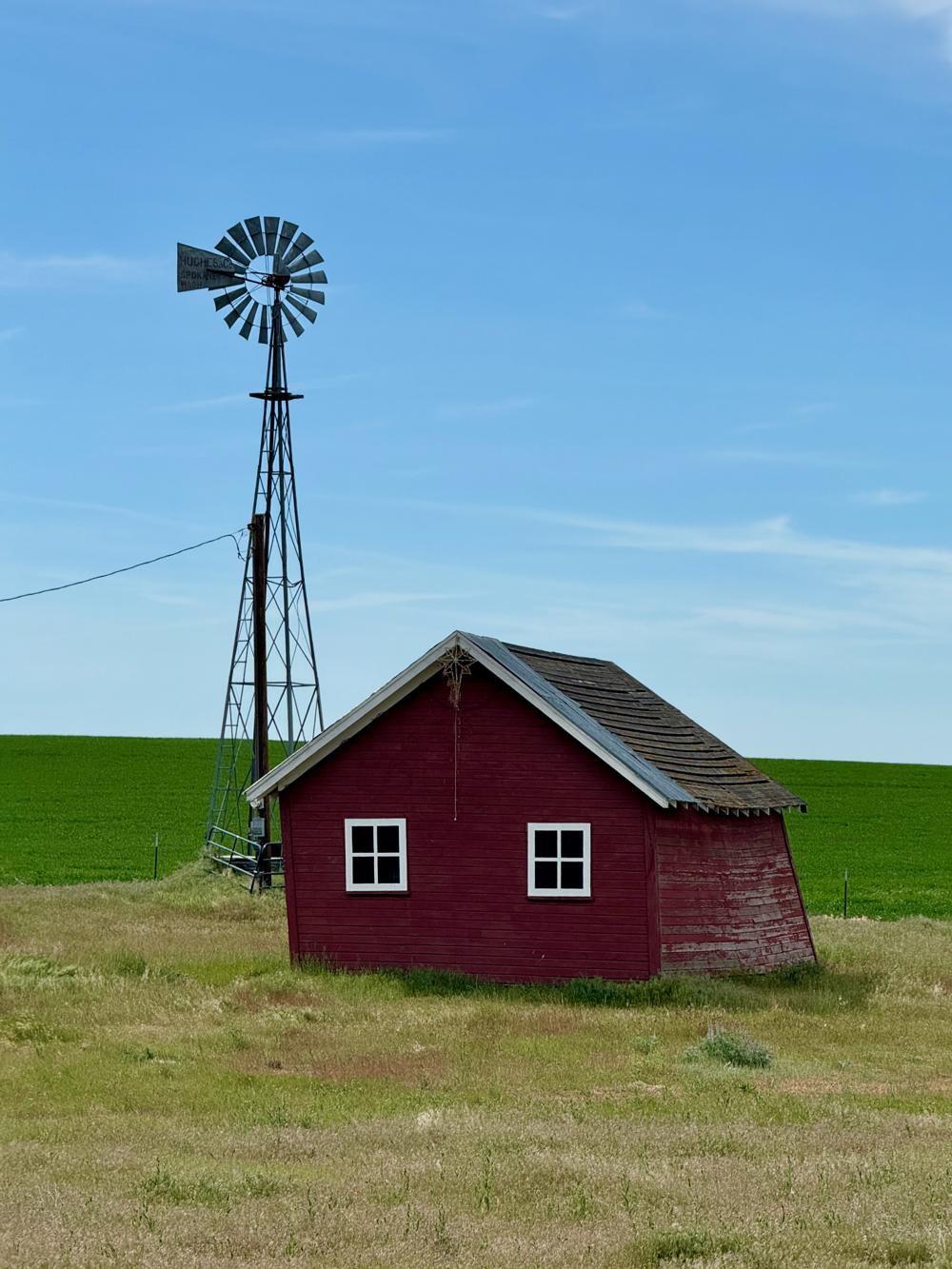
Jan’s Palouse Bike Trip, Day 5. We have breakfast at Starbucks. While finishing our coffees we watch a woman trying to clean the windshield of her stupidly big pickup truck. The truck is so tall that she has to step up on top of the front tire to reach the windshield. After breakfast we pick up another delicious to-go lunch from the adjacent Chevron.
We leave behind Ritzville’s oasis of trees and pass over the river of traffic on I-90. When Chris sees a truck, he makes the classic “Blow your horn” arm-pumping gesture, and the truck obliges with a blast.
We follow a country road endless wheat fields. At one point we pass the K-13 Ranch. Someone there likes welding: the lawn is covered with metal statues, including a giant, menacing robot.
We eventually rejoin the Palouse to Cascades Trail. There’s a locked gate in front of the trail. We’d registered our trip with Washington State Parks in order to receive a combination lock for these gates, but this is the first time we’ve needed it. (It turns out to also be the last.)
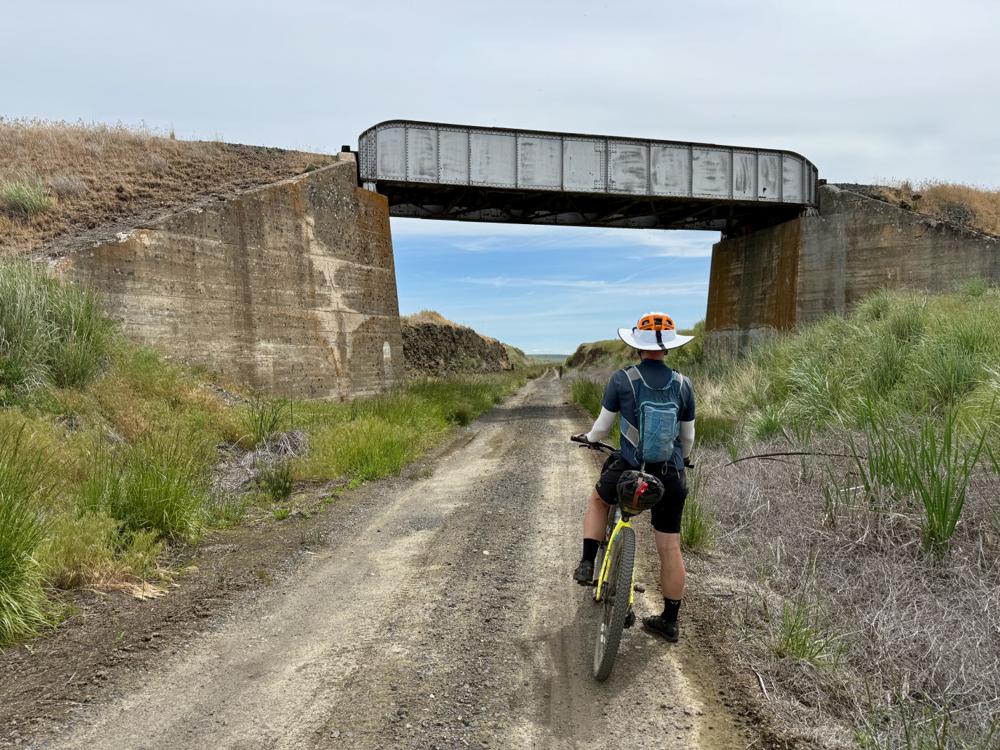
The trail is fairly hard-packed and we make good progress. We see an overpass ahead: the crossing of the Columbia Plateau Trail, another state park along an abandoned railroad bed. We plan to switch to that trail here for the northeast push to Spokane, but we see barbed wire preventing us from scrambling up to it. We eventually find a route up and decide to first walk up and investigate whether it’s worth the labor of hauling our bikes up.
We’d heard the Columbia Plateau Trail is “rougher” that the PTCT, and indeed it is. Instead of dirt or gravel, the trail surface is railroad ballast: small cut rocks about the size of a baseball. This looks tough to ride on, so we decide we’ll keep going on the Palouse to Cascades Trail.
Still, the old overpass bridge is a nice stop to rest at, and it’s interesting to be able to look back over the trail we’ve been biking on. The entire time we’re sitting on the bridge, a pair of crows calls raucously at us over and over. We scramble back down to our bikes and notice a nest under the bridge. “Sorry, crows! We’re going!” The birds must see an average of something like 0.5 people per day.
We continue biking due east, aiming for a small road crossing ahead. When we get there we discover a locked gate: it’s a private farm road, so off limits. We can see another road a few miles ahead called Revere Road, and hope that it’s an actual public road or we may be forced to travel much further east than we want.
Eventually a grain silo comes into view, which is a good sign — the farmer will need a real road for trucks to deliver and pick up grain, and indeed Revere Road is an actual public road we can start using to head north. It’s gravel, though, and makes a very long climb before finally gaining the top of a plateau.
I’m hungry and eager to have lunch, but there’s nothing but fields for miles. We eventually stop at a random point and sit down in the grass. Having seen several snakes on the trail so far, Chris checks for rattlesnakes before sitting down.
While we’re eating, a pickup truck comes along and stops. Um, maybe we’re sitting where we not supposed to? No, it’s a happy man that wants to ask us questions about biking. He supervises a group of teenagers at his church and is considering organizing a group bike ride along the trail. We recommend the Palouse to Cascades Trail but not the Columbia Plateau Trail.
After lunch we keep pushing north and eventually cruise down into the small hamlet of Lamont. The center of town has a tall tree with some kind of low concrete structure we can sit on in the shade for a break.
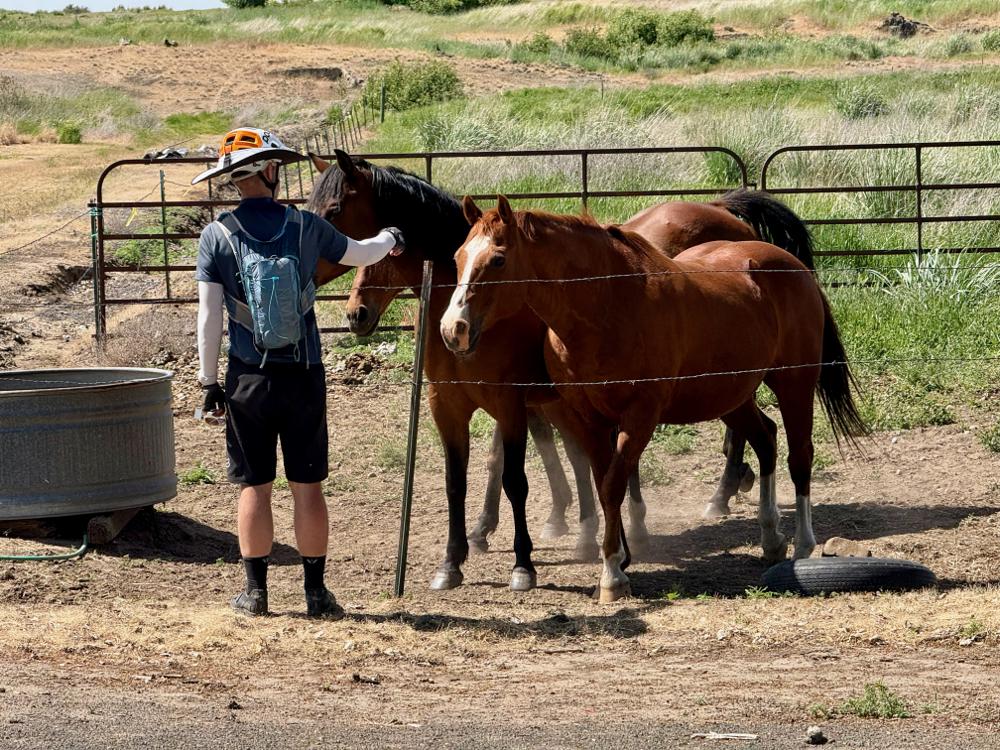
We look across the road to see three horses watching us from a paddock. Chris walks over to say hello to them, and all three horses approach. One horse is cautious but eventually permits his nose to be scratched.
From Lamont the only viable route going the direction we want is the same Columbia Plateau Trail we’d passed on earlier. We get on it, and biking on the rocky railroad ballast is as tough as expected. After laboring for a while just to reach a road overpass, we stop to reconsider our plan. This trail is so slow it’ll take a very long time to finish our remaining miles.
We take a closer look at the map and can see a detour to a road called Swift Road that will cut some miles off what’s needed on the Columbia Plateau Trail. We push our bikes down the brush-covered embankment to the road below, then pedal up a hill to reach Swift Road.
Swift Road is gravel, then turns to dirt, and then into a bumpy, boggy road with huge puddles. We have no photographs of this because we’re so focused on not stopping in the middle of a puddle. Eventually it returns to a reasonable dirt road that parallels the CPT, and we’re thankful we can make better time.
After a few miles, Swift Road turns away from the CPT and away from our destination, so we have to get back on the rocky trail. It takes a moment to find a break in the barbed wire fence so we can get closer to the trail, and then we see that the railbed at this point is inside a fairly deep cut with steep sides. We walk our bikes until we find a way down into the cut.
We’d thought the Columbia Plateau Trail was rough before, but now we discover the present trail is far worse. Here the railroad ballast rocks aren’t packed down — they’re loose, and shift around as we try to bike on them. Our wheels often spin, and it’s hard to bike straight. It is very slow going.
We finally reach a trailhead where we can get off of the trail, and connect up with the paved Williams Lake Road that will take us all the way to our destination: an extremely rustic “resort” called Bunkers Resort, an old fishing camp established in 1902. Chris has reserved a small cabin for the night. As we approach the lake, we come to the first sizable woods we’ve seen in days.
The resort office is about half an hour from closing when we arrive, and it’s a good thing we made it in time: there’s no restaurant anywhere in the area, and the only food on offer is a very small selection of frozen or shelf-stable items at the office store. We check with the office staffer that the cabin has a kitchen: “Yes, a full kitchen”, they say. We select two frozen pizzas, a can of corn, and drinks for the night, plus cereal and juice for the morning.
The cabin sits facing Williams Lake, and was recently rebuilt so it’s fairly nice. But as soon as we poke our heads into the two bedrooms, we discover an important fact. The cabin comes with essentially nothing: no bedding, no pillows, no towels, no soap, no shampoo. The “full kitchen” has appliances but no plates, no glasses, no silverware. Visitors are expected to bring all that.
While we ponder how we’re going to cook and eat dinner, I jump in the lake to cool off, and then we rest for a bit.
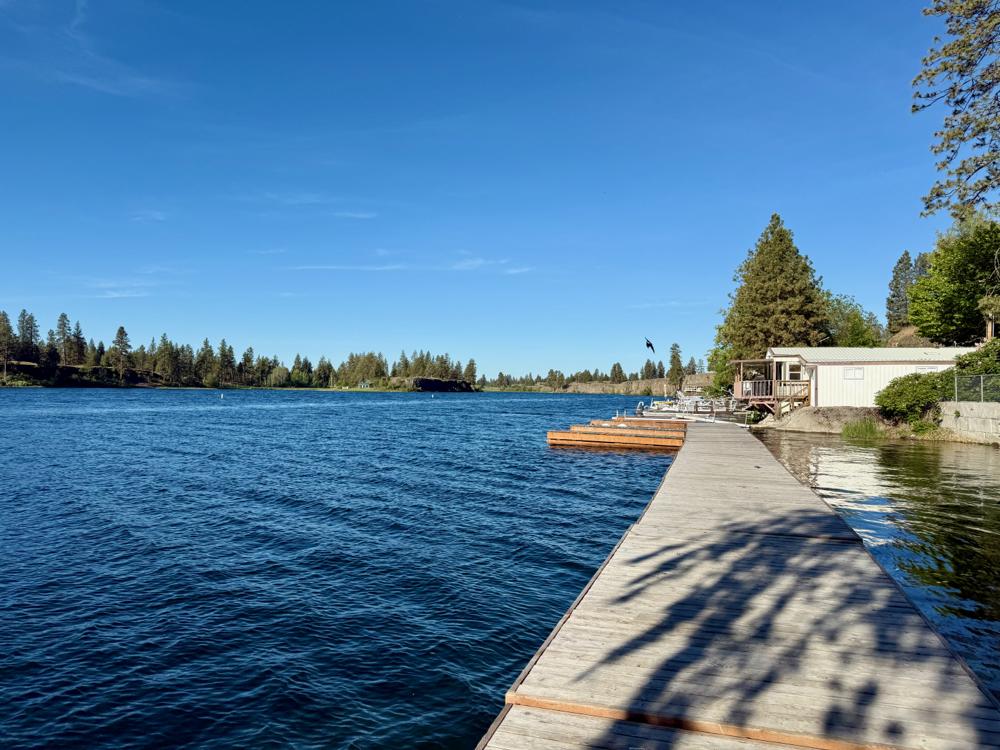
A woman from the family that owns the resort gives Chris a large pile of fruit to eat — they’d seen we were on bikes and thought we could use some more food.
We conduct a thorough search of the kitchen to come up with a plan for dinner. The frozen pizzas can be baked directly on the oven shelf, but we’ll need something to put the pizza on. Chris discovers that the microwave has a spinning glass platter that can be removed, so that can be our pizza serving plate and cutting board. I have a tiny Swiss Army knife that can be used to cut the pizza. The boxes the pizzas came in can serve as plates; the coffee maker’s filters can fill in as napkins.
The can of corn can go directly on a burner if we can find some way to open it. As luck would have it, one of the only things in the kitchen is an oven mitt, so at least we have a way to shift a hot pizza or pick up a hot can. Chris has a leftover small canister of Pringles that can function as one “bowl” for corn while the can itself can be the other. I go in search of someone with a can opener, and find a man who takes me back to his RV to help me open up the corn.
We are glad we each thought to bring a humangear spork in our bike bags, so we have something to eat with. Chris’ knife has a tiny bottle opener that I can use to open the drink I bought at the store.
Our dinner plan works quite well, and we stagger the baking of the pizzas so we can enjoy each one while it’s still hot. We take the food out to the picnic table and eat dinner watching the tree-lined lake. The lake is unusual in that it sits inside a basin lined with basalt columns, so there are tall cliffs on the opposite side. Birds keep flying back and forth over the lake, and occasionally a fish jumps in the middle.
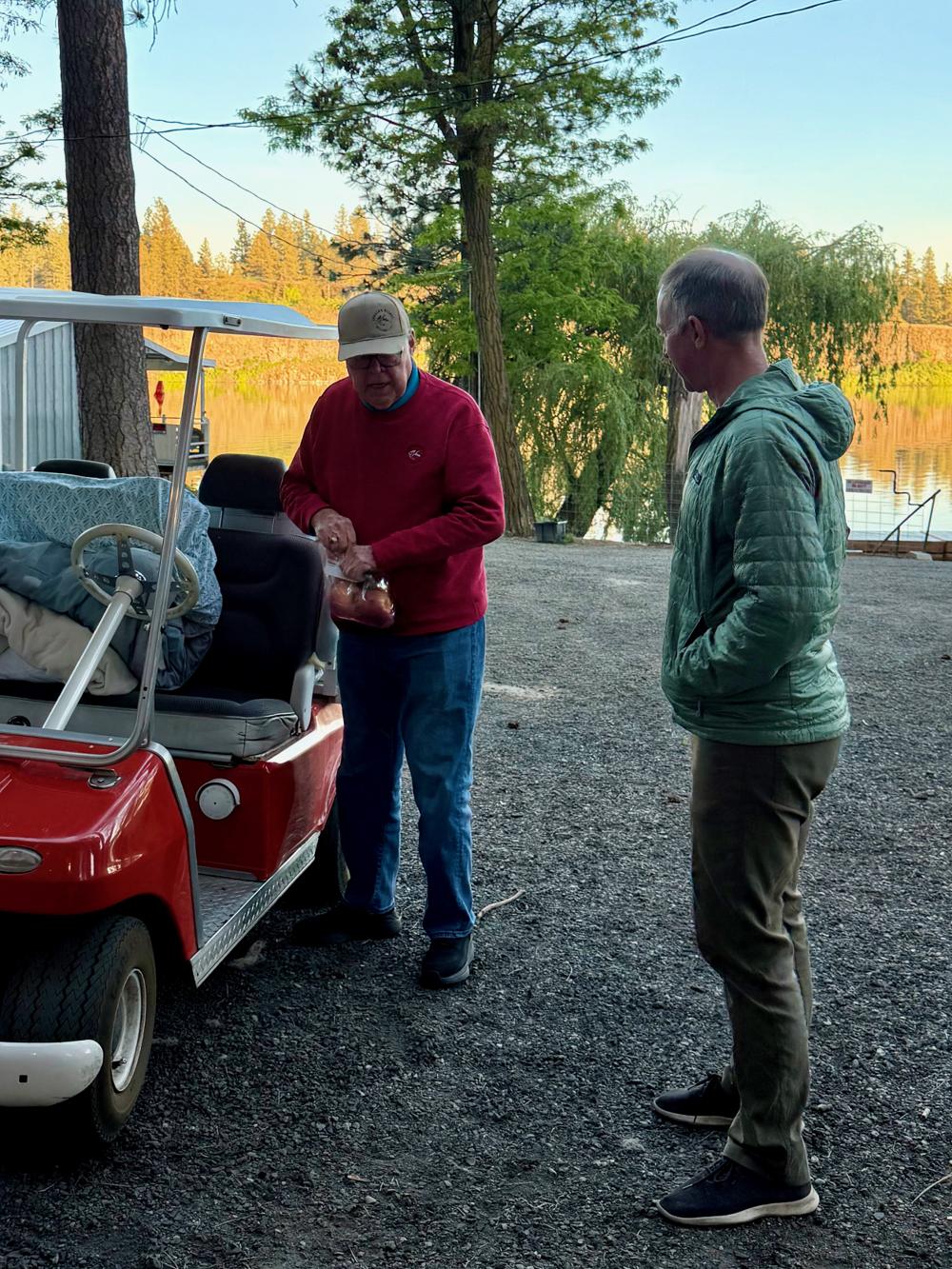
While we’re eating, a man named Ben drives up in a golf cart. He’s connected with the resort family and had spoken to Chris when he’d made the reservation. He asks if we’re set on food, and we say yes, but I ask him whether he can spare any pillows. He says he does, and drives off in his cart to return with pillows and blankets. He also gives us two huge apples, so now we have approximately 4 pounds of fruit to eat before we leave tomorrow morning.
Liya comes home for the summer! She’ll head to UBC in the Fall.
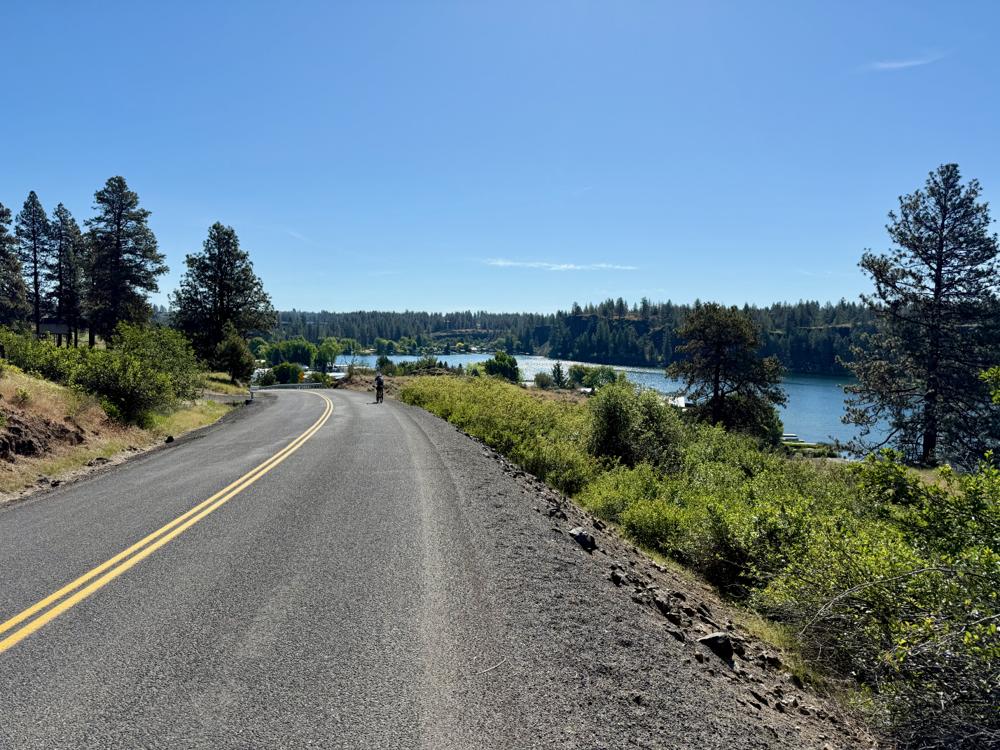
Jan’s Palouse Bike Trip, Day 6. Today’s our last day of biking. We have our breakfast at the picnic table outside, looking out at Williams Lake and trying to eat as much of the fruit we’ve been given. It’s a cool morning but will warm up.
There’s a climb on the way out of the lake basin. We’ve had different two people at the resort recommend taking a slightly longer route, on a less busy road, to reach Spokane. We decide to take their advice.
We’ve now mostly crossed the Palouse. Now there are large fields surrounded by trees instead of the other way around. The forest will continue all the way to Spokane.
We stop for an early lunch in Cheney at a restaurant called Bene that, perhaps predictably, is known for the varieties of Eggs Benedict. After lunch we try to get back to the Columbia Plateau Trail, but are blocked several times. One road is owned by a railroad, another leads to the city’s sewage treatment plant. We ask at the office if we can cross the very short distance to the trail on the other side of the facility but they say no.
We end up taking the Cheney-Spokane Road for a number of miles, finally rejoining the trail at the point where it becomes known as the Fish Lake Trail. This is paved, tree-lined, and flat; we cruise all the way to the outskirts of Spokane. There’s a final drop and then a final big hill, and then we enter the downtown area.
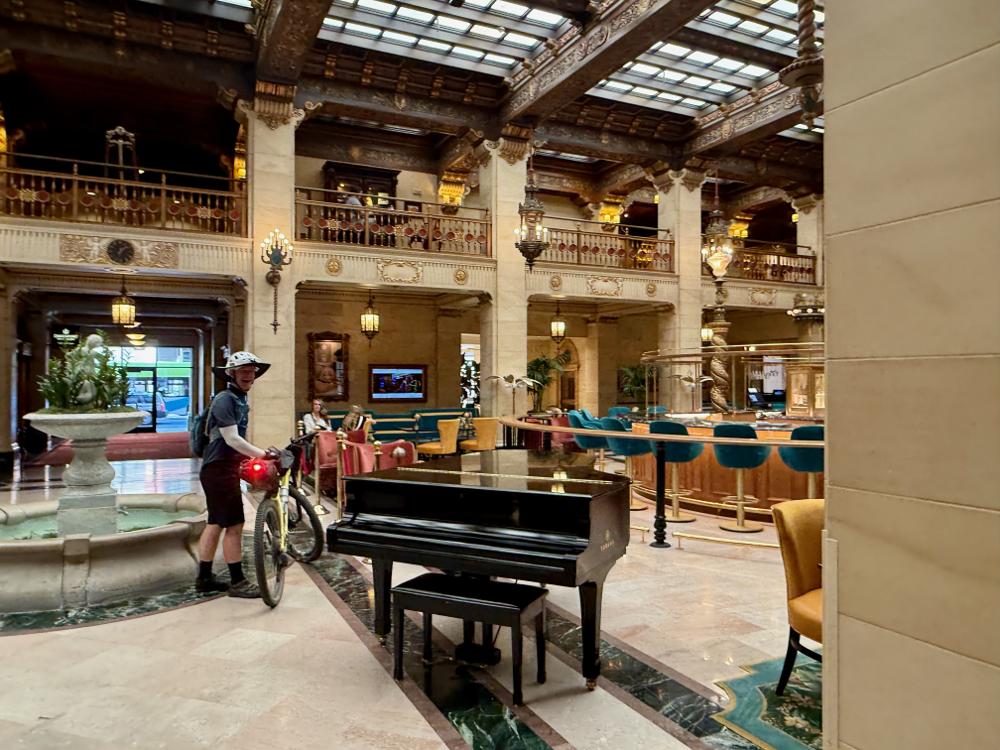
We bring our dusty mountain bikes inside the historic Davenport Hotel, and end up wheeling them through the huge, elegant lobby. The bikes look out of place, as do we.
We take time to shower off and nap, then have to bike across Spokane to get to a bike shop in the Hillyard neighborhood. By now it’s a hot 89°F, and we’re happy to finally reach the shop and the end of our biking. Jan returns his rented bike the shop, and the shop takes Chris’ bike to box up for his flight home tomorrow.
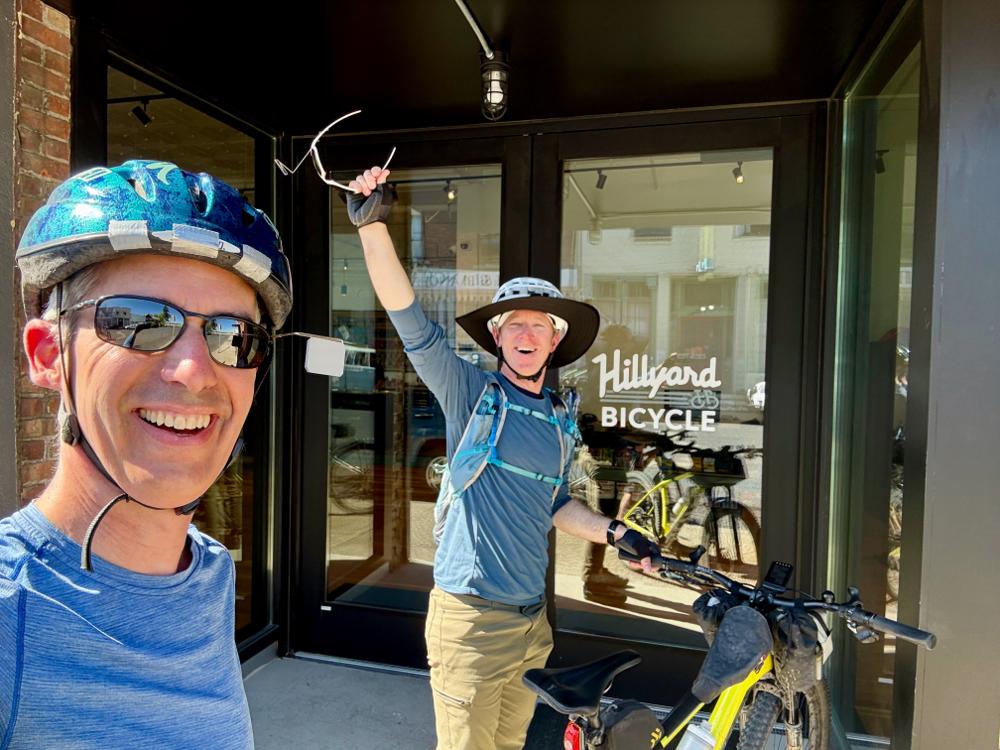
We get an Uber back to the Davenport Hotel, and only after getting out realize the city has multiple Davenport Hotels. We’re at the wrong one. We walk back to the right one and have a snack at the hotel’s elegant bar.
For dinner Chris has made a reservation at Hogwash Whiskey Bar, a quirky restaurant in a windowless basement that feels like a speakeasy. The food is quite good. We’re particularly happy to be able to eat salad again.
Jan’s Palouse Bike Trip, Day 7. We have a good breakfast at the stylish House of Brunch, then pack up for our flights home. My pannier backpack now has to accommodate all the bike gear I’d previously carried on the bike, so it’s a bit of a struggle to fit it all. I still have the huge apple Ben gave me at Williams Lake, and there’s no room for it. I solve this problem by eating the apple so I can carry it on the inside, as it were.
We get an Uber back to the Hillyard bike shop to pick up Chris’ boxed-up bike, then another, larger Uber for the ride to the Spokane Airport. The bike box just barely fits in the SUV to leave a single seat in the back for me.
Chris and I have a quick lunch at the airport, then say goodbye as he catches his flight back to Boulder and I catch mine to Seattle. I take the train up to Capitol Hill, and Liya picks me up for the short ride back home.
The Choate dining hall finally reopens after being closed for the past year. While it’s been closed for renovation, Bree and her classmates have been eating in a temporary dining area where lukewarm food was brought into the old student activity center. All year the students have eaten on disposable plates with disposable dining ware.
The school had said the dining hall would reopen in the Spring Term, but when the term started the dining hall was still closed.
Today the dining hall finally reopens with just a week of Spring Term left. Bree is delighted to be able to finally eat her regular meal of pasta on an actual plate with an actual metal fork.