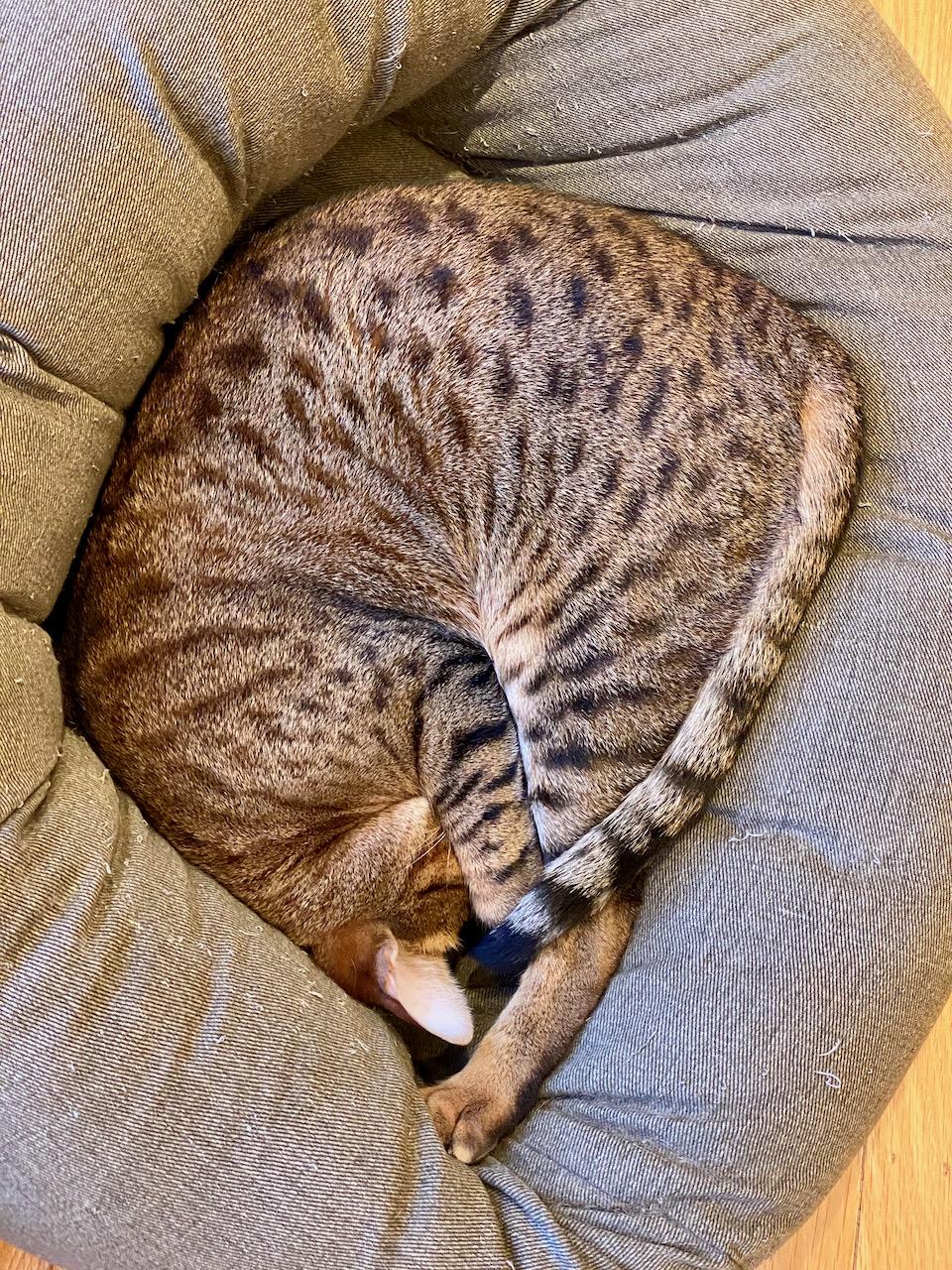
Mojo
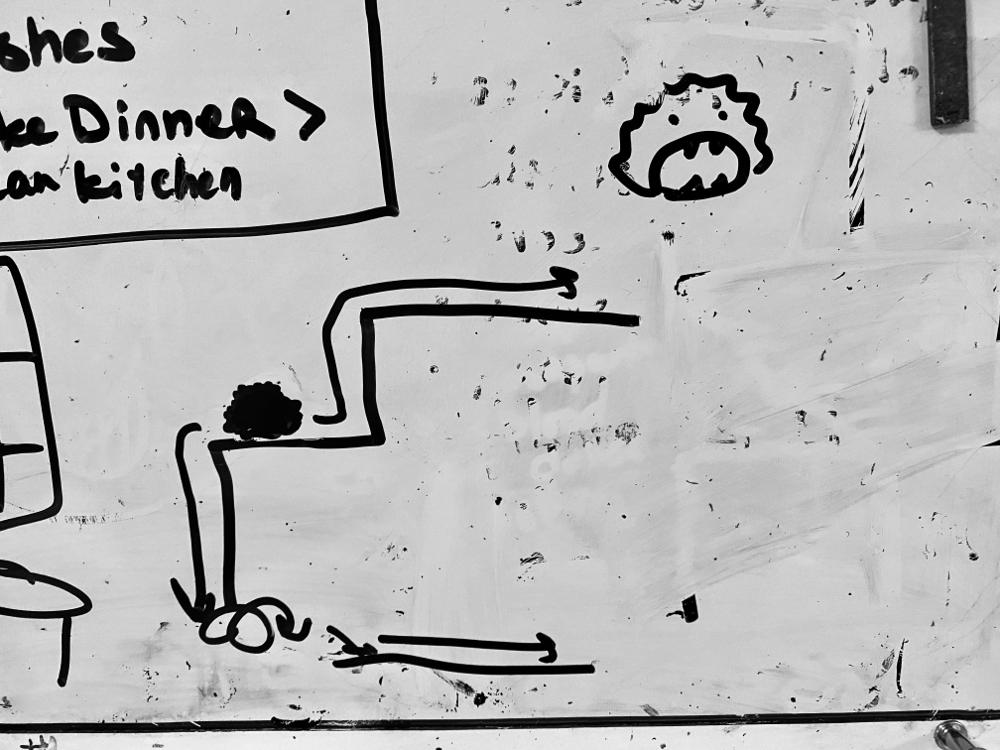
In a recent weekly family meeting, Jan had asked for everyone to try to clear the books and other detritus that end up on our main staircase bannister. The bannisters are long, horizontal slabs of wood — perfect for accumulating things that are meant to eventually go up or down the stairs.
Liya draws a sketch of a “bannister blob”: a cute but rapacious creature that will patrol the bannisters, gobbling up anything that’s left there too long.
Anya is now out of quarantine in Taiwan! She gets together with some of her Chen relations for a meal in an actual restaurant.
Jan says goodbye to Salesforce. He’s only been working there as a software architect since December 2019, but by his one year anniversary it was clear to him that he wasn’t going to get the chance to do any of the things he’d wanted to do in the role. From the outside, Salesforce looks like a dynamic, very successful business, but the experience on the inside — or at least the part of the company where Jan had worked — was quite different. He doesn’t know what he’ll do next, but for now is happy to be done.
Jan’s Puget Sound hike, day 1. I start a 3-day hike along a 68 mile (109 km) portion of the Pacific Northwest Trail that runs along Puget Sound. Mom drives me to a trailhead where the PNT descends a hill called Oyster Dome and arrives at the Sound. (I’m hiking the PNT in sections, so I’ll hike the section that comes down that hill at some later date.) We hug goodbye, then I start walking.
Although I’d picked this weekend because the 7-day weather forecast looked promising, the weather has ended up rather cool and cloudy. After walking for a while, though, I’m warm enough.
The road runs south, parallel to Samish Bay, then cuts west through the tiny town of Edison. The town has some delightful old buildings — an ancient Standard Oil garage among them — and some offbeat restaurants.
After Edison, the roads cross huge expanses of marshland and very soggy farmland. There are birds everywhere. I occasionally pass people parked at the side of the road taking pictures of the birds using tripods and lenses the length of my arm.
The road eventually leads to Bay View State Park, where I stop and eat a short lunch on the beach. On the way out of the park, I stop to talk with two people with a Winnebago Solis sprinter van — the same kind our family will be renting for spring break in a couple of weeks. The pair say they like the van, which is good to hear.
After the state park, the PNT route leaves the road for a walkway on top of a dike across the Padilla Bay nature preserve. More marshy ground, more birds, more photographers.
Leaving the nature preserve behind, the PNT heads towards Fidalgo Island to reach the town of Anacortes. Unfortunately, the only way to walk to the island is along the shoulder of Highway 20. It’s loud, windy, and there’s litter all along the roadside. I’m happy to cross a long bridge over the Swinomish Channel and onto Fidalgo Island where I can leave the highway behind.
The PNT cuts north along a peninsula that has almost nothing on it except for tiny farms and a massive oil refinery. I can’t hear any noise from the refinery — it is in fact extremely quiet — and there’s no particular industrial smell. The sun’s also come out, and there are nice views across the water.
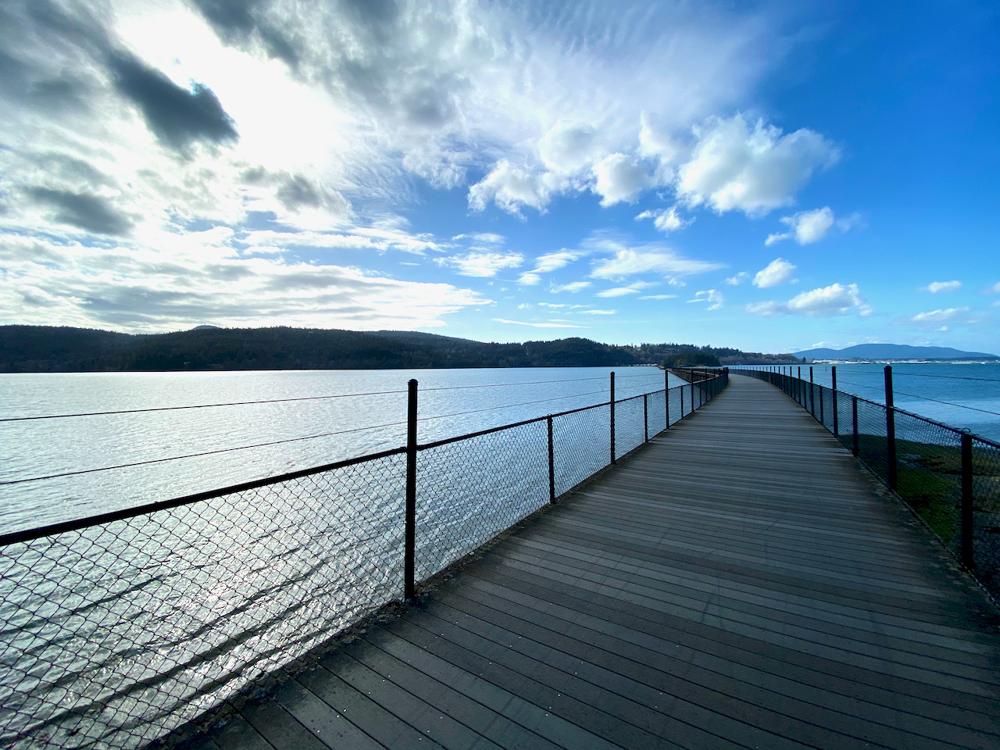
Still, I’ve now been walking for 20 miles or so and am beginning to flag. I’m happy to reach the Thompson Trestle: an old rail line converted into a pedestrian walkway across Fidalgo Bay. It’s a great place to walk on a nice day.
On the other side of the bay, I’m happy to finally come to the town of Anacortes, and a short while later reach the B&B where I’ll be staying for the night. After checking in, I decide to get dinner from a pizzeria just down the street — that’s about all the walking I can manage.
Liya comes in 4th place in a cross-country meet at Magnuson Park. She observes that the strong girls’ team from South Whidbey couldn’t make that meet, giving her school an edge. Liya’s team ends up finishing 1st overall.
Jan’s Puget Sound hike, day 2. I leave Anacortes in the early morning; very few people are out and about. As I walk out of town, I’m looking for a restaurant where I can buy something to eat later for lunch. All I can find is a Jack In The Box. The inside is closed, so I walk up the restaurant’s empty driveway to the drive-thru window and ask the woman in the window if I can order. The woman is flustered and says no, only cars can order at the window. A pedestrian can walk up to pick up an order, but only if they install an app first and order online. The woman is unmoved by the fact that there is no car traffic at this hour. Arg. I walk away.
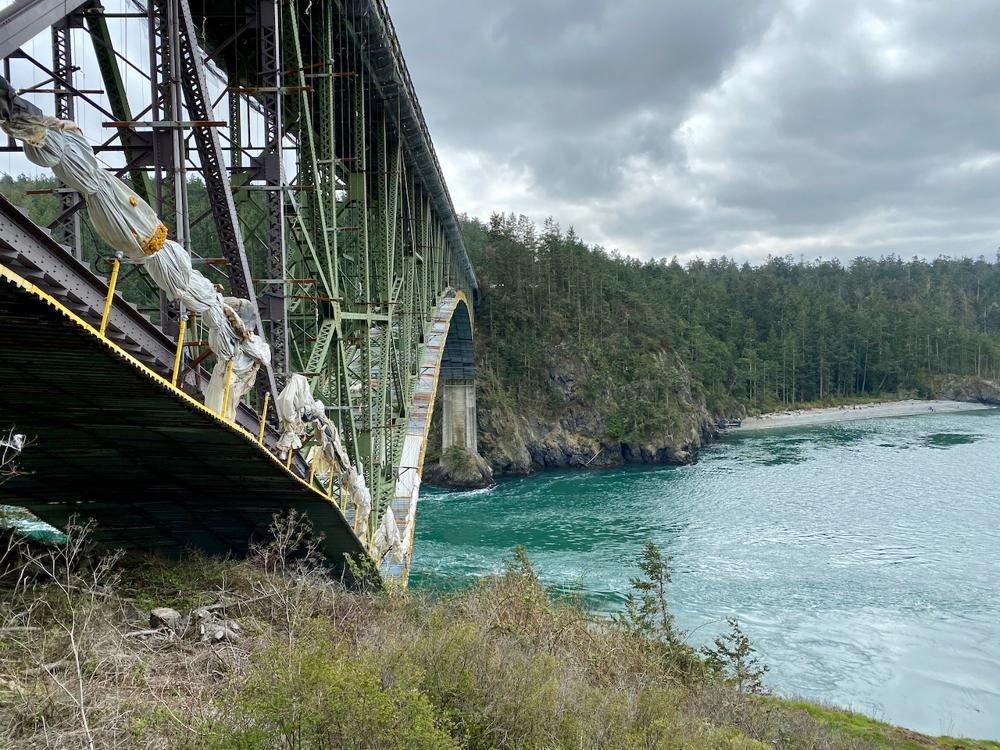
Anacortes sits at the edge of a sprawling chain of community forests. The extensive trail network is in good shape, but it’s a real maze. At two different points, it sinks in that I’ve been walking for a while on the wrong trail and I have to backtrack. I finally reach Deception Pass State Park, home to an impressive bridge high above the narrow waters of Deception Pass. It’s beautiful, but I find walking across the bridge to be unsettling.
On the other side of the park, I head for the only restaurant in the area: a fish-and-chips shack. The place turns out to be a gas station with a mini-mart. Sadly, the fish-and-chips counter is closed due to COVID. “Do you have any hot food?”, I ask. The cashier points to a sad little heated glass box containing deep-fried BBQ flavor “burritos”. They don’t look very appetizing, but better than a lunch of Doritos, so I take one.
For the rest of the day, the “trail” is on long country roads. These roads have picturesque scenery, but lie in a rigid grid that ignores local topography, so they go straight up and over hills. I see plenty of typical farm sights — sheep, cows, horses, chickens — along with some unusual ones. One pasture contains a grazing alpaca and an enormous sculpture of an elephant. Occasionally I hear dogs barking, at which point I’ll look to see if they’re fenced in. Thankfully I don’t meet any unfenced dogs, although there’s one dog that does manage to get most of its front half over its fence before falling back inside.
The last country road is a busy one that takes me past Whidbey Naval Air Station, and finally into the town of Oak Harbor. I check into the Coachman’s Inn, a very slightly upscale motel. My room’s door labels it as the “Admiral’s Room”, presumably in homage to the nearby naval station. One of the windows is a porthole.
This has been another long, 25 mile day. I’d planned to eat at a Chinese restaurant up the street, but Google says that’s 0.4 miles away. I settle for hobbling across the motel parking lot to a dubious Korean restaurant called “Harbor Sushi” that serves teriyaki and a bunch of other random Asian foods. The food is hot at least, and not terrible; the miso soup is actually great.
Before going to bed, I draw the curtains, then notice the curtain-less porthole window. I end up covering the porthole with a towel to keep out early-morning light.
Jan’s Puget Sound hike, day 3. The weather forecast calls for rain all day, but when I get up early, the rain hasn’t started yet. I grab breakfast from the motel, along with extra breakfast items to eat later for lunch. I walk out of the motel and leave Oak Harbor’s business district behind, passing through concentric urban zones: light businesses, cheap houses, then cheaper houses, then nondescript apartment complexes, and finally farms.
I reach Joseph Whidbey State Park on the western side of Whidbey Island. It finally begins to drizzle — then stops a few minutes later. Whew. Turing south, the PNT moves down onto the beach. There are huge bluffs all along the western side of Whidbey, and I’ve had to time my walk with the tide so that there’s enough beach to walk on for the rest of the morning. I walk for hours on the beach without seeing anyone else.
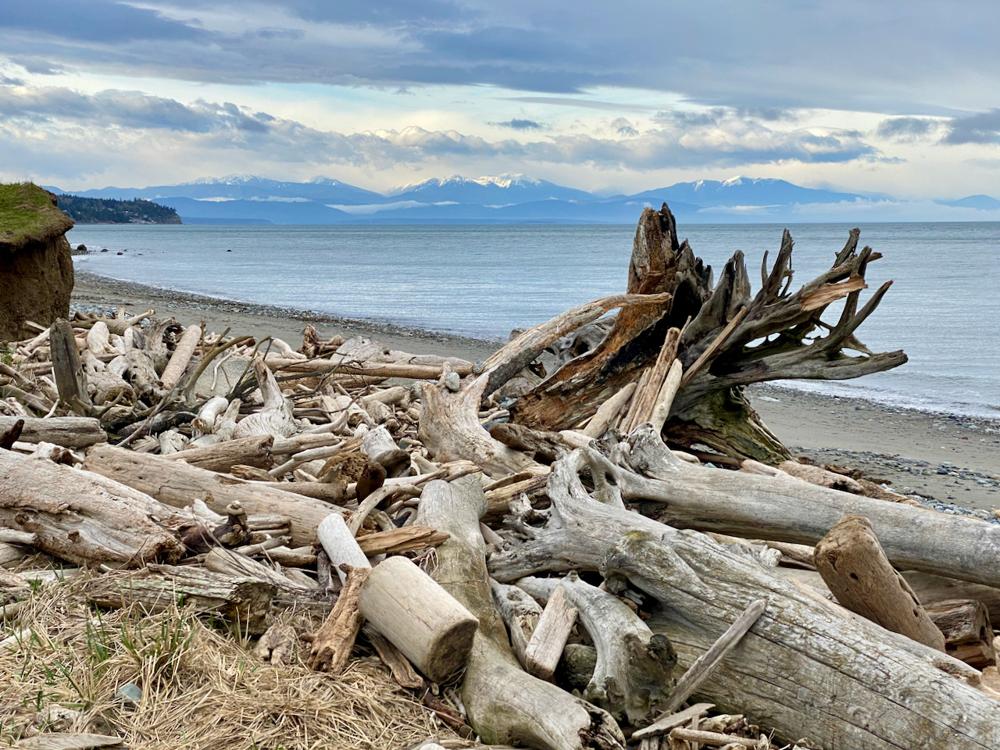
The beach eventually brings me to Fort Ebey State Park, and the PNT climbs up to run along the top of the bluffs. The wind picks up; the forecast had warned of the possibility of severe winds today. By the time the PNT comes back down from the bluff top to the beach again, the wind is howling. At the Ebey’s Landing trailhead, I hunker down behind some piled driftwood to get out of the wind and blowing sand so I can eat a quick lunch.
The PNT stays on the beach for the next 5 miles to Fort Casey, but the wind is so strong on the exposed beach that I decide to switch back to country roads in hopes that they’re more sheltered. They are — a little — but the wind is still strong enough that, when it gusts, it takes some effort to make forward progress.
I’m almost to the Fort Casey State Park and the Coupeville Ferry Terminal, where I’ll be ending my hike of this section of the PNT. I only have about 1.5 miles to go when it finally begins to rain — and then it starts to hail. I put on all my rain gear, but I’m walking straight into the wind. At the ferry terminal I’ll learn that the wind is blowing at 50 miles per hour, which means that hail pellets are shooting into my face at 50 miles per hour. This is unpleasant.
A short while later, the hail tapers off into rain. I finally reach the ferry terminal, which is completely quiet; the wind has scrubbed all ferry crossings. I’m happy to be done walking, and take shelter in the tiny passenger building. With the exception of the final mile or so, the walk has been really nice, but I’m also tired.
Meanwhile, Angela has been driving from Seattle to Whidbey via the bridge Deception Pass. She can’t take the ferry at the island’s south end, since that’s been cancelled due to high winds. She arrives around 2:30, then we head to Coupeville so I can get something warm to drink and to dry out a bit.
We poke into the bookstore and a little historical museum. The museum docent says that they’ll be closing in 20 minutes, but that we’re free to look around. While Angela’s looking at the Native American exhibit in the basement, all the lights go out. “Oh, sorry”, says the docent, and she turns them back on.
We head north to leave Whidbey Island. We’re getting hungry by the time we’re passing Anacortes, so stop for dinner. Angela’s in the mood for seafood, so we try a place called Bob’s Chowder Bar. They’re seating patrons inside, but we’re not vaccinated yet, so we opt to eat outside. It’s sunny but a little chilly. Angela notices a box of blankets for guests, which make sitting outside much more pleasant. The food is modest but hits the spot.

Angela is taking a weekly woodworking class. Her first project is a wooden carrying case for growler jugs. We don’t actually own any growlers ourselves, but if we did, we’d now have a way to carry them.

Liya’s cross-country team runs timed races for the Washington State championships. Instead of gathering for a massive running competition, this year each Washington team designates a day on which they’ll record and submit their running times. Liya runs well. After the running is finished, her teammates celebrate her as an outgoing senior and as the team captain. A group of younger girls deliver some nice testimonials to Liya, as does one of the coaches. Several of the speeches cite Liya’s feat of running 500 miles over the course of last summer as an example of her grit and hard work at self-improvement.